

Découvrir le shibori avec Suzusan : textiles traditionnels réinventés
Découvrez la vision contemporaine de Suzusan sur le shibori d'Arimatsu, vieux de 400 ans, à travers un atelier pratique de teinture nouée.
C'était une journée ensoleillée du début du printemps, le ciel bleu et lumineux. Le dernier souffle du froid hivernal se retirait progressivement de l'air. Lorsque l'équipe Musubi descendit du train dans le quartier d'Arimatsu à Nagoya, l'atmosphère d'une ville industrielle animée s'estompa rapidement, remplacée par l'architecture traditionnelle de poutres en bois sombre et de toits de tuiles d'argile le long de rues tranquilles.

Tissu noren suspendus aux avant-toits ondulaient dans la brise. Chacun proclamait « Arimatsu » en calligraphie assurée—méticuleusement réalisée en teinture shibori par nouage. Nous étions arrivés à destination : un célèbre village japonais de teinture par nouage avec 400 ans d'histoire.
Ici, nous allions bientôt essayer nous-mêmes la teinture shibori lors d'un atelier dirigé par Murase Hiroyuki, PDG et directeur créatif de la marque de mode shibori moderne Suzusan. Leurs textiles teints à la main font partie des efforts pour maintenir l'artisanat face aux pressions de la mécanisation et de la mondialisation, tout en restant pertinent pour les jeunes générations. En explorant la ville et en apprenant auprès d'artisans experts, nous avons été témoins de la beauté de cet artisanat traditionnel de près.

Histoires personnelles d'une ville de teinture par nouage
Dans la vitrine moderne de Suzusan, équipée de textiles aux teintures audacieuses et d'abat-jour à texture shibori qui diffusaient une lumière douce sur la scène, la visite commença par une histoire.
« Les gens travaillaient depuis chez eux. J'ai grandi au son du tap-tap-tap de la gravure de motifs », raconta Murase Hiroyuki, PDG et directeur créatif de Suzusan. Son père, Murase Hiroshi, se spécialise dans la création de pochoirs que les artisans de teinture par nouage suivent. « Cela faisait simplement partie de la vie quotidienne. Quand j'étais petit, j'accompagnais mon père lorsqu'il livrait son travail. Toutes les vieilles dames me donnaient des bonbons », se souvint-il en riant.


Le shibori s'est développé ici au début des années 1600 grâce à la position d'Arimatsu sur la route du Tokaido. Avec Kyoto à l'ouest, Edo (l'actuelle Tokyo) à l'est, et la production de coton dans les environs, le village était parfaitement positionné pour répondre au grand volume de voyageurs empruntant cette voie. Ceux qui traversaient Arimatsu achetaient des serviettes tenugui et des robes yukata teintes en shibori comme souvenirs. Cela, ainsi que le seigneur féodal local accordant au village les droits de vente exclusifs des textiles teints en shibori, cimenta la position d'Arimatsu comme centre japonais de l'artisanat de la teinture par nouage.
En marchant dans la ville, nous pouvions voir cette histoire exposée. Des piliers de pierre portant l'inscription « Tokaido » marquaient la rue. « Les bâtiments sont relativement bas parce que les daimyo passaient par cette route, et vous n'aviez pas le droit de regarder de haut un grand seigneur », expliqua Murase.
Le propriétaire âgé de la boutique de riz du quartier nous interpella pour nous saluer, et Murase s'arrêta pour discuter. Les habitants semblaient tous se connaître, et l'atmosphère douce d'une communauté où les gens se soucient les uns des autres flottait dans l'air.
À un moment donné, il y avait plus de 10 000 artisans à Arimatsu. Mais les modes de vie japonais ont changé au vingtième siècle, avec moins de kimonos portés dans la vie quotidienne. Le commerce a également changé. Le début de l'ère Meiji (1868–1912) supprima le monopole féodal, et dans la seconde moitié du vingtième siècle, certaines parties de la production furent envoyées à l'étranger pour réduire les coûts. Le nombre d'artisans diminua considérablement en quelques décennies seulement. La jeune génération cessa d'hériter de l'artisanat. La situation atteignit un point où le père de Murase, dans la cinquantaine, était le plus jeune artisan de la ville.
Les artisans âgés—et maintenant les jeunes artisans de Suzusan également—contribuent à maintenir l'artisanat vivant.
« Je fais cela depuis 82 ans »
Nous avons rencontré l'un de ces artisans de longue date à notre prochaine étape, le musée de la teinture par nouage d'Arimatsu-Narumi. Là, nous avons observé une femme âgée, Fujiwara Sumie, démontrer des techniques de nouage.
Elle salua Murase d'un « Tu as tellement grandi ! » même s'il n'a sûrement pas grandi depuis environ vingt ans. Il semble que ce soit simplement la réplique des grands-mères partout.

« Je fais cela depuis l'âge de huit ans », nous dit-elle. Maintenant âgée de quatre-vingt-dix ans, cela fait quatre-vingt-deux ans qu'elle noue des motifs shibori.
Utilisant un crochet de vélo réutilisé fixé à une perche en bambou vieille de cinquante ans, Fujiwara enroula rapidement et régulièrement fil après fil autour de points marqués sur un morceau de tissu. Les points sont réalisés à l'aide d'un motif gravé transféré sur le tissu avec une teinture soluble dans l'eau, qui se lave facilement sans gêner le pigment final. Les familles d'Arimatsu ont tendance à se spécialiser dans une technique particulière. Murase nous dit que Fujiwara est la seule personne capable de réaliser ce motif spécifique.
Exposés dans le musée se trouvent des dizaines d'exemples de ces motifs de nouage jalousement gardés. Ils portent des noms évocateurs comme « shibori de tempête » (arashi shibori) et « toiles d'araignée dans le saule shibori » (kumoire yanagi shibori). Éblouis par la beauté et la variété du tissu bleu et blanc, nous avions hâte d'apprendre nous-mêmes les bases.

Mise en pratique
Tisser des toiles, enrouler des fils
Nous sommes arrivés à l'espace d'atelier de Suzusan, dont la façade en bois classique et les portes coulissantes correspondaient à l'atmosphère traditionnelle du reste de la rue. Là, nous avons réalisé le processus de teinture shibori en miniature sur des carrés de soie légers.
D'abord vint la planification de nos motifs. Murase en démontra deux : tegumo shibori, qui crée des cercles angulaires comme des toiles d'araignée, et tesuji shibori, qui crée des rayures charmantes et organiques.

Chaque poste de travail était équipé d'un support métallique avec une pince qui se fixait à la table. « Considérez ceci comme votre troisième main », dit Murase. « C'est ce que Fujiwara-san utilisait auparavant », sauf que la sienne était en bambou. « Parce que les humains n'ont que deux mains, nous utilisons ceci pour maintenir le tissu en place. »
Le tegumo shibori utilise un crochet pour saisir le tissu, tout comme le crochet que nous avons vu Fujiwara utiliser—sauf que les nôtres n'étaient pas fabriqués à partir d'une pièce de vélo vieille de soixante-dix ans.Murase fixa son crochet à l'endroit où il voulait le centre du motif, puis enroula habilement le fil de haut en bas, tirant le tissu tendu de son autre main.

Puis vint notre tour. Impatiente de commencer, je n'ai pas fixé le crochet correctement et il n'arrêtait pas de tomber. Plusieurs variations du motif étaient proposées, chacune laissant apparaître différentes quantités de blanc après la teinture. Ma collègue Minyi et moi en avons essayé trois. Ne pas savoir à quoi cela ressemblerait avant la teinture ajoutait à l'anticipation.
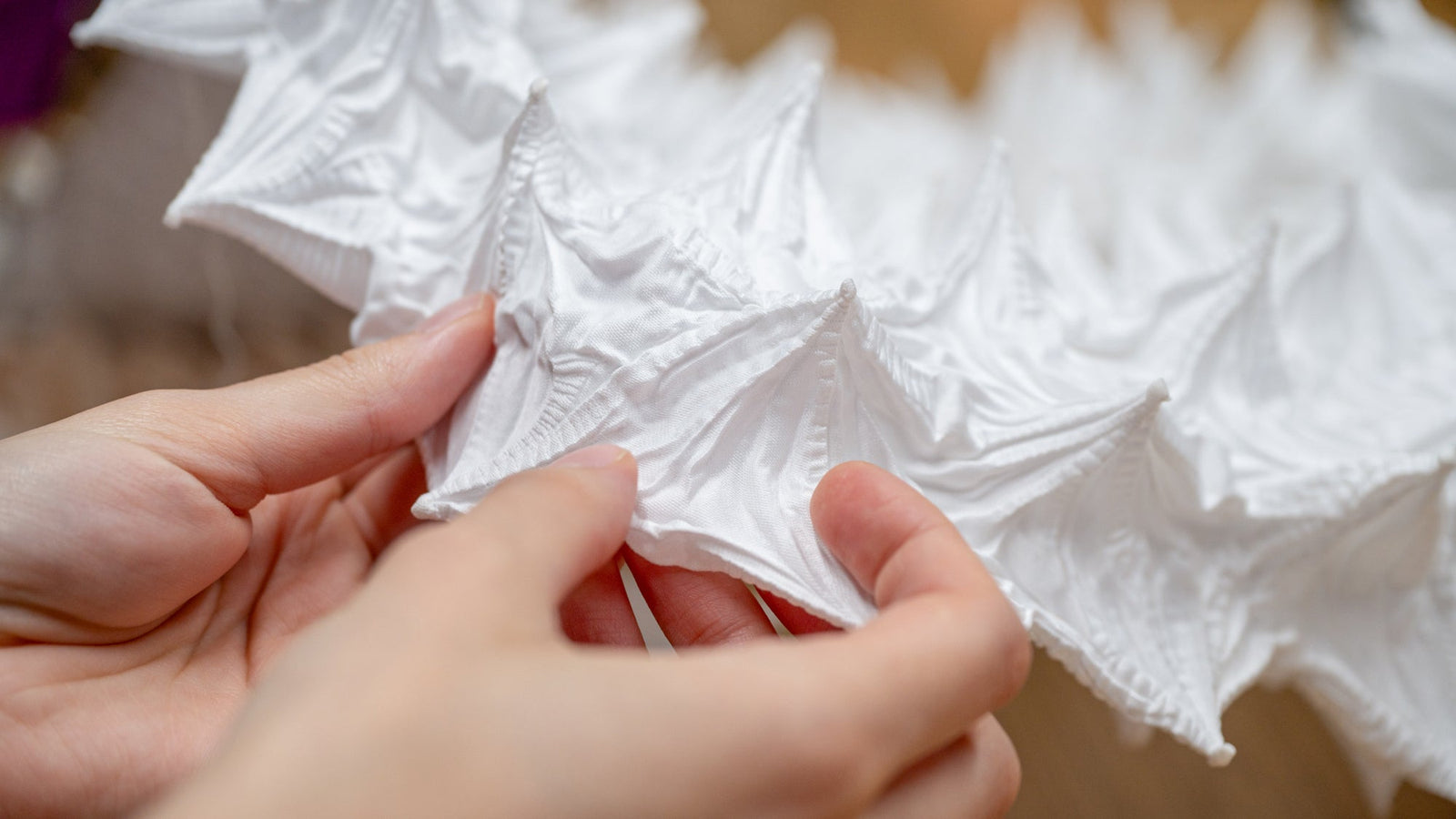
Pendant que nous travaillions, le personnel de Suzusan a déployé un tissu de plusieurs mètres pour nous montrer à quoi ressemble le tegumo shibori avant et après le retrait des fils. C'était impressionnant de voir à quel point le rouleau de tissu paraissait étroit avec les fils, comparé à sa largeur sans eux. L'idée de réaliser des centaines de nœuds parfaits à la main donnait le vertige.

“Il existe une façon d'aligner le motif en rangées régulières, dit Murase. « En réalité, c'est enroulé à main levée, sans pochoir, juste au toucher. Une personne nommée Honma-san procédait ainsi. Il est décédé à quatre-vingt-dix-huit ans, mais il m'a transmis sa technique. »

Le rouleau de tissu suivant offrait une sensation complètement différente. « La soie redevient plate si on la repasse », expliqua un membre du personnel. « Mais si vous appliquez chaleur et pression sur ce tissu, qui est en polyester, les traces du shibori demeurent. »

Soudain, les abat-jour sculpturaux de Suzusan prenaient tout leur sens. Cela aussi est hérité de l'artisanat shibori. Amatrice de bricolage, je me suis surprise à imaginer de nouveaux projets pour mes ampoules nues.
Ensuite venait le tesuji shibori. Au lieu d'un crochet, le tissu est maintenu en place par une boucle de ficelle. « D'abord, formez des plis », dit Murase. « Ils peuvent être un peu aléatoires, mais essayez de les rendre réguliers. » En maintenant la tension du fil d'une main, l'autre main attrape la bobine par en dessous, puis la fait repasser par-dessus encore et encore, enroulant le fil en spirale le long du tissu. « Si vous enroulez en laissant de larges espaces entre les fils, le tissu gonflera. Si vous enroulez avec des espaces étroits, moins de teinture pénétrera. C'est intéressant de jouer avec différentes largeurs. »
J'ai noué mon propre motif très serré, le fil marquant mes doigts. Il faut certainement une vraie compétence pour enrouler le fil uniformément toute la journée.
Les senteurs de teinture et de soleil
L'étape suivante nous a menés vers un espace de travail extérieur couvert, équipé de grands éviers, de marmites bouillonnant sur des réchauds portables, et d'étagères alignées de cartons de teinture en poudre. Glissant nos pieds chaussés dans des sandales en caoutchouc, nous sommes descendues sur des planches de bois patinées. L'odeur sucrée de l'herbe réchauffée par le soleil emplissait mes narines.

D'abord, nous avons trempé nos soies nouées dans un seau d'eau pendant quelques minutes, puis nous les avons plongées dans une marmite contenant de l'eau chaude et de la teinture. L'odeur vinaigrée de la teinture emplissait l'air tandis que Murase remuait avec un fouet pour encourager le pigment à imprégner tout le tissu.
« Le shibori est intéressant en ce sens qu'on ne sait vraiment pas comment il va ressortir », dit Murase pendant que nous attendions les quelques minutes nécessaires à la fixation de la teinture. « Parfois, même moi je fais "oh !" »

Quand le minuteur a sonné, nous avons sorti nos tissus et les avons plongés dans l'eau froide. Puis vint le moment de retirer les fils que nous avions noués.
Même avec un découd-vite pour faciliter le travail, il a fallu longtemps pour défaire les nœuds. Nous devions faire attention à ne pas percer le tissu. Imaginez défaire des centaines de nœuds au lieu de cinq ! Alors que chacun ouvrait son carré de soie, la pièce s'est remplie d'exclamations « Comme c'est beau ! » et « Génial ! »

Comme Murase l'avait laissé entendre, le résultat final n'était pas celui que j'attendais. Il y avait plus d'espace blanc dans mes plis que prévu — peut-être enroulés trop serrés pour laisser entrer la teinture — et je ne pouvais pas distinguer quel motif circulaire tegumo était censé être lequel. Pourtant, les couleurs sont ressorties vives et joyeuses, avec un effet aquarelle intéressant là où le vert rencontrait le bleu.
Les shibori de mes collègues, en revanche, étaient vraiment bien définis. Le jaune vif de Minyi et Hanako soulignait parfaitement différents motifs tegumo, tandis que les rayures diagonales de Takahashi encadraient magnifiquement une seule étoile au centre.


Dès que j'eus fini de repasser le mien et que le tissu fut presque sec, je l'ai noué à un angle désinvolte autour de mon cou. Minyi a passé le sien dans les passants de sa ceinture comme une touche de couleur contre son jean. Bien qu'il faille des années pour acquérir les compétences d'un shibori professionnel niveau Arimatsu, c'était satisfaisant que même des amateurs comme nous aient pu créer quelque chose d'intéressant.
« Un nouvel avenir a émergé »
« La culture ne se limite pas aux musées », dit Murase dans ses remarques de clôture. « La culture a une dimension économique, et l'économie a une dimension culturelle. J'espère que nous pourrons réussir à réunir ces deux aspects pour construire l'avenir. »

C'est quelque chose à quoi je pense souvent en tant que rédactrice pour MUSUBI KILN. Des artisans dévoués et travailleurs dans tout le Japon créent des œuvres incroyables, mais ils ne peuvent pas rester en activité et continuer à créer sans marché ni demande pour leurs produits. Soutenir ces artisans pour que leurs traditions puissent perdurer est une grande partie de la raison pour laquelle MUSUBI KILN existe. C'est un objectif partagé entre nous et Suzusan.
« Le fait que le shibori ait perduré pendant 400 ans signifie qu'il y a eu des gens qui ont continué à l'utiliser pendant 400 ans. S'il cesse d'être utilisé, il cesse d'être fabriqué, et le besoin de le fabriquer disparaît. Vous tous qui utilisez le shibori dans votre vie quotidienne contribuez à notre avenir, alors je voudrais vous remercier à nouveau », poursuivit Murase.
« Mon père disait en 2008 que cette industrie aurait disparu dans quinze ans, mais maintenant dix-huit ans se sont écoulés, les jeunes dans l'industrie ont augmenté, et un nouvel avenir que mon père n'avait pas imaginé a émergé. »
Après l'atmosphère de petite ville d'Arimatsu, où nous avons salué le vendeur de riz du quartier et acheté des tenugui artisanaux à rapporter, descendre du train dans l'acier étincelant de la gare de Nagoya donnait l'impression de sauter entre deux mondes. Mais le monde d'Arimatsu, où les textiles sont méticuleusement teints à la main, et celui du Shinkansen ultra-moderne nous ramenant à Tokyo ne font qu'un. L'artisanat traditionnel et la vie moderne coexistent, et c'est à nous d'aider les deux à perdurer dans le même avenir.
suzusan – boutique Arimatsu
1905 Arimatsu, Midori-ku, Nagoya, Aichi 458-0924, Japon
OUVERT Lun, Mar, Jeu, Ven | 11:00 – 18:00
OUVERT Sam, Dim | 10h00 – 17h00
FERMÉ Mer
TÉL +81 52 825 5636
jp@suzusan.com

Stay close to the craft
Now and then, a quiet letter — new stories, seasonal notes, and the hands behind the work.
Rencontrez les spécialistes d'outils qui soutiennent les artisans de Seto
Découvrez les coulisses de Seto et rencontrez les fabricants d'outils et les experts dont…
Carnet de voyage de l'acheteur : Transformer la Bizen ware en pots de plantes
Façonnés à la main à Okayama, ces pots en Bizen ware associent argile recyclée…
Shirata Ai
Rencontrez les maîtres de l'encens : l'art de l'arôme thérapeutique de l'île d'Awaji
Découvrez l'héritage de l'encens d'Awaji et apprenez comment l'artisanat traditionnel façonne des fragrances raffinées…
Leave a comment