

Carnet de voyage de l'acheteur : Transformer la Bizen ware en pots de plantes
Façonnés à la main à Okayama, ces pots en Bizen ware associent argile recyclée et formes conçues pour une croissance saine.
En janvier, nous nous sommes rendus à Okayama. La veille, le temps était doux, mais le froid s'était soudainement installé et un ciel lourd pesait au-dessus de nos têtes. Nous étions venus voir une nouvelle ligne de pots pour plantes. Je voyageais avec notre photographe, Suzuki, qui porte un amour profond aux plantes. Il cultive les siennes chez lui, ce qui faisait de lui le compagnon idéal pour cette visite.
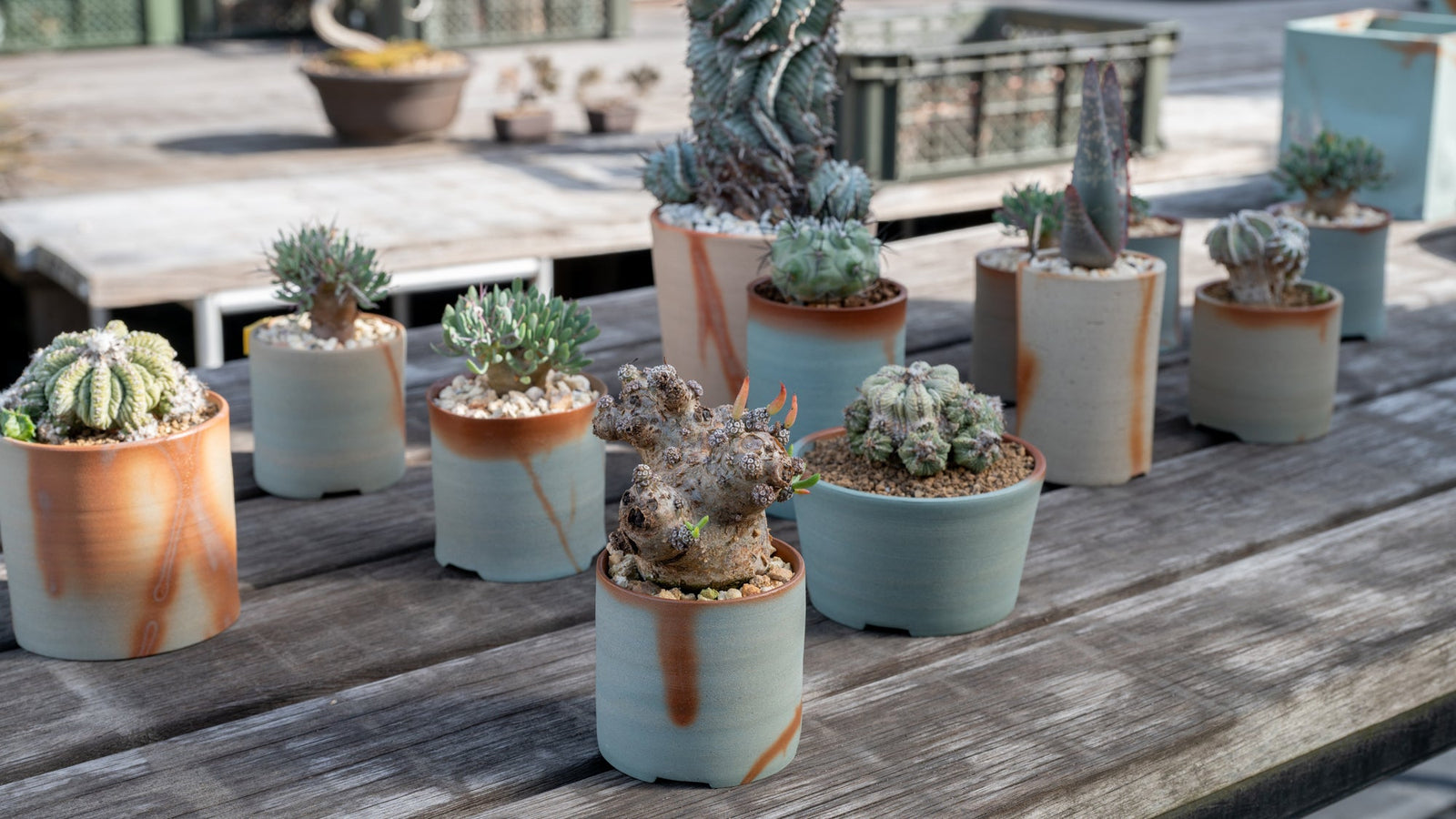
Jusqu'à ce voyage, je n'avais vu les pots qu'en photographie : certains dans un Bizen ware brun doux, et d'autres dans un turquoise calme qui évoquait une mer paisible. Une fois qu'une plante est placée à l'intérieur, les pots se retirent discrètement dans un rôle de soutien, permettant à la plante de briller. Pourtant, la personne derrière ces créations céramiques, Yoshino Hirofumi, portait une présence puissante. Son énergie semblait arriver avant ses mots.
Je ressens toujours une légère anticipation avant de rencontrer pour la première fois la personne derrière une œuvre. Mais dans la voiture, en route vers Yoshino Dorensha, l'atelier où Yoshino cultive des plantes et pétrit l'argile, il nous a tendu à chacun une bouteille de thé chaud. Dans ce petit geste, je me suis senti immédiatement à l'aise.
Yoshino Dorensha
Encadrer la beauté botanique
Une fois arrivés à son atelier, Yoshino nous a montré comment il rempote une plante caudiciforme. Il a brossé l'ancienne terre, délié doucement les racines, placé un carré de grillage de drainage à la base du pot, et ajouté de la terre fraîche. L'ensemble du processus n'a pris que quelques minutes.


Tout à la fin, il a dispersé une couche de paillage blanc sur la surface. C'est à ce moment que la plante a changé. Le tronc et les feuilles semblaient briller, comme si elle montait sur scène. J'ai demandé à Yoshino ce qu'il avait ajouté par-dessus.


« C'est de l'argile réfractaire utilisée pendant la cuisson, placée entre les pièces empilées pour éviter qu'elles ne collent. Normalement, elle est jetée après usage, mais nous la broyons et la réutilisons comme couche de finition », a-t-il expliqué. Ce qui aurait été jeté devient quelque chose qui met la plante en valeur.

Lorsque la pièce plantée a été posée, Suzuki a immédiatement commencé à photographier. Dans la lumière douce et diffuse du ciel couvert, la petite scène semblait délicate, mais portait une force. En regardant le monde contenu dans le pot, nous le savions. Cette taille devait faire partie de la gamme.
Façonné par la connexion

À l'intérieur de l'atelier de Yoshino, on nous a montré des pots de différentes tailles. Nos yeux se sont posés sur des pots familiers couleur terre avec des marques de hidasuki , créées en enveloppant chaque pièce de paille et en la cuisant dans un récipient couvert. Environ 30 pour cent de l'argile pour ceux-ci provient d'objets en Bizen ware cassés, qui sont ensuite broyés et recyclés. Les pots turquoise, en revanche, suivent un chemin différent. Ils ne sont pas faits d'argile recyclée, mais l'argile utilisée pour obtenir leur couleur douce est préparée ici par Yoshino lui-même.
Lorsque j'ai demandé à Yoshino pourquoi il avait commencé à produire des pots en utilisant de l'argile recyclée, il a partagé une histoire façonnée par les connexions entre les personnes, une histoire particulièrement convaincante.

Yoshino a commencé par le jardinage comme intérêt personnel. Avec le temps, cela s'est transformé en culture de plantes à partir de graines et en vente. Ce faisant, il a progressivement réalisé à quel point il était difficile de trouver des pots qui convenaient véritablement aux plantes qu'il cultivait.
Au début, il a commandé à un four la production des pots en Bizen ware turquoise qu'il avait imaginés et les a vendus avec ses plantes. Cependant, alors que ce four devenait de plus en plus occupé, ils ont finalement cessé de produire des pièces colorées.
C'est alors qu'il s'est tourné vers l'artiste céramiste Hosokawa Takahiro, quelqu'un qu'il connaissait depuis de nombreuses années.

Bien que le turquoise ne puisse pas être ramené immédiatement, Hosokawa a proposé une approche alternative. Il a suggéré d'utiliser de l'argile recyclée de Bizen ware faite à partir d'objets cassés, et de faire produire les pots par de jeunes artisans. Yoshino a accepté. Ainsi, tout en continuant son propre travail artistique, Hosokawa a également établi Hara Seitosho. Là, il travaille étroitement avec de jeunes artisans et donne vie à la production des pots pour plantes que Yoshino avait imaginés.
De nombreux céramistes à Bizen se forment au Bizen Pottery Center, mais même après avoir terminé leurs études, il n'est pas facile pour les jeunes artisans de s'établir immédiatement de manière indépendante. Produire des pots pour plantes dans des tailles cohérentes leur offre un moyen d'affiner leurs compétences par la répétition. L'argile elle-même est obtenue localement grâce à une initiative de recyclage, utilisant du matériau récupéré—bon pour la terre, également. C'est à travers les connexions entre Yoshino, Hosokawa et ces jeunes artisans que naissent les pots uniques de Yoshino Dorensha.
Pour Hosokawa, qui travaille habituellement avec des fours à bois, être impliqué dans ce projet—où les pots sont cuits régulièrement dans des fours électriques—est également devenu une occasion d'explorer différentes approches de l'argile et de la température. Il y avait le sentiment que chaque partie du processus avait de la valeur pour tous les participants.


De l'autre côté de l'atelier de Yoshino se trouve un grand malaxeur d'argile. Il y avait eu une forte demande pour les pots turquoise, mais même lorsque Yoshino parvenait à obtenir de l'argile recyclée, il ne pouvait pas se procurer l'argile nécessaire pour obtenir la couleur bleue distincte qu'il voulait. Alors, Yoshino a décidé de la faire lui-même. Il a commencé à mélanger du pigment bleu dans l'argile, établissant Yoshino Dorensha comme une installation pour préparer ce matériau. En utilisant cette argile, les pots turquoise ont été ramenés avec succès l'année dernière.
Une forme façonnée pour la croissance
Les pots en Bizen semblent simples de forme au premier regard. Une forme cylindrique épurée. Mais comme Yoshino l'a décrit, « Ce sont des pots façonnés dans la poursuite de la croissance des plantes. »

D'abord, rien n'interfère avec la croissance de la plante. L'intérieur se courbe doucement vers la base, guidant l'eau vers le bas, tandis qu'un large trou de drainage permet à l'eau de passer facilement. Laissée sans glaçure, la surface permet également la respirabilité.
Les pots faits de terre cuite à basse température ou de biscuit peuvent sembler appropriés au début, car ils drainent bien. Mais lorsqu'ils sèchent trop rapidement, l'argile évacue la chaleur. En hiver, cela peut faire chuter rapidement la température à l'intérieur du pot. Ils sont également plus sujets aux fissures.
Bizen ware est différent. Cuit à haute densité sans glaçure, il évite ces inconvénients tout en maintenant résistance et circulation de l'air.
« Ce sont des pots qui ne peuvent être fabriqués qu'avec une compréhension de ce dont les plantes ont besoin », a déclaré Yoshino.
Déjeuner de soba avec le cercle des pots pour plantes Bizen
Le cercle de Yoshino semblait tourner autour des plantes.
Pour le déjeuner, nous nous sommes arrêtés dans un restaurant de soba, où le propriétaire partage également l'amour de la verdure. Après notre repas, l'eau utilisée pour faire bouillir les soba a été apportée dans une carafe Bizen dotée d'une belle anse.

Connue sous le nom de soba-yu, cette eau est traditionnellement mélangée à la sauce de trempage restante et dégustée à la fin du repas. Riche de la saveur des nouilles, elle porte une chaleur adoucie par le sel du bouillon.
« Cette carafe a été fabriquée par Hosokawa, que nous allons visiter ensuite », nous a dit Yoshino. En entendant cela, je me suis retrouvé à attendre avec encore plus d'impatience la visite de l'après-midi à Hara Seitosho.

Hara Seitosho
Après le déjeuner, nous nous sommes dirigés vers Hara Seitosho, où nous allions observer la fabrication des pots pour plantes. À notre arrivée, nous avons été accueillis par Hosokawa et une jeune artisane.
Ils ont commencé par nous montrer le processus de façonnage, qui débute par le pétrissage en spirale, suivi du tournage.


Le processus de pétrissage de l'argile consiste à uniformiser sa consistance et à éliminer les poches d'air. Lorsque l'argile est travaillée dans un mouvement rotatif, des motifs ressemblant à des pétales de chrysanthème apparaissent à la surface. C'est un processus physiquement exigeant qui engage tout le corps.
Pendant le pétrissage de l'argile, de petites bulles d'air remontent à la surface avec de légers bruits d'éclatement. La masse est ensuite divisée en portions de la taille approximative d'une petite galette, chacune soigneusement pesée.

Vint ensuite le tour. Alors qu'il tourne à grande vitesse, l'artisan façonne la forme, s'arrêtant à intervalles pour vérifier les mesures. À proximité, une feuille indiquant les dimensions exactes des pots est placée à portée de vue.
Lorsque j'ai demandé à l'artisane ce qu'elle trouvait le plus difficile, elle a répondu : « Incorporer les points d'attention spécifiques de Yoshino dans chaque pièce. »
Non seulement la taille, mais aussi la courbe de la base intérieure doivent être formées au tour.
Alors que la forme cylindrique nette du pot et les lignes de tournage visibles prenaient forme, il me semblait déjà complet. Pourtant, elle ne l'a pas retiré du tour. Même s'il semble correct, une légère indentation peut empêcher le pot de devenir un cylindre parfait après la cuisson. Bien qu'il soit courant de tourner et d'affiner la forme après un séchage partiel, éviter l'étape de tournassage réduit à la fois le temps nécessaire et la perte d'argile.

En observant, Hosokawa a offert un conseil à l'artisane. « À la fin, il est utile de mettre votre regard au niveau du pot pour vérifier s'il est droit. On peut voir un léger rétrécissement ici. » D'en haut, c'était difficile à remarquer. Mais de côté, la courbe subtile devenait claire.
« Pour des moments comme celui-ci, je garde un miroir à proximité pour pouvoir vérifier le profil en étant assis. Se lever à chaque fois pour regarder de côté serait difficile. » Il a également mentionné que placer les pots finis sur des étagères à hauteur des yeux, plutôt qu'au sol, facilite la comparaison des formes et la détection des distorsions.
Ces petites observations et ces conseils attentifs semblaient essentiels pour la jeune artisane. Des moments comme ceux-ci, où le savoir est partagé directement, portent un poids réel.
Les pots finis sont ensuite apportés au Bizen Pottery Center et cuits dans des fours électriques loués à cet effet. Environ une fois tous les mois et demi, les artisans se rassemblent pour charger le four, le cuire, le décharger et terminer le processus de finition, où chaque pièce est poncée entièrement à la main.

Après avoir observé le processus de façonnage des pots, nous avons décidé de visiter le Pottery Center lui-même, le lieu où les artisans s'étaient formés.
Le Bizen Pottery Center

Lorsque nous sommes arrivés au Bizen Pottery Center, nous avons trouvé des étudiants au travail, chacun absorbé par ses propres pièces. Il existe des cours d'un an et d'un mois, et on nous a dit que beaucoup viennent de l'étranger pour étudier ici.

Le four électrique n'était pas utilisé ce jour-là, mais on nous a montré des photographies d'une cuisson précédente.

Sur ces images, des pots pour plantes de différentes tailles sont emboîtés par ensembles de trois, avec de la paille placée entre eux pour créer des marques hidasuki, permettant de cuire de nombreuses pièces à la fois. Idéalement, ils ne seraient pas empilés, mais cette méthode permet de les cuire plus efficacement. Pour que cela fonctionne, chaque artisan doit être capable de produire la même forme avec constance. Fabriquer plusieurs pièces de la même taille — ce que nous venions de voir comme une compétence fondamentale — révèle ici aussi son importance.

Près du four, Yoshino a repéré un seau et a lancé avec un sourire : « N'est-ce pas un trésor ? » À l'intérieur se trouvait de la cendre de paille d'un blanc pur. Elle provenait de la paille utilisée pour le hidasuki. Lorsqu'elle est cuite à basses températures, la cendre devient noire, mais à températures plus élevées, elle reste blanche. Cette cendre est mise de côté et ensuite placée sur le fond des pots avant de les empiler pour la cuisson afin d'éviter qu'ils ne collent ensemble. En raison de sa couleur, elle évite également de laisser des marques sombres sur la surface. Hosokawa a ajouté : « Même cela sert encore à quelque chose. »

Dans un coin se trouvait un tas de morceaux d'argile réfractaire, le même matériau que Yoshino utilise comme couche de finition lors du rempotage. Ceux-ci aussi retourneront probablement entre ses mains, où ils feront à nouveau ressortir la présence des plantes.

Avec cela, notre journée s'est terminée. Dans le train du retour, Suzuki et moi nous sommes retrouvés à parler de la journée, notre fatigue oubliée alors que nous revisions chaque moment.
Tout a commencé avec le désir de Yoshino de créer des pots pour plantes. De là, les conseils de Hosokawa sur la structure et la fabrication, le dévouement constant des artisans, et un cycle qui utilise pleinement chaque matériau se sont tous réunis.
Un pot pour plantes existe pour soutenir ce qui pousse en son sein. Pourtant, derrière chacun se trouve le soin et l'engagement de nombreuses mains. Et par la façon dont chaque partie s'est assemblée, un nouveau type de pot pour plantes Bizen ware est né.
Stay close to the craft
Now and then, a quiet letter — new stories, seasonal notes, and the hands behind the work.
Rencontrez les spécialistes d'outils qui soutiennent les artisans de Seto
Découvrez les coulisses de Seto et rencontrez les fabricants d'outils et les experts dont…
À propos de « Rokkoyo », les six anciens fours du Japon
Dans ce numéro, nous présentons les caractéristiques et l'attrait des six fours anciens ainsi…
Découvrir l'art de Bizen ware : un voyage à travers l'héritage de Hozan Kiln
Entrez chez Hozan Kiln et découvrez l'histoire riche de Bizen ware, son artisanat forgé…
Leave a comment