

Un goût de printemps : wagashi de saison
Découvrez les wagashi de printemps, accompagnés d'assiettes et de tasses à thé qui s'associent harmonieusement pour composer une table à thé japonaise de saison.
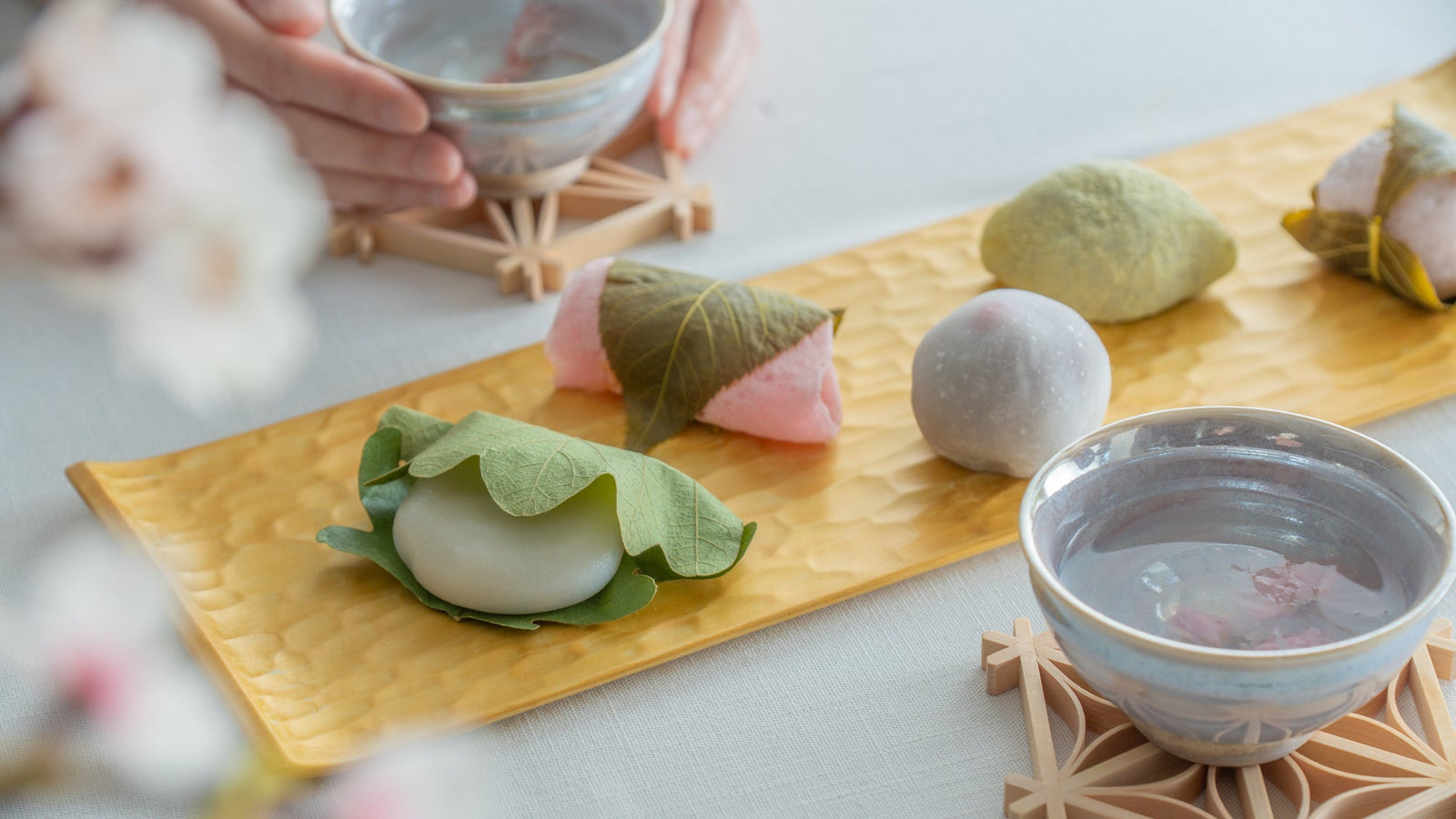
Les wagashii sont une douceur propre au Japon qui permet de goûter les saisons. Les wagashi de printemps présentent souvent des motifs tels que les fleurs de cerisier, et leurs teintes pâles de rose tendre et de vert apportent de la beauté au moment du thé. Dans ce blog, nous présentons des wagashi à savourer au printemps, et partageons les assiettes qui s'accordent parfaitement avec eux pour créer une table véritablement saisonnière.
Sakura Mochi
Le sakura mochi est l'un des wagashi de printemps les plus emblématiques. Il est largement disponible pendant la saison, des supérettes aux boutiques de wagashi haut de gamme et aux comptoirs de confiserie des grands magasins. Fait intéressant, il existe deux styles régionaux distincts.
Style Kanto
Le style apprécié dans la région du Kanto, à l'est du Japon, présente une pâte de haricots sucrée délicatement enveloppée dans une fine crêpe de farine de blé.
Le sakura mochi de style Kanto aurait été créé en 1717, pendant la période Edo (1603–1867), lorsque Yamamoto Shinroku, gardien du temple Chomeiji à Mukojima, a créé cette douceur.
Comme Mukojima était célèbre pour ses cerisiers en fleurs, il a cherché un moyen d'utiliser les nombreuses feuilles de sakura tombées. Il a salé les feuilles et les a utilisées pour envelopper le mochi, qui a rapidement gagné en popularité et est devenu une spécialité locale.
Pour servir le sakura mochi de style Kanto, cette élégante assiette au motif sakura est un choix idéal. La forme en pétale est délicatement peinte d'un motif de fleur de cerisier. Sa caractéristique la plus distinctive est son éclat nacré. Ce lustre raffiné complète le rose tendre du sakura mochi.

Style Kansai
Dans la région du Kansai, à l'ouest du Japon, le sakura mochi est souvent appelé Domyoji. Il est fait avec une farine grossière connue sous le nom de Domyoji-ko, produite à partir de riz gluant cuit à la vapeur et grossièrement écrasé, et se caractérise par sa texture agréable et la douceur du riz lui-même.
Ce sakura mochi expressif s'accorde magnifiquement avec cette assiette au motif « vagues » seigaiha, qui représente des vagues tranquilles se déployant à l'infini. Ce motif est depuis longtemps chéri au Japon comme symbole de paix et de prospérité durable.
Le bord festonné de l'assiette, évoquant les vagues, apporte de la fraîcheur à la table, tandis qu'en son centre apparaît une petite image du mont Fuji, conférant une note de bon augure. Lorsque le sakura mochi Domyoji y est déposé, le rose pâle de la douceur contraste vivement avec les vagues bleu profond, évoquant des pétales dispersés sur une mer printanière.

Comme accord printanier particulier, nous recommandons le sakuracha. Des pétales de fleurs de cerisier salés se déploient doucement dans l'eau chaude, leur douceur tendre équilibrée par une salinité délicate.
Les couleurs nacrées de la tasse japonaise Rainbow White conviennent parfaitement à cette boisson chaude. Une seule fleur repose dans la tasse, créant un petit moment de hanami discret à table.

Ichigo Daifuku
Comme son nom le suggère, le daifuku, signifiant « grande fortune », est depuis longtemps apprécié comme un wagashi de bon augure. Son mochi tendre, enveloppant une pâte de haricots rouges sucrée, est savouré depuis des générations.
Au printemps, l' ichigo daifuku, garni de fraises fraîches de saison, devient particulièrement populaire. À chaque bouchée, le jus sucré-acidulé de la fraise se répand sur le palais, se mêlant doucement à la douceur onctueuse de la pâte de haricots.
Pour servir l'ichigo daifuku, nous recommandons l' assiette latérale Soft Pink Balloon Flower, une assiette en forme de fleur dans un rose printanier tendre.
La surface finement sculptée donne à la pièce profondeur et texture, rappelant presque un délicat travail du bois. Son ton rose discret met en valeur le rouge vif de la fraise, créant un contraste joyeux qui trouve parfaitement sa place au printemps.


Yomogi Mochi
Fait avec de jeunes feuilles d'armoise qui commencent à pousser au printemps, le yomogi mochi est depuis longtemps considéré comme un wagashi qui annonce l'arrivée de la saison par son parfum. Il est connu pour sa couleur verte vive et profonde et son arôme frais, légèrement herbacé.
La pâte de mochi moelleuse, imprégnée du riche parfum du yomogi, s'accorde bien avec la douceur de la pâte de haricots rouges.
Pour servir le yomogi mochi, une assiette blanche mate avec une glaçure mouchetée comme une fine neige est un choix idéal. Sur ce fond blanc pur, le vert vibrant du mochi crée une scène saisissante, comme si la fin de l'hiver et les premiers signes du printemps coexistaient tranquillement sur la table.

Kashiwa Mochi
Le kashiwa mochi est fait en enveloppant de la pâte de haricots sucrée dans un mochi ferme à la texture agréable, fait de farine de riz finement moulue, puis en l'enfermant dans une grande feuille de chêne. C'est une douceur essentielle pour le Tango-no-Sekku, ou Jour des Enfants, célébré le 5 mai. Parce que les feuilles de chêne ne tombent pas avant que de nouveaux bourgeons ne commencent à pousser, cet arbre est depuis longtemps considéré comme un symbole de prospérité familiale et de continuation des générations.
Pour servir cette douceur saisonnière, une assiette en magewappa constitue un choix approprié. Fabriquée par des artisans qualifiés chez Odate Kogeisha à partir de cèdre d'Akita, la pièce est légère mais digne. La finition brillante, en particulier, ajoute une touche festive, rehaussant l'expérience de savourer des wagashi accompagnés de matcha ou de thé vert.
Le contraste entre la feuille de chêne vert vif et les tons rouge vif ou violet profond de l'assiette reflète un sens de l'harmonie des couleurs distinctement japonais. C'est une pièce polyvalente qui rehausse le moment du thé quotidien.

Uguisu Mochi
Le uguisu mochi est une douceur printanière inspirée de la fauvette des buissons, connue sous le nom d'uguisu en japonais. Cet oiseau est souvent dit annoncer l'arrivée du printemps. Le mochi est façonné en un petit ovale et saupoudré de kinako vert pâle fait de jeunes graines de soja torréfiées, connu sous le nom d' uguisu-ko.
L'apparence simple et attachante de l'uguisu mochi s'accorde bien avec une assiette Shino qui reflète la sensibilité japonaise traditionnelle du wabi sabi. Cette pièce Shino présente une surface aux tons rose tendre avec une texture terreuse et naturelle. Les fines craquelures dans la glaçure et les variations subtiles de sa finition garantissent qu'aucune pièce n'est exactement identique.

Les wagashi de printemps capturent l'instant fugace des couleurs douces, des arômes frais et de la joie qui accompagne l'arrivée de la saison. Prenez le temps de savourer ces saveurs éphémères avec votre assiette préférée et une tasse de thé chaud, et laissez le printemps se déployer lentement à votre table.
Les wagashi offrent de petites façons de découvrir les quatre saisons du Japon—le printemps, l'été, l'automneet l'hiver—chacune avec sa beauté unique. Vivez ce sens de la saisonnalité à travers les douceurs japonaises lors de votre prochaine visite au Japon.
Stay close to the craft
Now and then, a quiet letter — new stories, seasonal notes, and the hands behind the work.
Renouveau de printemps : 5 façons douces de rafraîchir votre espace
Accueillez le printemps chez vous avec cinq gestes simples pour renouveler votre espace à…

Printemps des rencontres et des séparations
Entrez dans le printemps au Japon et vivez une saison façonnée par des transitions…
Le messager du printemps : la palette colorée des premières floraisons
Accueillez le printemps avec les premières floraisons du Japon. Découvrez la beauté et la…
Leave a comment