

Guide des articles pour le sake japonais
Découvrez les tasses et carafes à sake traditionnelles japonaises, leurs formes uniques, et comment savourer le sake avec élégance.
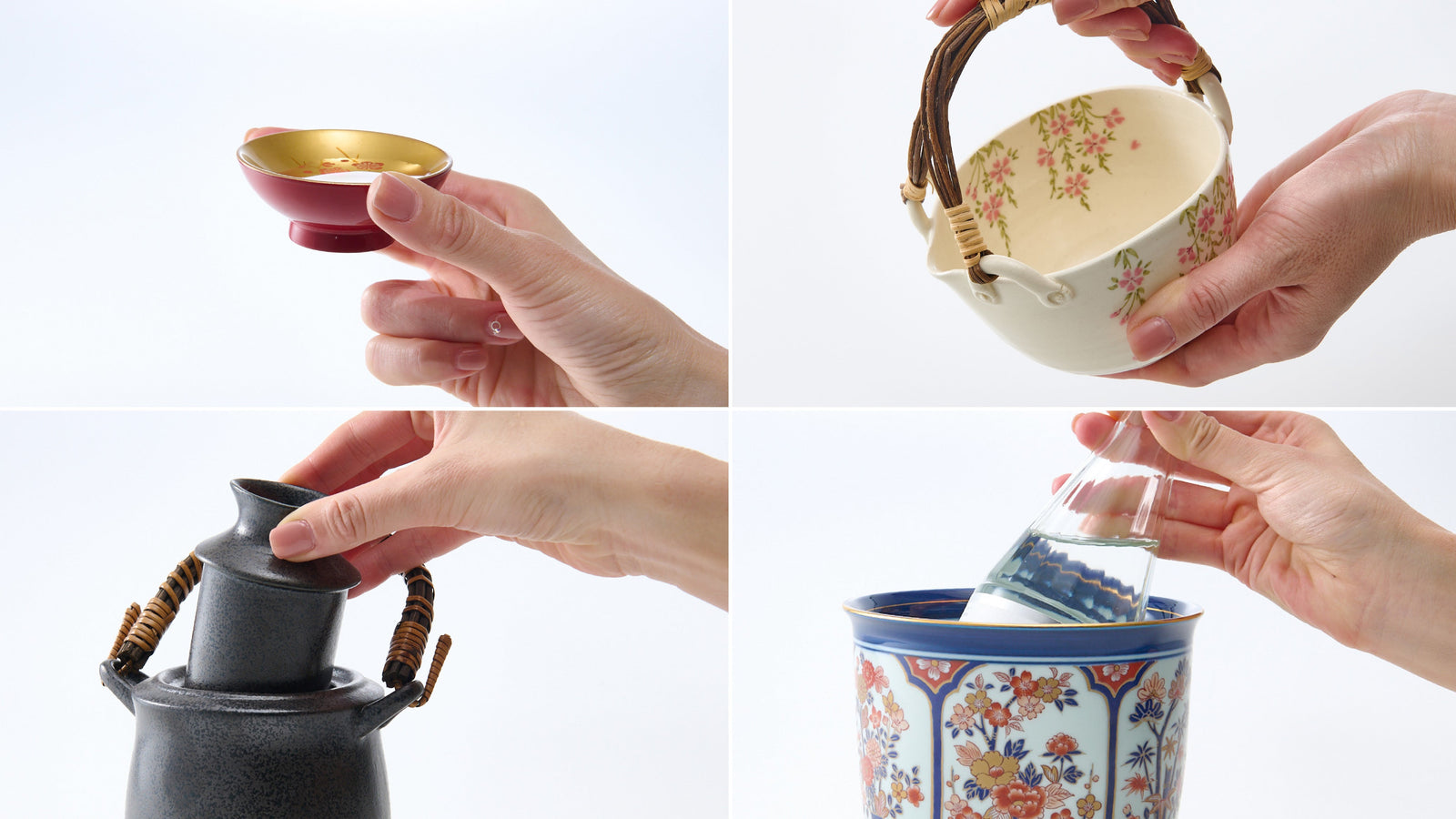
Le sake—boisson japonaise ancestrale à base de riz—rassemble les gens depuis longtemps. Les récipients utilisés pour le servir ont façonné cette culture tout autant, présents dans tous les contextes, des mariages et célébrations du Nouvel An aux rencontres informelles entre amis.
Dans cet article, nous présentons les principaux types de récipients à sake, expliquons ce qui rend chacun unique, et partageons quelques conseils d'étiquette pour enrichir votre expérience du sake.
Coupes à sake japonaises

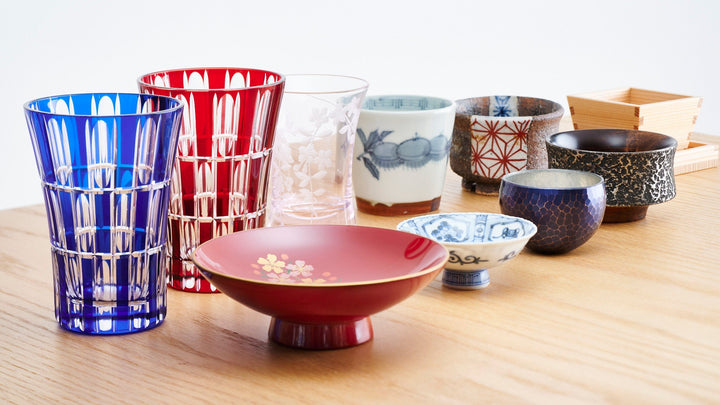
Les coupes à sake sont les récipients les plus essentiels dans l'univers du sake japonais. Leurs formes varient largement, et chaque forme influence l'expérience de dégustation à sa manière. Dans cette section, nous présentons les principaux types de coupes à sake, montrons comment elles sont utilisées dans différents contextes—des cérémonies formelles aux repas quotidiens—et expliquons les variétés de sake qui s'accordent magnifiquement avec elles.
Nous expliquons également comment différents matériaux conviennent à diverses façons de déguster le sake, qu'il soit servi chaud, frais ou pétillant.
Types de coupes à sake japonaises
Sakazuki

Plate et à large ouverture, la sakazuki est la forme la plus classique de récipient à sake. Traditionnellement utilisée dans les rituels shinto, les mariages et autres cérémonies propices, la coupe ne contient qu'une petite quantité, destinée à être terminée en une ou deux gorgées. La conception peu profonde permet à l'arôme de s'élever doucement, rendant ce style idéal pour le sake ginjo parfumé.

Cet ensemble de sakazuki à motifs Aizu-e, orné de motifs floraux élégants, convient parfaitement aux occasions spéciales. Lorsque le sake est versé, les motifs brillent doucement, ajoutant un charme lumineux au moment.
Ochoko

L' ochoko est peut-être la coupe à sake la plus familière aujourd'hui, souvent vue dans les izakaya et restaurants à travers le Japon. Petite et facile à tenir, cette coupe est traditionnellement associée à une carafe à sake tokkuri , permettant au sake—en particulier les variétés chaudes—d'être servi et partagé avec grâce.

En raison de sa taille compacte, l'ochoko maintient le sake à la bonne température et encourage le service fréquent, symbolisant l'hospitalité et la connexion. Les matériaux vont du grès et de la porcelaine au verre, offrant d'innombrables façons de refléter le goût personnel et le cadre.
La Coupe Ochoko Hanazume Dorée est décorée d'un motif floral hanazume complexe souligné d'or et terminé par une seule ligne bleue à l'intérieur. Ces coupes apportent de l'élégance à toute table, vous invitant à admirer leur savoir-faire autant que le sake qu'elles contiennent.
Guinomi

Plus grande qu'une ochoko, la guinomi convient à ceux qui préfèrent boire le sake lentement et généreusement. Idéale pour le sake frais ou à température ambiante, la taille ample de ce récipient laisse l'arôme et la texture se déployer progressivement. Le corps plus épais fait également de la guinomi un excellent accord pour le sake nigori ou junmai corsé.

La chaleur de la boisson à travers la main, les guinomi en céramique et porcelaine sont particulièrement appréciées. Les guinomi artisanales sont chéries non seulement pour un usage quotidien mais aussi comme pièces de collection.
Cette guinomi rustique en grès du Kousai Kiln présente un corps en argile terreux et texturé serti de panneaux de porcelaine incrustés, peints à la main avec un motif de feuilles de chanvre rouges et un motif géométrique bleu profond qui créent un contraste visuel audacieux.
Verre à sake

Les verres à sake conviennent parfaitement au sake frais. Comme les verres à vin, ils permettent de faire tourner et d'admirer la boisson, en particulier lors de la dégustation de variétés ginjo et daiginjo délicates. Leur transparence les rend également idéaux pour le sake pétillant, ainsi que pour servir du whisky ou du vin.

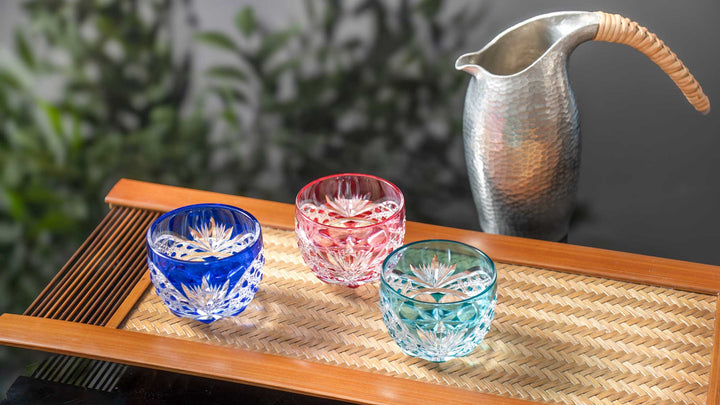
L' Ensemble de coupes à sake Tsubomi et Hana, fabriqué avec du verre Edo, rehausse à la fois le parfum et la saveur du sake. Élégantes et polyvalentes, elles constituent un excellent cadeau pour les occasions spéciales.
Types de sake et matériaux de coupes correspondants
Grès

Les coupes en grès ont une texture subtile qui adoucit la saveur du sake, lui donnant un profil plus rond et plus doux. Leur épaisseur les rend agréables à tenir et à boire, et parce qu'elles retiennent bien la chaleur, elles conviennent particulièrement au sake chaud ou très chaud. Elles s'accordent magnifiquement avec les variétés junmai et nigori connues pour leur profondeur terreuse.
Porcelaine

Les coupes en porcelaine présentent des bords fins et lisses qui offrent une gorgée nette et vive, parfaite pour le sake aromatique et raffiné tel que le ginjo. Leur apparence gracieuse complète les tables tant traditionnelles que modernes. La porcelaine fonctionne bien à toutes les températures, qu'elle soit dégustée fraîche ou légèrement réchauffée.
Laque

Les coupes en laque offrent une sensation douce et délicate contre les lèvres et rehaussent subtilement la saveur du sake. Légères mais durables, elles isolent bien, les rendant adaptées au sake chaud comme froid. Le lustre profond de la laque développe une richesse au fil du temps, conférant à ces récipients une élégance intemporelle qui convient aux occasions festives.
Verre

Le verre est le meilleur accord pour le sake frais ou pétillant. La surface lisse et transparente met en valeur la couleur et la clarté de la boisson tout en permettant à son arôme et sa saveur purs de se déployer. Les verres fins accentuent la finesse du daiginjo, tandis que les plus épais complètent les variétés plus riches et non filtrées. Les verres à sake modernes ressemblent souvent à des verres à vin, permettant d'apprécier l'arôme et les bulles en buvant.
Métal

Les coupes en métal, en particulier celles en étain, sont également appréciées pour le sake frais. La structure moléculaire poreuse de l'étain adoucirait les saveurs plus vives et mettrait en valeur la douceur naturelle du sake. Avec une excellente conductivité thermique, les coupes en métal peuvent réchauffer le sake rapidement sans atténuer son arôme, bien qu'elles refroidissent aussi rapidement, donc les récipients plus petits sont idéaux pour savourer les services chauds. L'étain ajoute une touche raffinée aux types de sake fruités ou aromatiques.
Voir la collection de tasses à sake
Pour mieux comprendre comment choisir la tasse à sake la plus adaptée, consultez notre article, Comment choisir la tasse à sake parfaite avec des conseils d'experts.
Carafes à sake japonaises

A Une carafe à sake est un récipient élégant et pratique pour servir et partager le sake. Que vous versiez du sake chaud ou frais, le simple geste d'utiliser une carafe transforme un repas ordinaire en quelque chose de plus raffiné. est un récipient élégant et pratique pour servir et partager le sake. Que vous versiez du sake chaud ou frais, le simple geste d'utiliser une carafe transforme un repas ordinaire en quelque chose de plus raffiné.
Types de carafes à sake japonaises
Une carafe à sake est un récipient élégant et pratique pour servir et partager le sake. Que vous versiez du sake chaud ou frais, le simple geste d'utiliser une carafe transforme un repas ordinaire en quelque chose de plus raffiné.
Tokkuri

Le tokkuri est la carafe à sake la plus emblématique du Japon. Reconnaissable à son corps arrondi et son col étroit, il se tient confortablement dans la main et aide à retenir l'arôme du sake lorsqu'on le verse. Le nom tokkuri viendrait du doux son tokuri-tokuri—une onomatopée décrivant le versement délicat du sake.

Adapté au sake chaud comme au sake frais, le tokkuri est particulièrement apprécié pour servir l' atsukan, , le sake chauffé. La plupart sont fabriqués en grès ou en porcelaine, des matériaux qui rehaussent naturellement la douceur du sake tout en ajoutant une touche de chaleur à l'expérience du repas. Sa silhouette gracieuse est aussi agréable à regarder qu'à utiliser.
Ce tokkuri en Hasami ware présente le motif traditionnel de rayures tokusa , lui conférant une présence authentique et intemporelle. Il est parfait pour déguster du sake chaud dans un cadre à la fois classique et serein.
Katakuchi

Le katakuchi—littéralement « une bouche »—est une carafe en forme de bol avec un seul bec verseur sur un côté, rappelant le bec d'un oiseau. Sa forme ouverte permet au sake de respirer, libérant des arômes délicats et adoucissant la saveur. Cela le rend particulièrement adapté au sake frais ou ginjo, où le parfum et la nuance comptent le plus.
Comme l'arôme se développe à mesure que la température monte, laisser le sake reposer brièvement dans un katakuchi avant de le verser peut révéler encore plus de profondeur et de complexité.
Ce katakuchi exquis du Tosen Kiln présente un motif peint à la main représentant les cerisierspleureurs emblématiques de Gion à Kyoto. La palette de couleurs douces et la poignée en bois évoquent la beauté éphémère du printemps à Kyoto, une pièce qui incarne à la fois l'artisanat et le charme poétique.
Chirori

Le chirori est une carafe traditionnelle en métal, le plus souvent en cuivre ou en étain, conçue spécifiquement pour chauffer le sake. Sa haute conductivité thermique permet un contrôle précis de la température, vous permettant de chauffer le sake uniformément et rapidement sans perdre son arôme délicat.
Raffiné dans son apparence, le chirori est un élément incontournable des restaurants japonais haut de gamme et des auberges traditionnelles. Parmi eux, les chirori en étain sont particulièrement prisés : on dit qu'ils adoucissent les notes âpres, rehaussent l'arôme et révèlent la douceur du sake, ce qui en fait un favori des connaisseurs.
Ce chirori en étain de Seigado est une véritable œuvre d'artisanat. Chaque pièce est façonnée à la main, le métal martelé des dizaines de milliers de fois pour obtenir une finition lisse et lustrée. Conçu pour durer toute une vie, c'est un chef-d'œuvre qui unit tradition, fonction et beauté.
voir la collection de carafes à sake
Chauffe-sake et rafraîchisseurs japonais
Chauffe-sake japonais

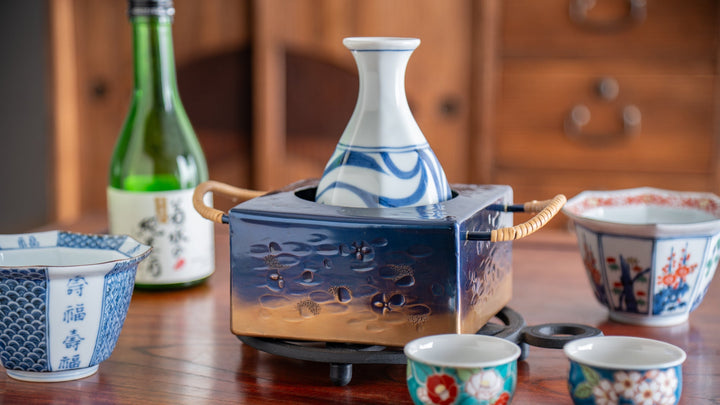
L'un des vrais plaisirs du kanzake, le sake chaud, réside dans la façon dont son arôme et sa saveur évoluent avec la température. Un léger changement de chaleur peut transformer le caractère d'un sake, révélant des couches cachées de douceur, d'umami ou de parfum. Pour apprécier ces subtilités, un chauffe-sake est un élément indispensable.
Compact et raffiné, un chauffe-sake est un petit récipient de table conçu pour réchauffer doucement le sake tout en préservant son équilibre délicat. Il suffit de le remplir d'eau chaude, d'y placer un tokkuri ou un chirori, et de laisser reposer quelques minutes. Comme il réchauffe le sake indirectement, la boisson ne surchauffe jamais, permettant à son arôme et sa saveur de s'exprimer pleinement.
À la fois fonctionnel et décoratif, un chauffe-sake s'intègre magnifiquement dans un cadre de repas ou de bar à domicile. Ils sont disponibles dans divers matériaux tels que la céramique, la porcelaine et le cuivre, chacun offrant une esthétique distincte et une qualité de rétention de chaleur.
La plupart sont conçus pour contenir une carafe d'une portion—environ 180 ml—ce qui les rend idéaux pour les repas partagés ou les soirées détendues à la maison.
Rafraîchisseur de sake japonais

Pour les amateurs de sake frais, le rafraîchisseur de sake est le compagnon parfait. Il maintient le reishu, le sake froid, à la température idéale, vous permettant de savourer sa saveur vive et rafraîchissante plus longtemps. La plupart des rafraîchisseurs sont conçus pour contenir un tokkuri ou un katakuchi entouré de glace, et certains présentent une structure à double paroi qui refroidit le sake sans contact direct avec la glace, préservant ainsi son goût pur.
Le sake froid s'accorde magnifiquement avec les repas d'été et convient particulièrement aux variétés aromatiques comme le ginjo et le daiginjo. L'utilisation d'un rafraîchisseur évite les fluctuations de température, aidant à préserver la vivacité et le parfum de la boisson tout au long du repas.
De nombreux rafraîchisseurs de sake sont fabriqués avec des designs raffinés et contemporains qui rehaussent toute la présentation du repas. La plupart sont conçus pour contenir une carafe d'une portion d'environ 180 ml, ce qui les rend idéaux pour les repas partagés ou les soirées détendues à la maison.
La plupart contiennent une bouteille de sake standard de 720 ml ou une bouteille de vin de 750 ml, ce qui les rend aussi polyvalents que beaux.
voir la collection de chauffe-sake / rafraîchisseurs
Conseils pour enrichir votre expérience du sake
Comment verser le sake

Lorsque l'on verse le sake, l'étiquette compte autant que la précision. La manière appropriée consiste à tenir le tokkuri à deux mains, votre main dominante saisissant le corps et votre autre main le soutenant délicatement près du bec verseur. Le dos de votre main dominante doit être orienté vers le haut, l'autre main stabilisant légèrement le tokkuri sur le côté. Évitez de le tenir par en dessous, ce que l'on appelle la « prise inversée », car cela est considéré comme impoli dans les contextes formels.
En versant, veillez à ce que le bec ne touche pas la coupe et remplissez-la aux trois quarts environ. Un versement gracieux possède un rythme : commencez doucement, versez un peu plus régulièrement, et terminez avec légèreté. Une petite rotation du poignet évite les gouttes et témoigne du raffinement.
Un hôte attentionné remarque lorsque la coupe d'un convive est presque vide et la remplit avant qu'elle ne soit sèche. Se servir soi-même est généralement évité dans les situations formelles, mais entre amis proches, c'est parfaitement acceptable. L'essence de l'étiquette japonaise du sake réside dans omotenashi, l'esprit d'hospitalité exprimé par le simple geste de se verser mutuellement.
Comment recevoir le sake

Lorsque vous recevez une coupe de sake, utilisez vos deux mains. Tenez la coupe avec votre main dominante et placez l'autre en dessous pour la soutenir. Ce geste simple transmet le respect et crée une apparence gracieuse. Pendant que quelqu'un verse pour vous, une légère inclinaison et un discret « merci » complètent l'échange avec élégance.
En buvant, soulevez légèrement la coupe vers votre visage et buvez discrètement. Pour les récipients plus grands comme le guinomi, tenez-le délicatement d'une main tout en le soutenant par en dessous avec l'autre, créant une posture naturelle et composée.
Fait intéressant, à l'époque des samouraïs, il était d'usage de tenir la coupe de sake avec la main non dominante, permettant un accès rapide à son sabre en cas d'urgence.
À l'époque des samouraïs au Japon, il était d'usage de tenir la coupe avec la main non dominante, laissant la main dominante libre de dégainer un sabre si nécessaire.
L'acte de boire le sake est plus qu'un simple plaisir ; c'est un rituel silencieux qui rafraîchit l'esprit et renforce les liens entre les personnes. Dans les formes et les textures des récipients à sake, et dans la manière dont on verse et reçoit, vit un esprit raffiné de beauté et d'hospitalité transmis de génération en génération au Japon.
Lorsque vous tenez votre coupe préférée, son poids, sa texture et la sensation contre vos lèvres influencent subtilement la saveur du sake lui-même. Dans le rythme doux du versement, de la prise de l'arôme et de la dégustation lente réside la véritable essence du sake—un art de la pleine conscience et de l'appréciation. Trouvez le récipient qui résonne en vous, et laissez chaque versement devenir un moment à savourer.
Stay close to the craft
Now and then, a quiet letter — new stories, seasonal notes, and the hands behind the work.
Guide des chauffe-sake
Maîtrisez l'art de réchauffer le sake avec notre guide sur les chauffe-sake, les méthodes…
Comment choisir la coupe à sake parfaite : conseils d'experts
Apprenez à choisir la coupe à sake idéale grâce aux conseils d'un sommelier, y…
Qu'est-ce que le sake japonais ? Un guide complet
Découvrez l'histoire, le processus de brassage et les types de sake japonais. Apprenez à…
Hirata Paku Kayoko
Leave a comment