

L'esthétique du caractère écrit dans l'artisanat japonais
Du caractère auspicieux 福 à la poésie cachée ashide, découvrez comment les caractères deviennent décoration et sens dans l'artisanat japonais.
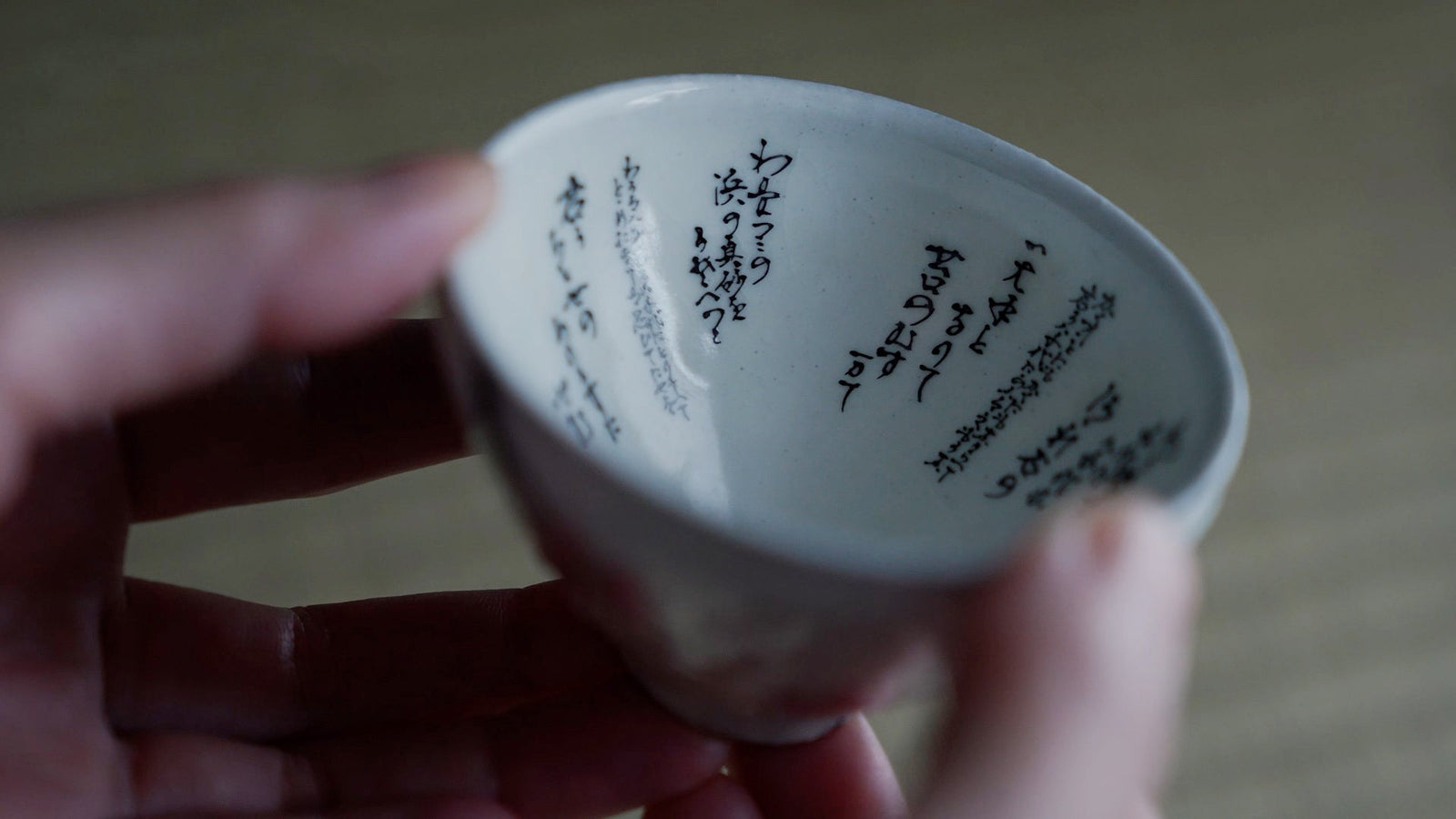
Parmi les nombreux éléments décoratifs présents dans l'artisanat traditionnel japonais, les caractères et l'écriture occupent une place distinctive. Contrairement à la calligraphie, où l'écriture constitue l'œuvre elle-même, les caractères apparaissent ici comme un motif décoratif parmi d'autres — et les exemples sont innombrables. Cette pratique s'observe depuis longtemps dans des domaines tels que la céramique, la laque et les rouleaux suspendus.
Les caractères dans ces œuvres peuvent créer un impact visuel puissant ou, au contraire, exister avec une présence subtile. Dans les deux cas, ils constituent un élément essentiel du « paysage » global d'une œuvre. Au-delà de la beauté de leurs formes, les significations qu'ils portent ajoutent une autre dimension de profondeur. Cet article explore l'univers des caractères dans l'artisanat japonais et la beauté unique qu'ils incarnent.
Nous examinerons ici le rôle de l'écriture selon trois perspectives : prier, réciter et dissimuler. En poursuivant votre lecture, vous découvrirez peut-être les diverses manières dont les caractères enrichissent ces formes traditionnelles.
Prier
En Chine, où la céramique se produit depuis l'Antiquité, l'écriture était traitée comme une décoration à part entière. Sous la dynastie Ming (1368–1644), des caractères de bon augure tels que 福 (fortune) et 寿 (longévité) s'étaient établis comme motifs décoratifs. Ils ne servaient pas de signature ou de note, mais constituaient le motif principal d'une pièce.
Leur attrait reposait sur plus que leur forme. La longue vie et la bonne fortune étaient les vœux vers lesquels convergeaient à la fois le respect confucéen pour l'âge et les espoirs taoïstes d'immortalité.
Les caractères offraient également au potier un espace de travail. 福 seul subsiste sous une centaine de formes variantes ou plus, du fluide au strictement géométrique, de sorte qu'un seul caractère pouvait être redessiné sans jamais épuiser sa signification. Il pouvait remplir le centre d'un plat, commander le corps d'une jarre ou se dresser en grand sur la paroi extérieure d'un récipient.

Arita ware a également adopté la pratique d'inscrire des caractères peu après ses débuts, suivant l'exemple de la porcelaine chinoise. Parmi les caractères de bon augure, 福 et 寿 furent particulièrement largement utilisés. Les styles d'écriture varient considérablement, incorporant des écritures chinoises traditionnelles, des formes simplifiées et des motifs transformés en patterns décoratifs.

Les caractères de bon augure, avec leur richesse de formes d'écriture, servent encore de décoration sur les céramiques produites aujourd'hui. Une forme de lettre chargée d'histoire s'accorde facilement avec des argiles, des glaçures et des motifs qui portent le poids de la tradition ; les deux agissent l'un sur l'autre, et ce qui en résulte est un récipient différent de tout autre.

Cette tasse à thé présente le caractère 福 écrit en tensho (écriture sigillaire). L'une des plus anciennes formes d'écriture chinoise, le tensho est né dans la Chine ancienne et continue d'être utilisé aujourd'hui dans les sceaux et le lettrage décoratif. Ce caractère a été rendu dans de nombreuses variations différentes dans ce style.

Au centre de cette assiette se trouve un caractère 福 stylisé basé sur l'écriture sigillaire. Apparaissant presque comme un symbole ou un motif géométrique, le caractère joue un rôle visuel fort en tant qu'élément de design.
Réciter
Les caractères peuvent également faire partie d'un paysage tout en préservant leur signification originale. Des expressions incorporant des poèmes waka , des vers chinois, des paroles de Noh et des passages littéraires se trouvent dans un large éventail d'artisanats, notamment les rouleaux suspendus, la laque maki-e , la céramique et les textiles. Ces caractères restent lisibles, tout en existant simultanément comme partie de la composition globale. Ils peuvent être lus comme des mots ou simplement appréciés comme formes visuelles.
L'une des origines de cette approche peut être retracée à l'esthétique du chirashi-gaki (écriture dispersée), qui serait apparue vers le milieu du XIe siècle. Le chirashi-gaki est un style de calligraphie uniquement japonais dans lequel des poèmes waka ou des textes sont écrits sur du papier coloré, des bandes de papier ou des lettres, avec des lignes placées à des hauteurs variables pour créer une composition dispersée et fluide. Cette technique apporte rythme et variation à l'œuvre.
Un exemple célèbre est Sunshoan Shikishi, écrit durant la période Heian (794–1185), qui présente un poème célèbre d'Ariwara no Narihira (825–880) en écriture dispersée.

chihayaburu
kami yo mo kikazu
tatsuta gawa
karakurenai ni
mizu kukuru to wa
« jamais entendu même
dans les récits de l'époque
des dieux redoutables —
les eaux du cours d'eau Tatsuta
teintes d'un rouge chinois »
(Traduit par Laurel Rasplica Rodd avec Mary Catherine Henkenius)
La beauté fluide des caractères, associée au mouvement dynamique créé par le placement ascendant et descendant des vers, a rendu cette œuvre hautement valorisée non seulement pour son contenu poétique mais aussi pour la beauté artistique de l'écriture elle-même. La beauté des caractères peut être appréciée à travers de nombreux éléments : l'équilibre entre différentes tailles de lettres, leur arrangement, l'espace blanc environnant et l'individualité de chaque style d'écriture.
Les artisanats incorporant la poésie waka existent depuis l'Antiquité, mais une technique relativement récente est le mohitsu saiji Kutani (microcalligraphie au pinceau Kutani). Elle consiste à écrire de la littérature classique, en particulier des poèmes waka, sur de la porcelaine à l'aide d'un pinceau extrêmement fin. À partir de l'ère Meiji (1868–1912), elle s'est développée dans le sud de la préfecture d'Ishikawa comme une forme d'expression distinctive qui complétait la décoration délicate sur couverte de Kutani ware. Depuis plus d'un siècle, la technique se transmet au sein de la famille Tamura comme un artisanat héréditaire.

Tamura Seito écrit des poèmes waka sur les surfaces courbes de la porcelaine à l'aide d'un pinceau extraordinairement fin. Bien que les caractères soient si petits qu'ils sont presque impossibles à lire, elle cherche à exprimer la beauté unique de l'écriture hiragana — le tracé délicat du pinceau, les traits qui s'estompent et les formes dispersées caractéristiques de l'écriture japonaise. En regardant de près, on perçoit les mots se déplacer entre sens et motif, créant une expression élégante et poétique.
Dissimuler
Comme l'écriture dispersée, une autre forme d'expression écrite aurait pris forme à l'époque Heian : la technique appelée ashide. Ashide désigne un style d'écriture dans lequel les caractères sont magnifiquement conçus et intégrés à l'imagerie, presque comme une peinture. Il s'est développé en ashide-e, où les caractères des poèmes waka se fondaient dans les roseaux, l'eau et les oiseaux, devenant populaires parmi les aristocrates.
Le suzuribako (boîte à écriture) est l'un des objets artisanaux où l'ashide apparaît le plus fréquemment. Comme ces boîtes servaient à composer de la poésie, écrire des lettres et consigner des pensées, incorporer des poèmes célèbres dans leur décor était considéré comme une expression raffinée du goût et de la connaissance culturelle. Pour cette raison, la décoration maki-e utilisant la technique ashide-e est devenue particulièrement populaire.

Sur les rochers, sept caractères — 志, 本, 能, 山, 散, 新, 亭 — sont dispersés en incrustation d'argent. Les dissimuler dans les contours de la pierre, dans des formes assez riches pour passer pour du roc, révèle l'esprit ludique cultivé de l'époque.
Encore aujourd'hui, l'ashide se trouve sur les rouleaux suspendus et ailleurs, où paysage et caractère sont tracés sans frontière entre eux.

Ce qui vit dans les caractères de l'artisanat japonais est un sens distinct de la beauté, où mot et forme se font écho. Regarder de près chacun d'eux, c'est voir chaque œuvre émerger comme une histoire, inscrite avec les pensées et les sensibilités esthétiques de ceux qui l'ont faite et chérie.
Références
Kyushu Ceramic Museum. « What Do the Marks on the Bottom Mean? Themed Exhibition: Inside Story of Dishes. » PDF. Consulté le 23 juillet 2026.
Digital Archive Project. « Lesson 7: The Beauty of Chirashi-gaki and Decorated Paper (Ryoshi). » PDF. Consulté le 23 juillet 2026.
Rodd, Laurel Rasplica, trad., avec Mary Catherine Henkenius, trad. Kokinshū: A Collection of Poems Ancient and Modern. Boston : Cheng & Tsui Company, 1996. Publié pour la première fois en 1984 par Princeton University Press.
Kyoto National Museum. « Shioyama Maki-e Suzuribako (Writing Box with Plovers at Shioyama). » PDF. Consulté le 23 juillet 2026.
Stay close to the craft
Now and then, a quiet letter — new stories, seasonal notes, and the hands behind the work.
L'art de Kitaoji Rosanjin : la beauté de la cuisine
Rosanjin a uni la céramique, la calligraphie et la cuisine en une seule vision…
Iwata Mana
La beauté durable de la porcelaine fine d'Imari
Découvrez les origines et les traditions de la porcelaine Imari, du Kakiemon au Nabeshima,…
Retournez-le : lire un objet depuis le dessous
Découvrez ce que révèle le dessous d'un récipient : argile nue, anneau de pied,…
Leave a comment