

Tras Bambalinas en un Taller de Raku Ware
Explore la gracia de la cerámica Raku, nacida del fuego para la ceremonia del té, su historia, filosofía y artesanía viva en Kioto.
La cerámica Raku, un tipo de alfarería que surgió a finales del período Momoyama (1573–1603 d.C.), se utiliza en las ceremonias del té como recipiente para saborear matcha. Elaborada por Chojiro (1516–1592 d.C.), inicialmente fabricante de tejas, esta cerámica distintiva fue concebida específicamente para crear cuencos de matcha para el maestro del té Sen no Rikyu (1522–1591 d.C.) para encarnar la esencia del wabicha, un estilo de ceremonia del té japonesa que enfatiza la simplicidad.

La ceremonia del té ocupa un lugar importante en la cultura japonesa. El anfitrión y los invitados preparan y participan en una ceremonia del té para facilitar una conexión de corazón a corazón. Un paso esencial, la purificación, tiene lugar dentro del cuenco de té. Aunque se utilizan muchas herramientas, el cuenco de té es único por su contacto directo con los labios.

Al comienzo de la primavera, el equipo Musubi llegó a Kioto, un lugar profundamente arraigado en el terreno fértil de la cultura tradicional japonesa, que nutre diversos oficios fascinantes. Tuvimos la fortuna de entrevistar a Kawasaki Motoo, el octavo jefe generacional de Raku Studio Waraku, quien compartió con nosotros las complejidades del proceso de producción y la artesanía de la cerámica Raku, junto con sus reflexiones personales sobre su atractivo.
El encuentro con la cerámica Raku

Kawasaki nació en Kioto, y podría decirse que su encuentro con la cerámica Raku comenzó desde el nacimiento. Criado en una familia tradicional de alfarería, pasó su infancia observando a su padre elaborar cerámicas, pero inicialmente no vio este camino como su carrera y búsqueda de por vida. Al ingresar al mundo laboral, eligió emplearse en Tokio, manejando negocios internacionales.
A los 30 años, después de un proceso difícil de toma de decisiones, decidió regresar a Kioto para asumir el legado familiar, dedicándose al oficio en el que sus ancestros habían volcado sus corazones. Fue en este momento cuando se puede decir que Kawasaki se encontró con la cerámica Raku una vez más.
Único e irrepetible

Durante la entrevista, Kawasaki amablemente nos mostró su taller y proporcionó una explicación apasionada y detallada del proceso de nacimiento de la cerámica Raku. Saliendo por la puerta trasera de la tienda, que exhibe varios productos, y atravesando un camino estrecho, llegamos a su taller.
Como la esencia de la cerámica Raku no reside en patrones o decoraciones complejas sino en la artesanía de su forma y esmalte, los cuencos de té se moldean meticulosamente a mano, reflejando un espíritu fuerte y calidez. Es precisamente por esta característica que cada uno es único, poseyendo su propia singularidad.

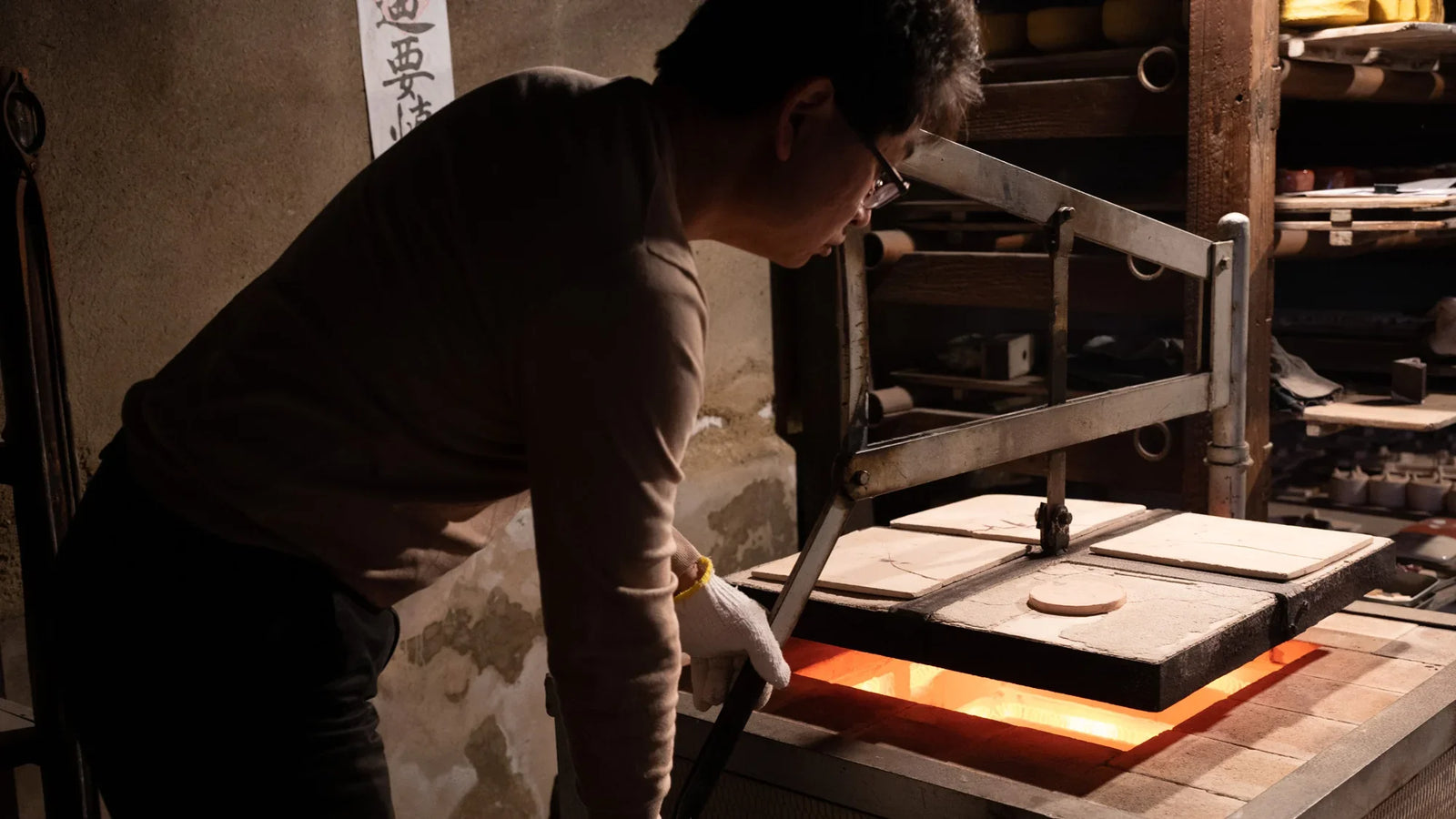
También tuvimos la fortuna de presenciar la apariencia de la cerámica Raku justo cuando emergía del horno.
Kawasaki mencionó que la etapa más desafiante del proceso es la cocción de los cuencos de té Raku negros. Incluso cuando la fórmula del esmalte se calcula y aplica cuidadosamente, es imposible controlar completamente las condiciones dentro del horno, como los niveles de oxígeno y la circulación del aire. Como resultado, la forma en que el esmalte se funde y los colores emergen varía con cada cocción.
"Esa imprevisibilidad es lo que lo hace difícil", explica, "pero también es lo que lo hace fascinante".
El cuerpo de arcilla del cuenco y el esmalte se expanden y contraen a ritmos diferentes. Después de que la pieza se retira del horno y se enfría rápidamente, el esmalte se contrae más que la arcilla debajo de él. Esta diferencia en la contracción crea patrones de grietas finas en la superficie, conocidos como kannyu.
Cuando Kawasaki abre la tapa del horno y levanta la vasija con pinzas metálicas, la temperatura aún ronda los 800°C (1472°F). Momentos después, un cuenco de té recién cocido comienza a emitir un sonido tenue, similar a una campana, muy parecido a un carillón de viento, mientras grietas delicadas se trazan gradualmente a través del esmalte.

Kawasaki mencionó que la técnica de hacer cuencos de té no es excesivamente compleja. Para el creador, cultivar la sensibilidad y una apreciación más profunda del espíritu encarnado dentro es mucho más importante. Para mejorar su oficio, Kawasaki también estudió contenido relacionado con la escuela de té Urasenke.
Ichigo ichie, que significa "un encuentro único en la vida", es un concepto significativo en la ceremonia del té. Expresa la idea de que cada reunión debe abordarse como un momento singular e irrepetible, en el que tanto el anfitrión como el invitado se dedican el uno al otro con sinceridad. Como cada cuenco de té es único, el proceso de hacer cada uno puede verse como la encarnación del espíritu de ichigo ichie.
Abrazar la imperfección: el encanto de la cerámica Raku

Bañada en luz solar, la cerámica Raku irradia un brillo lustroso y cálido en su totalidad, su apariencia simple pero elegante armoniza perfectamente con las características aparentemente sencillas pero profundamente culturales de la ceremonia del té. En general, posee una textura y sofisticación inmensamente atractivas.
En la visión de Kawasaki, el encanto de la cerámica Raku no solo se deriva de su apariencia externa, sino también de una tolerancia intrínseca y aceptación de las cosas tal como son.
Kawasaki cree que la cerámica Raku es un tipo de alfarería que permite el fracaso. Para decirlo de manera más dramática, incluso si hay algunas imperfecciones, si la pieza posee un encanto que supera sus defectos, entonces alguien la apreciará. A pesar de cualquier imperfección menor, desea continuar elaborando objetos que irradien una belleza que trascienda sus defectos.
Sostener un cuenco de té Raku no es simplemente sostener un objeto, sino entrar en una relación. Nos recuerda que la belleza no emerge solo del control, ni de la perfección cuidadosamente diseñada, sino de una apertura a la incertidumbre. Cada cuenco lleva la memoria de su creación, así como cada reunión de té existe solo una vez, moldeada por quienes la comparten.
En un mundo que a menudo valora la uniformidad y la eficiencia, la cerámica Raku ofrece una medida diferente de valor. Nos enseña a aceptar la irregularidad, a encontrar significado en la moderación y a reconocer que lo que perdura no es la perfección, sino la sinceridad.
Stay close to the craft
Now and then, a quiet letter — new stories, seasonal notes, and the hands behind the work.
El Secreto Detrás de la Belleza de la Espada Japonesa
Jóvenes herreros de espadas en Kioto reviven la fabricación japonesa de katanas. Descubre su…
Ito Ryo
Horno Tosen: Patrimonio cerámico y futuro de Kioto
Adéntrese en el histórico mundo del arte cerámico de Kioto con el prestigioso horno…
Explorando la cultura cerámica artística de Kioto
Haga un viaje a Kioto con el equipo Musubi y explore los reconocidos artesanos…
Zhao Minyi
Leave a comment