

El ingenio del Ukiyo-e: humor y acertijos del periodo Edo
Conozca el lado cómico del ukiyo-e: animales vestidos, rostros estirados y acertijos visuales que los espectadores de Edo disfrutaban resolver.
A beauty in an elaborate kimono, a kabuki actor striking a dramatic pose, Mount Fuji rising in the distance—these are some of the images that have come to define ukiyo-e.
Ukiyo-e was closely tied to the world of its time. Its artists observed it with an acute eye, but they also turned that same attention toward the peculiarities of everyday life. At times, the result was witty, satirical, or deliberately absurd. Some works were made to raise a laugh; others presented visual riddles meant to be solved.
This is another face of ukiyo-e.
The Art of Wit in Edo
Ukiyo-e is often introduced through several established subjects. Pictures of beauties are known as bijin-ga, portraits of kabuki actors as yakusha-e, and views of celebrated locations as meisho-e. Humor is rarely listed among them. Yet it appeared in many forms. Animals took on human roles, familiar actors were exaggerated, and pictures concealed words and place names through combinations of visual clues.

Many of these jokes depended on recognition. Viewers might need to know a street seller’s call, recognize a kabuki actor or role, or connect the sounds of pictured objects with the name of an Edo neighborhood before the joke became clear.
In the latter part of the Edo period (1603–1868 CE), humor could also provide an indirect outlet for criticism of the shogunate. During the Tenpo Reforms of the early 1840s, restrictions on ukiyo-e curtailed subjects such as portraits of kabuki actors. Artists sometimes responded by disguising recognizable people and current affairs as animals, historical figures, or fantastic scenes. Not every comic print was political, but humor offered one way to express dissatisfaction that could not be stated openly.
Comic Pictures: Transforming the Familiar
Humorous and playful pictures, known as giga, were an important part of ukiyo-e. Among the artists who excelled at them was Utagawa Kuniyoshi (1797–1861), whose imaginative prints transformed cats, fish, birds, and other animals into figures drawn from human life.
His series Goldfish places aquatic creatures in scenes modeled on the summer customs and entertainments of Edo. The series comprises nine known designs in which goldfish and other small aquatic creatures are personified in humorous scenes.

Here, a goldfish becomes a street seller surrounded by a curious gathering of turtles, tadpoles, and other fish. Soap-bubble sellers walked the streets of Edo selling bubble liquid to children, blowing bubbles to attract customers as they called “Tama-ya, tama-ya,” roughly “bubbles, bubbles.” The work is not simply a fantasy about fish: it is a recognizable summer street scene transferred underwater.
Humorous personification could also conceal commentary on current events. In the triptych The Great Battle of the Vegetables and the Fish by Utagawa Hirokage (dates unknown), seafood and vegetables take up arms against one another.

The print followed the nationwide cholera epidemic of 1858. At the time, fish were thought to increase the risk of infection, while vegetables were considered safer and their prices rose. Hirokage turns these opposing ideas about food into a literal battle. Some also read the fighting as a reference to power struggles within the shogunate.
The humor may therefore have operated on more than one level. The armies of fish and vegetables created an absurd spectacle, but viewers familiar with the epidemic, and perhaps the political situation, could recognize the conflict concealed within it.
Kuniyoshi transforms everyday activities into an underwater world, while Hirokage turns anxieties into a fantastic battle. The joke becomes richer when the viewer recognizes the real world behind it.
The Other Hokusai: Humor in Human Movement
Comic invention did not always require turning one thing into another. Sometimes it began with watching how people moved.
Katsushika Hokusai (1760–1849) is now inseparable from Under the Wave off Kanagawa, commonly known as The Great Wave. Open Hokusai Manga, however, and a very different world appears.

First published in 1814 and eventually extending to fifteen volumes, Hokusai Manga gathers people, animals, landscapes, buildings, supernatural beings, tools, faces, gestures, and bodies in motion. It was conceived as an illustrated manual for students, but its contents extend far beyond straightforward models for drawing. The title’s “manga” is said to refer to pictures drawn freely or spontaneously rather than “manga” in its modern sense.
Some people pull distorted expressions. Others bend, strain, lose their balance, or twist themselves into implausible positions.

Hokusai often approached his subjects playfully. In the third volume, he depicts an Edo-period dance known as the Sparrow Dance. The dancer appears repeatedly in successive poses, almost like a visual guide. Seen in succession, the figure almost turns into a comic animation, hopping and twisting across the page.

Here, Hokusai shows people pulling and manipulating their faces into exaggerated expressions. The sketches demonstrate his use of deformation: rather than reproducing the human face exactly as it appears, he stretches its features while keeping the expressions instantly recognizable. The result turns familiar human gestures into comedy. Simple yet instantly funny.
Pictorial Riddles: Completing the Image
Other pictures required the viewer to do more than recognize something funny. They had to find the answer.
Known as hanji-e, these pictorial riddles invited viewers to decipher words from images. An object could represent the sound of its name, while changes in placement, orientation, or written characters altered the answer. The form was not merely decorative: it was an Edo-period guessing game designed to be solved. As literacy spread among commoners during this time, such riddles also found a place within the flourishing culture of popular print.
Their subjects ranged from everyday objects and familiar expressions to actors, songs, and place names. Because the puzzles drew on the language, customs, and popular culture of their time, some answers that were immediately accessible to Edo viewers now require explanation.

In 1858, Utagawa Shigenobu (1826–1869) created Visual Riddles of Famous Places in Edo. Instead of presenting celebrated locations as landscapes, the print fills the page with small, seemingly unrelated pictorial clues. Each one conceals the name of a place in Edo.
Take the tongue and arrow. It is one of the easier riddles to solve. The Japanese word for tongue is shita. An arrow is ya.
Shita + ya = Shitaya.
The answer is a district in what is now Taito Ward in Tokyo. Both identifying the objects and reading their Japanese names are necessary; looking at the picture is only the beginning.
Other riddles play with numbers as well as objects. Four green onions, for example, combine negi (green onion) with shi (four) to reveal Negishi, a neighborhood also in present-day Taito Ward.
The puzzle cannot be completed by the artist alone. The artist arranges the clues, but the viewer must identify them, sound them out, and make the final connection. The moment of recognition, when two unrelated pictures suddenly become a known name, is the source of the pleasure.
What Made Someone in Edo Smile?

Together, these works reveal another side of ukiyo-e, shaped by humor, wordplay, and visual play. They also offer a glimpse into the popular culture of Edo, where shared language, familiar characters, and everyday experiences could become material for a joke. Understanding the clues brings us a little closer to the people who once laughed at them.
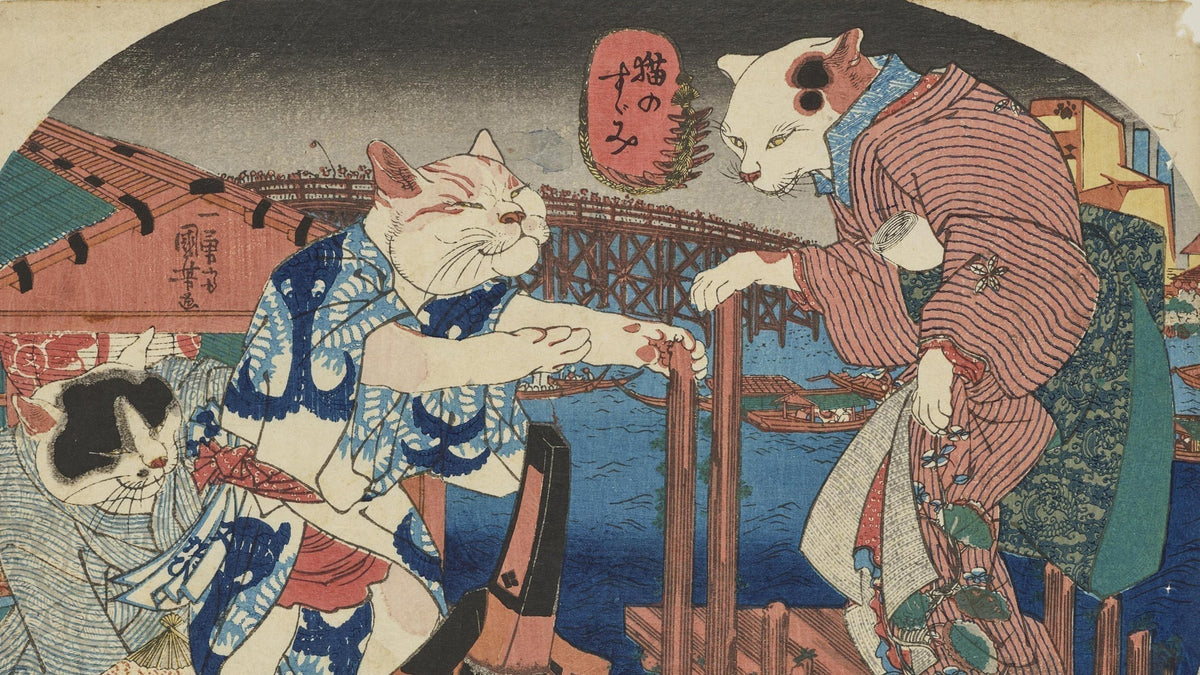
Main visual image credit: Utagawa Kuniyoshi, Cats Enjoying the Evening Cool, Edo period, 19th century. Woodblock print (nishiki-e). Tokyo National Museum. Source: ColBase.
Stay close to the craft
Now and then, a quiet letter — new stories, seasonal notes, and the hands behind the work.
¿Qué es el ukiyo-e? Una mirada al arte icónico de la xilografía japonesa
Explore la belleza del ukiyo-e, desde la historia del arte de la era Edo…
Un Bocado del Pasado: Saborea la Riqueza de la Era Edo de Japón
Explora los sabores del Japón del período Edo a través del sushi, soba y…
La perdurable belleza de la fina porcelana Imari
Descubra los orígenes y tradiciones de la porcelana Imari, desde Kakiemon hasta Nabeshima, y…
Leave a comment