

Dele la vuelta: Leer una pieza desde su base
Descubra lo que revela la base de una vasija: arcilla desnuda, anillo de apoyo, marcas del horno y sello del artesano.
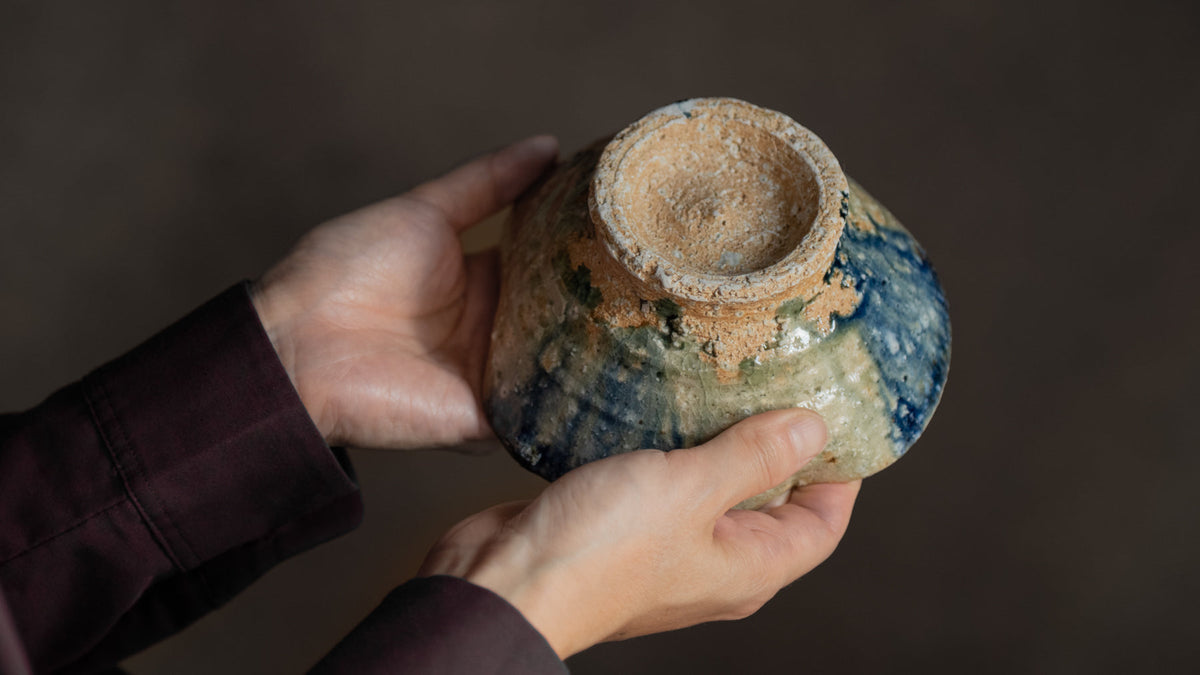
Solemos mirar solo la superficie de una vasija: el borde que toca nuestros labios, el esmalte que atrapa la luz, el diseño pintado con delicadeza. Nuestra mirada se detiene ahí. Sin embargo, cada vasija tiene otro lado.
Boca abajo sobre una mesa, guardada al fondo de un estante, la parte inferior pasa su vida sin ser vista. Aquí es donde el alfarero dejó la arcilla desnuda, presionó herramientas sobre la superficie, aceptó las marcas del fuego y, a veces, incluso talló un nombre. Sin embargo, este lado oculto suele revelar más que el frente sobre dónde se hizo una pieza, cuándo se hizo y por qué mano.
Voltee una vasija y la verá de manera diferente. Aquí trazamos el acto de "mirar la parte inferior" a través de cuatro indicios. Al terminar de leer, quizá se encuentre volteando la vasija que tenga más cerca.
Tsuchimise: Donde se encuentra la arcilla misma

La mayoría de las vasijas esmaltadas dejan alguna parte de la base sin esmaltar. Dado que el esmalte se funde en vidrio durante la cocción, una base completamente esmaltada se fusionaría con la repisa del horno. Por eso el alfarero limpia o recorta el esmalte de la base antes de que la pieza entre al fuego.
Sin embargo, el término tsuchimise—literalmente "mostrar la arcilla"—se refiere a más que este parche necesario de desnudez. Nombra la elección deliberada de dejar la arcilla expuesta como punto de belleza: no arcilla que resulta estar desnuda, sino arcilla que el alfarero eligió revelar.
Esta intención es más fácil de ver en la cerámica Raku, la tradición de Kioto que data del período Momoyama (1573–1603 d.C.). El fundador, Chojiro, cubría sus cuencos de té completamente con esmalte, un estilo llamado soyu, o "esmalte completo". Su sucesor, Jokei, influenciado por el gusto Oribe, se convirtió en el primer alfarero Raku en dejar la arcilla expuesta. Para la tercera generación, Donyu alternaba entre esmalte completo y arcilla expuesta, cuenco por cuenco. Ocultar la arcilla o revelarla no era una limitación técnica sino una elección estética.
Mostrar la arcilla cumple otro propósito. Al dejar parte del cuerpo sin esmaltar, el contraste se agudiza entre el brillo vítreo del esmalte y el grano seco de la tierra desnuda. Brillo y mate, color y arcilla, luz y sombra. Colocados lado a lado, el esmalte se ve más profundo y la arcilla más vívida. Tsuchimise es una especie de espacio negativo que intensifica el diálogo entre superficie y cuerpo.

En la cerámica Shino , el pie sin esmaltar ha sido apreciado durante mucho tiempo como un punto para admirar, un lugar para saborear la belleza de la arcilla misma. Arriba, un esmalte suave rosa-blanco; abajo, un marrón pálido del color de la tierra naranja. Un solo cuenco contiene tanto su esmalte como la arcilla que le dio origen, cada uno haciendo al otro más vívido.
Kodai: Donde permanecen la mano y las herramientas

En el centro de la arcilla expuesta se encuentra un pequeño anillo que sostiene la vasija. Este es el anillo del pie—kodai.
Los anillos del pie se hacen de dos maneras principales. En la primera, el alfarero torna la forma en el torno, luego talla el pie de la base en estado de cuero con una herramienta de recorte. En la segunda, un anillo moldeado por separado se adhiere a la parte inferior. Al tallar, los alfareros suelen ahuecar el interior del anillo. Si moldear el cuerpo superior es un proceso de construcción, el pie es un proceso de tallado. Por eso las marcas de la cuchilla—el ritmo del recorte—sobreviven aquí con más viveza que en cualquier otro lugar.
Y aquí reside el corazón de mirar la parte inferior. Precisamente porque el pie está oculto, preserva los hábitos del alfarero: el país, la época, el horno, la mano particular de un alfarero individual. Por esta razón, el pie ha sido considerado durante mucho tiempo uno de los indicios más confiables para autenticar una pieza e identificar dónde se hizo.
Para el período Momoyama (1573–1603 d.C.), los alfareros dedicaban cuidado especial a esta área oculta, y la práctica de voltear vasijas para apreciar el pie se arraigó como una costumbre reconocida. Mirar la parte inferior es una forma de ver que ha sido parte de la cultura cerámica japonesa durante siglos.
Los pies toman muchas formas. Un anillo simple se llama wa-kodai. Un anillo escalonado que se asemeja a un nudo de bambú es takefushi-kodai. Un pie con un anillo de esmalte limpiado en su interior es janome-kodai, o "pie de ojo de serpiente". Un anillo con muescas cortadas en él es wari-kodai, o "pie dividido".
Cada forma lleva la intención y el estilo de su creador, y la manera en que se talla un pie cambia cómo se asienta una vasija y cómo se sostiene.

Una taza choko de soba del horno Baizan de cerámica Tobe, con un anillo de pie janome (ojo de serpiente). El esmalte se deja solo en la porción interior más recesada del anillo del pie, y un meiin (sello del creador) que dice "bai" (梅, ciruela)—descrito más adelante—está estampado allí también. Esto muestra que incluso un artículo cotidiano como un choko de soba lleva una atención meticulosa al detalle hasta en las características más pequeñas.

El pie de este kobachi de cerámica Iga es lo que los alfareros llaman un tokin-kodai. Mire con atención y un pequeño pico se eleva en el centro del anillo del pie, moldeado, como sugiere el nombre, como el tocado puntiagudo conocido como tokin.
Meato: Marcas dejadas por el fuego y el tiempo

Dentro del anillo del pie o en la base interior, a veces se encuentran pequeños puntos dispuestos en círculo, a menudo de tres a cinco. Estos son meato, o marcas de espuela: las cicatrices dejadas por la cocción.
Provienen de una práctica llamada apilamiento. Para aprovechar al máximo el espacio limitado del horno, los alfareros colocan vasijas una encima de otra, separadas por pequeños soportes. Donde un soporte tocaba el esmalte, el esmalte no podía fundirse y quedaba un punto desnudo, un punto. Estos soportes tomaban varias formas, como pequeñas bolitas de arcilla, granos de arena o espuelas de arcilla refractaria.
Estas marcas no son exclusivas de Japón. La técnica de apilamiento para una cocción eficiente se compartió en toda Asia Oriental. Las mismas cicatrices aparecen en las bases de cerámica qingbai—una porcelana pálida de tono blanco azulado— de los hornos de Jingdezhen de la dinastía Song del Norte (960–1127 d.C.), en piezas de la península coreana, y en cerámicas producidas en grandes cantidades en hornos vietnamitas y tailandeses que se transportaban por mar. Los pequeños puntos en la base reflejan técnicas de cocción compartidas en toda Asia Oriental, cuyas cerámicas también circulaban ampliamente a través del comercio marítimo.
Dado que la disposición y el material de los soportes variaban según el horno y el período, las marcas de espuelas ayudan a identificar qué linaje de hornos produjo una pieza y cuándo fue cocida. Estos pequeños puntos son, en efecto, las huellas dactilares de la vasija, que registran cómo atravesó el fuego.
A primera vista, las marcas pueden parecer defectos—astillas en el esmalte. Sin embargo, algunos alfareros las dejan deliberadamente como parte del paisaje de la vasija. A diferencia de la uniformidad de los productos industriales, estas son huellas del fuego y del tiempo.

Meikan: La marca del creador

En el lugar más oculto de todos—el fondo mismo, que rara vez ve alguien—un creador a veces deja una marca.
Un sello, un trazo de pincel, una incisión hecha con una espátula de madera: cuando un alfarero registra el nombre del artesano, del horno o de un mecenas en la base, la marca—o el acto mismo—se llama meikan, una marca del creador. Una versión estampada se llama meiin. En las bases de la cerámica Imari, por ejemplo, a menudo se encuentra un carácter cuadrado para fuku (福, fortuna), conocido como kaku-fuku; una versión en espiral llamada uzu-fuku; frases auspiciosas; o incluso marcas de reinado como "Hecho en la gran era Chenghua de Ming" (1465–1487 d.C.)—inscritas en homenaje a célebres hornos chinos más que para fechar la pieza. Estas pequeñas marcas en el fondo registran dónde deseaba pertenecer su creador.

Esta práctica no se limita a las antigüedades. Los hornos y alfareros todavía estampan y firman su trabajo en la parte inferior hoy: un pequeño sello con el nombre del horno, un sello que certifica el lugar de origen, una marca presionada a mano pieza por pieza. En el mismo lugar donde los artesanos de Imari una vez tallaron el carácter de bendición, los artesanos contemporáneos dejan sus propias marcas. Voltee una pieza que acaba de tomar, y es muy probable que encuentre una—una pequeña inscripción que le dice a qué linaje pertenece la vasija.
La mayoría de los compradores nunca la notan. Incluso en el uso diario, la marca rara vez entra en vista. Aun así, el artesano la inscribe, dejando prueba de que la mano llegó hasta el final, en un lugar que saben que rara vez será visto. Cuando voltea una vasija y encuentra esa marca, la mano del creador surge a la vista del otro lado.

El Plato Cuadrado para Salsa con Borde de Pincel Azul, de Shiga, es obra de Omi Shimoda Toubou—el único horno que aún lleva la cerámica Omi Shimoda al presente. En su parte inferior, una textura de tela tejida llamada nunome, dejada por la tela durante el formado, se extiende por la base, y presionada sobre ella hay una marca del creador con el nombre del horno. Junto con esa base marcada por la tela, la pequeña marca habla en voz baja de un plato como ningún otro.
El mundo que se abre desde la parte inferior
Arcilla, mano, fuego, nombre. Capas de huellas que nunca aparecen en la superficie permanecen en la parte inferior—la arcilla de la que fue hecha, la mano que la talló, el horno cuya llama atravesó, el creador que le dio forma. Saber lo que yace debajo añade una dimensión al mundo de las vasijas; la misma pieza comienza a aparecer como un objeto con historia.
La próxima vez que tome una vasija, voltéela con cuidado. Sienta el anillo de arcilla bajo sus dedos, el ritmo del torneado, el círculo de puntos, la pequeña inscripción. Este es un gesto que los conocedores han practicado durante siglos. La parte inferior no es el final de una vasija—es otra entrada.
Referencias: Yabe, Yoshiaki, ed. Kadokawa Nihon Toji Daijiten [Enciclopedia Kadokawa de Cerámica Japonesa]. Tokio: Kadokawa Shoten, 2002.
Stay close to the craft
Now and then, a quiet letter — new stories, seasonal notes, and the hands behind the work.
Una introducción a los esmaltes cerámicos japoneses
Explore la historia, variedades y belleza de los esmaltes cerámicos japoneses y cómo transforman…
Ito Ryo
El arte de Kitaoji Rosanjin: la belleza de la cocina
Rosanjin unió la cerámica, la caligrafía y la cocina en una sola visión de…
Iwata Mana
La estética del carácter escrito en las artesanías japonesas
Desde el auspicioso 福 hasta la poesía oculta ashide, explore cómo los caracteres se…
Leave a comment