

Die vielen Ursprünge des Rot in japanischer Keramik
Entdecken Sie die vielfältigen Ursprünge des Rot in der japanischen Keramik – von fein gemaltem akae und eisenhaltigem Ton bis zu hidasuki-Brandspuren und shinsha-Glasur.
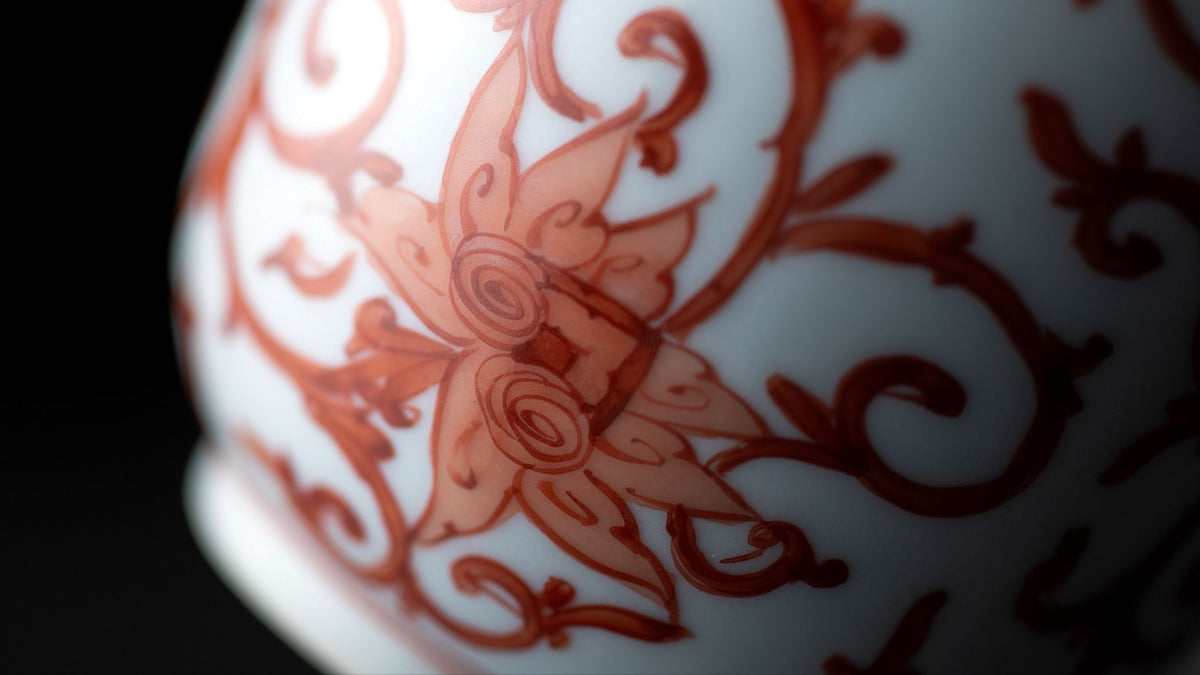
Japanische Keramik zeigt Rot auf bemerkenswert unterschiedliche Weise. Ein Gefäß trägt feine gemalte Linien. Ein anderes den warmen, erdigen Ton des Tons selbst.
Unter den vielen Farben japanischer Keramik bietet Rot eine besonders faszinierende Möglichkeit, die Vielfalt des Handwerks zu würdigen. Kaum eine andere Farbe kann durch eine so große Bandbreite an Materialien, Techniken und Brennverfahren entstehen und dabei so bemerkenswert unterschiedliche Charaktere hervorbringen.
Dieser Artikel untersucht die vielen Wege, auf denen Rot entsteht – von Pigmenten, die mit dem Pinsel aufgetragen werden, bis zu Farben, die in Ton, Glasur und Feuer geboren werden.
Rot in feinen Details
Manche Rottöne belohnen einen näheren Blick.
Aus der Ferne fesselt ein akae -Gefäß mit seiner brillanten Aufglasurmalerei. Tritt man näher, beginnt sich das Dekor in feine Pinselstriche aufzulösen. Winzige Kreise, Federn und geometrische Motive treten nacheinander hervor, jedes bewahrt die Bewegung des Pinsels.

Ein verbreitetes rotes Pigment in der Aufglasurmalerei ist bengara, das hauptsächlich aus Eisenoxid besteht. Für feine Pinselarbeit ist wiederholtes Mahlen erforderlich. Die Pigmentmischung muss auch an Temperatur und Luftfeuchtigkeit angepasst werden, da das Trocknen ihre Konsistenz verändern und es schwierig machen kann, gleichmäßige Linien zu erhalten.

Anders als viele andere Aufglasurfarben entwickelt bengara-Rot nach dem Brennen nicht dieselbe glasartige Oberfläche. Es kann in dünner Schicht ein kräftiges, deckendes Rot erzeugen und eignet sich daher besonders für feine Linienführung. Bei akae-saibyobilden rote Linien, kaum dicker als ein Haar, Strich für Strich ineinandergreifende Kreise, Blütenranken und glückverheißende Motive. Einzeln sind sie kaum wahrnehmbar. Zusammen erzeugen sie Muster von überraschender Leichtigkeit.


Die Helligkeit und Dunkelheit des Rots variiert mit dem Grad der Verfeinerung – kleinere bengara-Partikel neigen dazu, ein lebendigeres Rot zu erzeugen, größere Partikel einen dunkleren Ton.

Bei Zoho Kiln in der Präfektur Gifu beginnt die Vorbereitung des Rots lange bevor es den Pinsel erreicht. Die Werkstatt verwendet ein seltenes bengara-Pigment, das nicht mehr hergestellt wird, und mischt und mahlt es etwa eintausend Tage lang, bevor es für die akae -Malerei bereit ist. Sobald das Gefäß in den Händen seines Besitzers ist, reift das Rot weiter und gewinnt mit der Zeit und dem Gebrauch an Tiefe.


Rot aus dem Ton
Nicht jedes Rot wird auf ein fertiges Gefäß gepinselt.
Anstatt auf die Oberfläche aufgetragen zu werden, beginnen manche Rottöne mit dem Material selbst: Der Ton enthält bereits das Potenzial für Farbe, und das Brennen erweckt sie zum Leben.

Rote Raku- matcha-Schalen bieten ein besonders eindrucksvolles Beispiel. Im späten sechzehnten Jahrhundert in Kyoto geschaffen, um dem Geschmack von Sen no Rikyuzu entsprechen, wurden diese Schalen vollständig von Hand geformt, ohne Töpferscheibe. Das warme Rot kann vom Eisen im Tonkörper stammen, sichtbar unter einer transparenten oder transluzenten Glasur. Ein eisenreicher keshodo (dekorativer Schlicker) kann auch vor dem Glasieren aufgetragen werden, um ein helleres Rot zu erzeugen.


Tokonames shudei erreicht Rot auf einem anderen Weg. Aus dem eisenreichen Ton der Chita-Halbinsel gefertigt, bleiben diese Keramiken unglasiert, sodass der gebrannte Ton selbst zur fertigen Oberfläche wird.

Über Generationen verfeinerten Handwerker ihre Brenntechniken, um den charakteristischen zinnoberroten Farbton hervorzubringen und Teekannen mit weicher Textur und warmem, erdigem Erscheinungsbild zu schaffen. Mit jahrelangem Gebrauch entwickelt die unglasierte Oberfläche allmählich größere Tiefe und Glanz.


Rot, geboren aus Feuer
Manche Rottöne können nicht im Voraus vorbereitet werden.
Sie werden weder auf das Gefäß gepinselt noch in einer Glasur entwickelt. Stattdessen entstehen sie erst während des Brennens, geformt durch die Bedingungen im Inneren des Ofens.
Bei Bizen warewird die durch das Brennen erzeugte rötliche Färbung als hiiro (Feuerfarbe) bezeichnet. Ein besonders charakteristischer Roteffekt ist hidasuki, die scharlachroten Markierungen, die entstehen, wo Reisstroh während des Brennens mit dem eisenreichen Bizen-Ton in Kontakt kommt. Traditionell wurde Reisstroh zwischen gestapelte Gefäße gelegt, um zu verhindern, dass sie verschmelzen. Wo das Stroh den Ton berührte, erschienen leuchtend scharlachrote Markierungen.

Der Ursprung dieses Scharlachrots war lange ein Rätsel. Reisstroh selbst enthält kein rotes Pigment. Stattdessen reagiert Kalium aus dem Stroh mit dem eisenreichen Bizen-Ton. Während der Ofen abkühlt, bildet Eisen im Ton Hämatit – dasselbe Eisenoxid, das die Grundlage von bengara bildet. Hier wird nie ein Pigment aufgetragen. Der Ofen erzeugt das Rot selbst.


Jeder Brand kann ein anderes Ergebnis hinterlassen. Die Platzierung des Strohs, die Position des Gefäßes und die Bedingungen im Ofen beeinflussen alle das endgültige Muster. Anstelle von handaufgetragener Dekoration bewahrt hidasuki die Aufzeichnung eines einzelnen Brandes, der nie wiederholt werden kann.
Rot in der Glasur
Manche Rottöne scheinen von innen zu leuchten.
Shinsha -Glasur gilt als eines der schwieriger zu erzielenden keramischen Rottöne. Ihre Farbe hängt davon ab, dass mehrere Bedingungen zusammenkommen: die Zusammensetzung und Dicke der Glasur, der Tonkörper darunter und die Bedingungen des Brennens.

Bei manchen Stücken kann am Rand, wo die Glasur dünner ist, eine weißliche Farbe erscheinen. Dieser Kontrast zwischen den hellen Rändern und dem tieferen Rot des Körpers ist Teil des charakteristischen Erscheinungsbilds der Glasur und kann auch helfen, sie von Rottönen zu unterscheiden, die mit eisenbasierten Farbstoffen erzeugt werden.

Der Name der Glasur stammt von ihrer Ähnlichkeit mit shinsha (Zinnober), dem roten Mineral, das historisch als Pigment verwendet wurde. Trotzdem wird sie nicht aus Zinnober selbst hergestellt. Das Rot der Glasur wird stattdessen durch Kupferverbindungen mittels sorgfältig kontrolliertem Brennen erzeugt.
Rot in der Keramik ist niemals einfach eine Farbe. Eine scharlachrote Markierung, die von Reisstroh hinterlassen wurde, das erdige Rot einer Teekanne – jede bewahrt eine Aufzeichnung davon, wie das Gefäß hergestellt wurde und welche besonderen Bedingungen es seinem Rot erlaubten zu erscheinen. Hinter jedem Farbton liegt ein Moment, in dem Material, menschliche Hände und Feuer zusammenkamen, um nie wieder auf genau dieselbe Weise wiederholt zu werden.
Referenzen: Takada, Jun, und Hiroshi Asaoka. „Taking on the Red of Pigments: Developing a New Red Pigment Inspired by Bengara." Chemistry Today, Oktober 2005. PDF / Toguri Museum of Art. „No. 3: On Copper Red and Red Overglaze Enamels." Curator's Corner, Juni 2017. PDF / Kusano, Yoshihiro. „Bizen-yaki 'Hidasuki' Moyo" [Bizen-Ware „Hidasuki"-Muster]. Okayama University of Science. Research Topics. https://www.dac.ous.ac.jp/kusano/Research.html#p2
Stay close to the craft
Now and then, a quiet letter — new stories, seasonal notes, and the hands behind the work.
Fukushima Reiko: Den Charme von Akae-Saibyo mit modernem Empfinden vermitteln
Lernen Sie die Kutani-Keramikkünstlerin Fukushima Reiko kennen, die moderne Stile mit traditionellen roten Akae-Saibyo-Maltechniken…
Die Welt der Raku-Keramik: Form, Feuer und Wabi
Entdecken Sie Raku-Keramik, die von Hand und durch Feuer geformt wird. Erforschen Sie ihre…
Iwata Mana
Die beständige Schönheit feinen Imari-Porzellans
Entdecken Sie die Ursprünge und Traditionen der Imari-Porzellankunst – von Kakiemon bis Nabeshima-Ware –…
Leave a comment