

So Different! The Food Cultures of Eastern & Western Japan
Explore the distinct food cultures of eastern and western Japan, shaped by history, climate, and local tastes.
The Japanese archipelago consists of six climates, eight regions, forty-seven prefectures, and 14,000 islands—but when it comes to food culture, it can be broadly divided in two: the culinary style of the Kanto region of eastern Japan, centered around Tokyo, and that of the Kansai region of western Japan, centered around Osaka and Kyoto.
Since the food cultures of eastern and western Japan differ in so many ways, people from Kanto are often surprised when visiting Kansai—and vice versa. But what exactly are the culinary differences between these two regions?
Here we’ll take a look at popular Japanese dishes known around the world to explore how food culture differs in Kansai versus Kanto. We’ll also dig deep into the fascinating historical background that gave rise to these differences—and how that impacts what people in eastern and western Japan eat today.
Kanto and Kansai: Regions That Have Long Nurtured Distinct Food Cultures
Tokyo: one of the world’s leading gourmet cities. Tokyo was once known as Edo from about 160–420 years ago. That is also the era in which the abundant seafood caught in what is now Tokyo Bay gave rise to the food culture of edomae cuisine—Edo-style dishes like sushi and tempura that used these local ingredients. According to food culture historian Nagayama Hisao, “Kanto cuisine” essentially refers to this Edo-style fare.

Osaka, on the other hand, was at that time a bustling merchant city, a hub to which large volumes of rice and food supplies from all over the country were brought and traded. Blessed with high-quality ingredients from both land and sea, Osaka has long been known for its people’s deep passion for food, fostering a culinary culture distinct from that of Edo or Tokyo.

Neighboring Osaka is Kyoto, which served as Japan’s imperial capital and the center of rule by emperors and nobles from the late eighth to the late twelfth century. With the support of the imperial court and aristocracy, Kyoto saw the establishment of numerous Buddhist temples, and by around the sixteenth century, it had also become a major center for the tea ceremony. Consequently, Kyoto gave birth to or refined five types of cuisine that make up Kyoto cuisine, or Kyo ryori. These include daikyo ryori, or banquet cuisine for the emperor and nobles; shojin ryori, a Buddhist vegetarian cuisine of vegetables and soy; and kaiseki ryori, multi-course meals served during the tea ceremony.

One of the biggest differences between the Kanto cuisine born in Edo and the Kansai cuisine represented by the dishes of Kyoto and Osaka lies in the salt content of their seasonings. In general, Kanto dishes tend to be stronger in flavor, while Kansai dishes are lightly salted. But why?
Food historian Nagayama explains, “Kansai—particularly Kyoto—has a much longer culinary history than Kanto. As its food culture developed earlier, people there cultivated more refined palates, leading them to favor lighter seasoning that highlighted the natural flavors of the ingredients themselves. In contrast to the merchant cities of Kyoto and Osaka, Edo developed as a city of samurai and craftspeople. Samurai and craftspeople generally led more physically active lives than merchants, which may have contributed to the saltier flavors typical of Edo (and Kanto) cuisine.”
On a related note, historian Miyamoto Mataji says: “The volcanic-ash soil of Tokyo made for poor farmland, and the river water was of low quality, so vegetables didn’t grow well and lacked flavor. To get around this, Tokyo cooks used large amounts of richly colored and strongly flavored dark soy sauce, or koikuchi shoyu, and established a cooking style of simmering vegetables until the sauce reduced and they turned dark. The nearby seas also yielded crudely-flavored, red-fleshed fish with a noticeably fishy smell, which required seasoning with dark soy sauce. Thus, Tokyo’s dishes became salty and richly flavored.”
Miyamoto continues, “In contrast, Osaka’s soil was fertile and good for farming, producing delicious vegetables. The nearby seas provided delicate white-fleshed fish, so Osaka people sought to make the most of these subtle flavors, using soy sauce sparingly. When they did use it, they preferred light soy sauce, or usukuchi shoyu, which has a lighter color and aroma than the dark variety. As a result, the Kansai palate favored gentler, less salty flavors than Tokyo.”
So to Miyamoto, it was differences in the quality and variety of ingredients available in Edo (Tokyo) and Osaka that led to differences in the types of soy sauce used, the cooking methods adopted, and the seasoning styles that became characteristic of each region.
Geographically speaking, the terms “Kanto” and “Eastern Japan” refer to a region much broader than just Tokyo, and “Kansai” or “Western Japan” encompass more than just Kyoto and Osaka. Yet the culinary cultures centered in Tokyo and in the Kyoto–Osaka area strongly influenced their surrounding regions, shaping the overall tendencies and characteristics of eastern and western Japanese food culture as a whole.
Even today, this difference in saltiness is evident not only in traditional Japanese dishes but also in modern home cooking.
Differences in Kanto and Kansai Food Culture as Seen in 8 Dishes
In the previous section, we looked at the general outlines of the food cultures of Kanto and Kansai and their overall differences. From here, let’s focus on the specific differences found in individual ingredients and dishes between eastern and western Japan. Please note, however, that what follows represents general tendencies—naturally, there are exceptions.
Soba and Udon: East–West Culinary Contrast in the Two Main Noodle Dishes
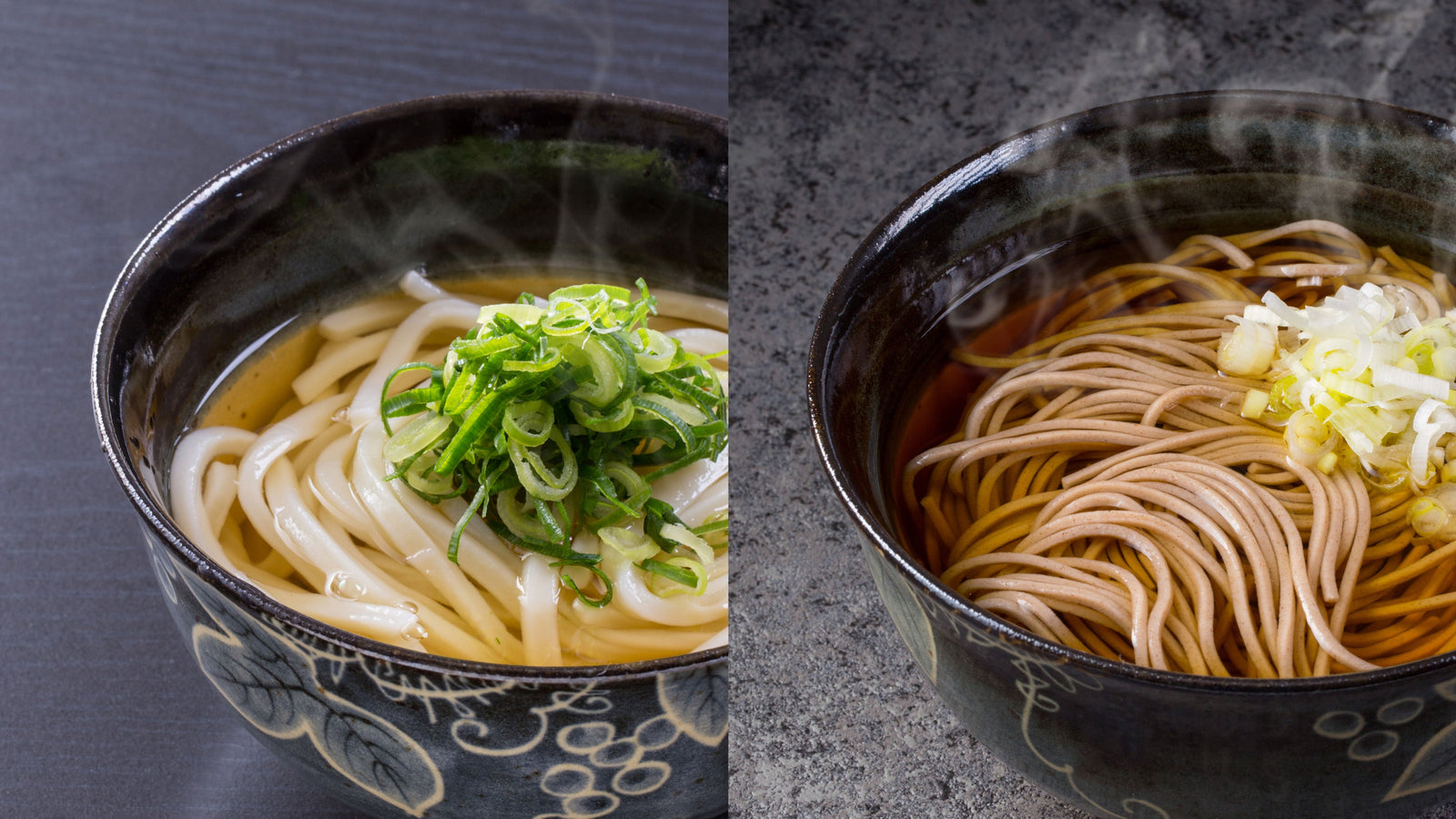
When it comes to classic, everyday Japanese comfort food, two noodle dishes stand out: soba and udon. In general, soba is more popular in Kanto, while udon is preferred in Kansai—and this difference appears to have been strongly influenced by regional climate.
Before the development of modern agricultural techniques and crop breeding, buckwheat—the base ingredient of soba noodles—was grown as an emergency food to be eaten during famines. Since buckwheat thrives in poor soil and cooler climates, many parts of the cooler Kanto region came to enjoy and eat it.

Wheat, on the other hand, the main ingredient in udon, generally does better in warmer climates, so many regions of the warmer-weathered Kansai came to favor udon over soba.

This east–west divide can be traced back to the Edo period (1603–1868 CE). Soba shops began to crop up in Edo around the mid-seventeenth century, but Kyoto and Osaka were a different story—udon had already become more popular there. Soba quickly caught on in Edo as a convenient year-round fast food, and by the early nineteenth century, soba restaurants accounted for roughly half of the approximately 6,000 eateries in the city.
Yet the soba dishes of Kanto and the udon dishes of Kansai differ in many other ways, too, making them something of a showcase for Japan’s regional culinary contrasts. Let’s look at some of their key differences below.
Differences in Broth
Although Japan’s water tends to be soft, Kanto’s water is slightly harder than Kansai’s. The soup base for noodles, called tsuyu, is made with dashi, a broth created by heating water with ingredients such as kombu (kelp) or katsuobushi (dried bonito flakes) to extract umami. Soft water has a higher permeability, making it better suited than hard water for drawing umami from kombu. As a result, the main ingredient for dashi in Kansai has traditionally been konbu, while in Kanto, katsuobushi-based dashi is more common.


Kombu dashi produces a gentler flavor than katsuobushi dashi. Accordingly, Kansai’s udon tsuyu combines kombu dashi with a bit of katsuobushi dashi and light soy sauce for a pale color and mild aroma. In contrast, Kanto’s soba tsuyu is made with katsuobushi dashi mixed with dark soy sauce, giving it a deeper, more robust flavor.
Differences in Green Onions
Green onions, or negi, are a common topping not only for soba and udon but also for ramen and other noodle dishes. In Kanto, people generally use shiro-negi (white leeks with long, thick white stems), whereas in Kansai, ao-negi (thin, green-topped scallions) are more typical. Shiro-negi are pungent when raw but turn sweet when heated, while ao-negi are valued for their fresh aroma.


Green onions originated in China, and the varieties differed by climate: in colder regions, those with larger white parts were commonly grown; in warmer regions, those with longer green parts; and in intermediate areas, hybrid types with traits of both. When green onions were introduced to Japan around the Nara period (710–794 CE), regional varieties were cultivated according to local climates—a practice that continues to this day.
Differences in Spices
Many readers may be familiar with shichimi togarashi, the Japanese seven-spice blend made primarily from red chili peppers used as a condiment for soba and udon. Interestingly, even this spice mix varies between Kanto and Kansai: the Kanto (Tokyo) blend emphasizes the heat of chili peppers, while the Kansai (Kyoto) blend highlights the aroma of sansho, or Japanese pepper.


One theory suggests that this may have arisen from the noodle dishes themselves. The sharp, spicy flavor of chili peppers complements the rich, dark soba broth of Kanto, whereas the lighter udon broth of Kansai pairs beautifully with the fragrant Japanese pepper. Thus, even Japan’s signature spice blend reflects the culinary divide between east and west.
Kanto’s Square Mochi and Kansai’s Round Mochi
Mochi, made by steaming glutinous rice and pounding it until it becomes elastic and sticky, is one of Japan’s most representative traditional foods. In addition to its use in many Japanese sweets, mochi is also central to New Year’s celebrations, when families eat ozoni—a soup dish featuring mochi. But a clear regional difference exists in the shape of mochi used in ozoni: in Kanto, mochi is typically square, while in Kansai, it is round.

According to one theory, mochi was originally always made round, due to its origin in kagami mochi, or “mirror rice cakes”—decorative round mochi offered to deities at the New Year to pray for happiness and prosperity. Its circular shape is said to represent mirrors, hearts, or human souls. Since Kansai has a longer and deeper history and culture than Kanto, people there have continued to favor the original round form, known as maru mochi.

Kanto’s central city of Edo, on the other hand, developed later than Kansai’s major cities and took a different route. During the bustling Edo period, efficient production of mochi took precedence over tradition. It was therefore both logical and preferred to flatten pounded mochi into rectangular sheets, then cut them into smaller squares to create the rectangular kaku mochi. This method became standard in the region and still continues today.
Kansai’s Onigiri Weren’t Always Triangular
Today, onigiri rice balls are usually triangular. But historically, different regions across Japan had their own distinctive shapes.
During the Edo period, five major roadways were built to connect the political capital of Edo to various domains. One theory suggests that triangular onigiri became popular in Kanto among these travelers because they were compact, easy to hold, and convenient to carry.

However, rice balls shaped like logs—traditionally called tawara-gata, or “straw bale–shaped”—were easier to wrap with sheets of nori seaweed and pack into bento boxes alongside other dishes. As a result, this style proliferated in Kansai from the Edo period on.

A major catalyst for the triangular shape becoming the standard we see today was 7-Eleven’s 1974 introduction of onigiri products. The company chose the triangular form for several reasons: it used the same amount of rice yet looked larger and more appealing; it could be packed tightly without gaps for efficient transportation; and it stood upright easily on display shelves, giving a beautiful appearance.
However, even among triangular onigiri, an east–west difference still remains in the type of seaweed used. In Kanto, roasted seaweed or yaki-nori—seaweed roasted at high heat into crisp sheets—is the norm. In Kansai, flavored seaweed or ajitsuke-nori—seaweed seasoned with soy sauce and sugar, then dried—is more common.
Kansai’s preference for ajitsuke-nori dates back to 1869, when Emperor Meiji, then residing in Tokyo’s Imperial Palace, visited Kyoto and brought ajitsuke-nori as a gift from Tokyo. The product had been developed by a seaweed shop in Tokyo’s Nihonbashi as an interesting alternative to ordinary roasted seaweed. Thanks to the Emperor’s popularity in western Japan and the product’s uniqueness, ajitsuke-nori gained widespread acceptance there. When Showa-period (1926–1989 CE) companies in Osaka succeeded in mass-producing ajitsuke-nori, it became a staple of the average Kansai resident’s dining table. Now the word “nori” makes Kansai people think first of ajitsuke-nori, a trend reflected in the region's onigiri to this day.
East and West Tempura: Similar in Appearance, Different in Essence
Alongside sushi, tempura is one of Japan’s most beloved dishes, a food that allows one to enjoy the natural flavors of seafood or vegetables in a light, crispy batter.
According to Kondo Fumio, head chef of a two Michelin–starred tempura restaurant in Tokyo, Kanto-style tempura originated in Edo at the end of the eighteenth century. Originally the dish consisted of fish caught in Edo Bay (modern-day Tokyo Bay), coated with a flour batter and deep-fried. To suppress fishy odors, aromatic sesame oil, made by pressing roasted sesame seeds, was used for frying, and the accompanying tempura dipping sauce (tentsuyu) was made with dark soy sauce.

By contrast, the Kansai region’s diet was historically more vegetable-based. To bring out the natural flavors of vegetables, Kansai cooks used the lighter rapeseed oil or vegetable oil for frying, and traditionally ate tempura sprinkled with salt rather than dipped in tentsuyu. Thus, although the dishes may look similar, the tempura of eastern and western Japan differ in oil, condiment, and flavor profile.

A 2016 survey by a Japanese newspaper found that there is also a unique custom in Kansai of eating tempura with Worcestershire sauce. This is speculated to have started in Osaka during the Meiji era (1868–1912 CE), when Western food culture was spreading rapidly. Pouring Worcestershire sauce over a number of dishes, including tempura, was seen as both cutting-edge and sophisticated—and this sauce usage gradually spread throughout western Japan.
Even the Cookware Differs: Eastern and Western Tamagoyaki
Tamagoyaki—a rolled omelet made by mixing beaten eggs with broth or other seasonings, then cooking—is a popular dish for casual meals and bento boxes across Japan.
Kanto-style tamagoyaki was originally made to be a sushi topping or appetizer. Its firm texture and comparatively larger amount of sugar make it fairly substantial, designed to complement sake and vinegared sushi rice.

Kansai-style tamagoyaki, on the other hand, usually contains no sugar and instead highlights the flavor of the dashi added to the eggs, earning it the name dashimaki tamago. The word maki, “roll,” refers to the process of repeatedly folding thin layers of egg while cooking to achieve an unbrowned surface and a texture so soft and delicate it almost falls apart. Conversely, Kanto-style tamagoyaki is flipped only once during cooking and grilled slowly over low heat to form a firm, thick block with a browned surface—hence the alternative name atsuyaki tamago, literally “thick-grilled eggs.”

Dedicated tamagoyaki pans are used for making these omelets. Even the pans differ somewhat by region, created with a mind to what is most convenient when cooking dashimaki tamago versus atsuyaki tamago. The Kansai-style pan is rectangular, designed for rolling up the dashimaki tamago, while the Kanto-style one is nearly square and often comes with a wooden lid for flipping the finished eggs out onto. Nevertheless, the more practical Kansai-style rectangular pan has become the standard in home kitchens across Japan.
Sukiyaki: A Stew in Kanto, a Grilled Dish in Kansai
Sukiyaki is a dish of thinly sliced beef, vegetables, and tofu simmered in a sweet-savory broth called warishita (made from soy sauce, sugar, and sake), but its roots can be traced back to different foods in Kanto versus Kansai.
The predecessor of sukiyaki came from Kansai in the mid-Edo period (seventeenth to eighteenth centuries), to a dish in which fish or shellfish were grilled on the metal blade of a suki—a spade-like plow used for tilling soil. Beef grilled instead of seafood was called sukiyaki, literally “grilled on a suki,” the apparent origin of the dish’s name. The sukiyaki born in Kansai involves first grilling the beef, then adding warishita broth and vegetables.

In Kanto, however, a different yet similar dish called gyunabe, or “beef hot pot,” emerged in Yokohama at the end of the Edo period. Inspired by the beef dishes eaten by foreigners in the international settlements of this port city, which was one of the first to open to the West, gyunabe involved adding raw beef and vegetables to a sauce made from miso or soy sauce and simmering. The dish spread rapidly from Yokohama to nearby Tokyo and became a sensation, with many specialty restaurants opening. But after the Great Kanto Earthquake of 1923, most of these establishments were forced to close. The gyunabe of Kanto took on the characteristics of the sukiyaki of Kansai, and the dish’s name, too, unified as “sukiyaki.” Even so, while restaurants in Kanto began adopting the Kansai method of grilling the meat first, in ordinary households it remains common to cook beef and vegetables together in simmering warishita.

A related linguistic note: in Kansai, when people simply say “meat” (niku), they generally mean beef, whereas in Kanto, “meat” often refers to pork. This difference stems from historical agricultural practices. In Kansai, where rice paddies were common, cattle were often used in farming as draft animals. When the ban on eating meat was lifted in the nineteenth century, the use of cattle shifted from farming to food. In Kanto, where dry fields were more common, horses had long been used as draft animals. But since horse meat was tough and yielded little edible flesh, it was pigs that were raised for meat, instead. Interestingly, the beef used in Kanto for gyunabe was originally imported from Western countries, China, or Korea. The use of domestically raised beef came later, when meat raised in the Hyogo region began to supply Yokohama and Tokyo.
Why the East–West Difference in Egg Sandwiches?
Among the Japanese dishes that have recently drawn attention from international visitors is the tamago sando—the egg sandwich with a beautiful cross-section served in Japanese coffee shops and cafés.
The difference between eastern and western Japan lies in its filling. In Kanto, the filling is typically an egg salad made by mixing mashed boiled eggs with mayonnaise. In Kansai, however, it is more common to find sandwiches filled with tamagoyaki, the rolled omelet discussed earlier.


The origin of this difference isn’t clearly known, but a newspaper once interviewed an illustrator who describes himself as an avid “egg sandwich enthusiast,” eating 200–300 of them per year. He offered an intriguing theory:
“When cafés serve egg-salad sandwiches, they probably prepare the egg mixture in advance before they open for the day. If there aren’t enough orders, that filling goes to waste. In Kansai, where thriftiness and dislike of waste are deeply rooted, it’s more efficient to make sandwiches to order using freshly cooked tamagoyaki, which can be prepared quickly without leftovers. That’s probably why the Kansai style took hold.”
Indeed, this reasoning aligns with Kansai’s cultural traits. In Osaka, a historic “city of merchants,” people have long valued reducing unnecessary waste and making full use of every resource. Likewise, since Kyoto is surrounded by mountains and far from the sea, it once lacked easy access to fresh ingredients like fish, fostering a culture of avoiding waste in all things. While this theory lacks formal proof, it seems quite plausible given the spirit of western Japan.
Differences Beyond the Food: What to Notice in Restaurants of East and West Japan
When visiting Japan from abroad, most travelers will experience Japanese cuisine through restaurants. So to conclude, let’s take a look at some of the differences between Kanto and Kansai that can be observed not in the dishes themselves, but in the restaurants where they are served.
Differences in the Layout of Teishoku Set Meals
A teishoku is a set meal served on a tray, typically consisting of steamed white rice, a bowl of miso or other soup, and a combination of a main dish (shusai) and one or more side dishes (fukusai).
According to the standard rules of Japanese table setting, rice is placed at the front left of the tray, soup at the front right, the main dish behind the soup, and side dishes behind the rice. Most restaurants in Kanto adhere to this traditional arrangement. However, in Osaka and other parts of western Japan, it’s not uncommon to find the soup placed behind the rice (in the upper left of the tray) and the main dish toward the front to the right of the rice.

Tomita Keiko, an associate professor at Kindai University, attributes this to Kansai’s enduring merchant spirit:
“Restaurants in Kansai tend to compete by how substantial their main dishes look. Placing the main dish at the front makes the meal look more appealing, perhaps reflecting the [business-minded] sensibilities of Kansai people.”
As for why the miso soup is positioned farther away, a representative of an Osaka-based miso manufacturer offers this explanation: “As commerce developed in Osaka and Kyoto, restaurants began to avoid serving hot soups that were hard to drink quickly. That may have carried over to today.” There’s also a practical reason: placing hot soup toward the front near the diner’s hands increases the risk of it being knocked over and spilling. Moving it farther away may have been a thoughtful change with a mind toward customer convenience.
Differences in Noren Curtains Hung at Restaurant Entrances
A noren is a fabric curtain hung at the entrance of a shop or restaurant, serving to shield the interior from view, provide shade from the sun, and announce the shop's name or products.
Although these days the distinctions are less strict, noren were originally made differently in Kanto versus Kansai.
The Kanto-style noren is short in height and long in width. According to one theory, it was considered chic in Edo-period Kanto to quickly slip under the curtain when entering a shop. Also, Kanto noren typically have multiple small fabric loops for threading the curtain rod sewn along the top edge. These leave visible gaps between sections, reflecting the Kanto aesthetic of “showing” rather than concealing.

In the Kansai-style noren, by contrast, the upper edge is folded over and sewn from the back to create a continuous sleeve for the rod, leaving no gaps. This design is said to have originated in Kyoto—the birthplace of the noren—whose aristocracy considered it refined and modest to “conceal rather than reveal.” Consequently, Kansai noren tend to be longer vertically and hang lower, with no gaps at the curtain rod, ensuring the inside of the shop or restaurant is fully hidden from view.

Among the dishes and foods introduced in this article, were there any that you particularly liked or found intriguing? Some readers may be surprised to discover that there exist so many detailed regional differences between east and west, despite it all falling under the umbrella of Japanese cuisine or washoku.
Deepening your understanding of the small details behind the things you enjoy often makes them even more appealing—and can turn appreciation into an affection that enriches everyday life. It is my hope that this article helps spark greater curiosity and enjoyment not only toward Japanese cuisine and washoku but also toward Japanese culture as a whole.
Stay close to the craft
Now and then, a quiet letter — new stories, seasonal notes, and the hands behind the work.
Chanko Nabe: The Power Food of Sumo Wrestlers
Step into the home of sumo culture, and learn how chanko nabe became the…
Nakazawa Hiroko
A Bite of the Past: Taste the Richness of Japan's Edo Era
Explore the flavors of Edo-period Japan through sushi, soba, and more, brought to life…
Admiring the Beauty of Floral Art at Sannomaru Shozokan
Discover floral masterpieces at Sannomaru Shozokan's "Hyakka Hiraku," showcasing art treasured by Japan's Imperial…
Leave a comment