

Tracing the Breath of Glass: The Living Lines of Takeoka Kensuke
Learn about Takeoka Kensuke's woven glass vessels, where molten lines, breath, and light create forms filled with movement.
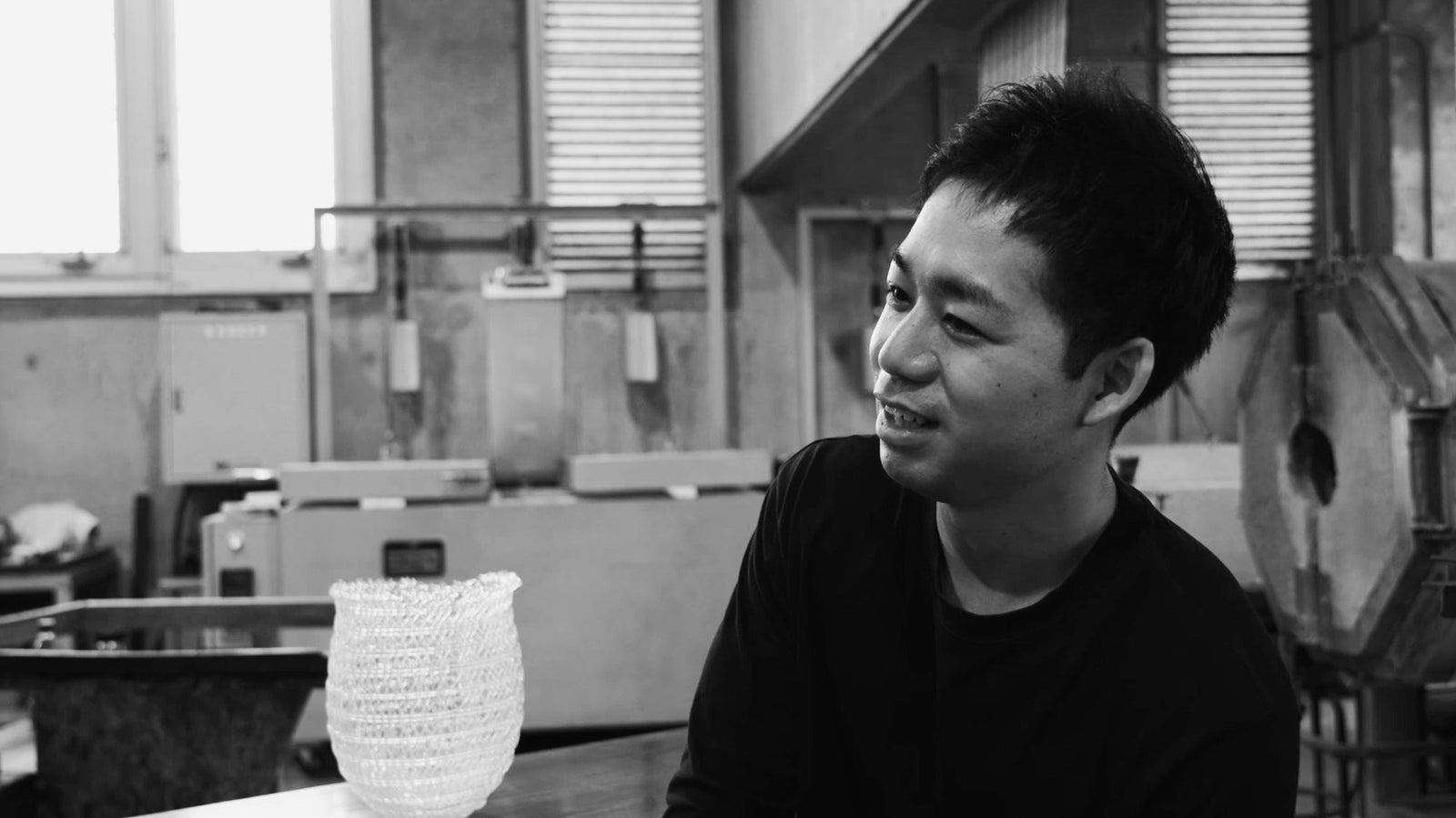
Glass exists in a quiet state of transformation between softness and solidity, motion and stillness. When heated, it begins to move, to bend and breathe; when cooled, that movement is preserved, suspended in time.
For glass artist Takeoka Kensuke, this fleeting moment of transformation lies at the heart of his craft. His works explore the delicate tension between order and change, structure and fluidity. What appears at first glance as a woven form is in fact a choreography of glass lines.

This article explores the philosophy behind Takeoka’s work, his concept of “tracing lines,” the dialogue between glass and Japan’s weaving traditions, and his reflections on the sculptural beauty of form in his works.
Tracing the Line

“A single line emerges from molten glass, gradually forming a structure and eventually becoming a three-dimensional form. That process itself appears in the work as sen no kiseki, the ‘trajectory of the line.’”
There is a moment in glassblowing that most people never see. Before the molten glass takes shape, before the breath enters the pipe, a single thread of molten glass is drawn from the furnace, thin, luminous, weightless as a brushstroke suspended in air. For Takeoka, that moment is not a prelude to the work. It is the work.

Takeoka's guiding philosophy centers on what he calls sen no kiseki—the trajectory of a line. It sounds deceptively simple. But follow the thought, and it opens into something much more than that: the idea that a line is never just a mark. It is a record of process, of decision, of the material's own resistance and compliance. In his hands, a single rod of glass becomes one unit, assembled into latticed surfaces that are then coaxed into three-dimensional form through heat and breath. What begins flat becomes volumetric. Once returned to the flame, it collapses back toward flatness.
He is also drawn to something less quantifiable: a quality he describes as fabric-like. He is fascinated by the way cloth drapes when dropped from above, the way it folds and catches, the way edges fray. These are not properties one typically associates with glass, a material more often described in terms of clarity, hardness, and cold precision. Yet Takeoka sees in the glass lattice something analogous—a surface that is ordered but not rigid, geometrically constructed but somehow soft in feeling. The goal, quietly radical for a medium so associated with transparency and distance, is warmth.
In Conversation with Japanese Bamboo Weaving
Watching Takeoka work makes it easier to understand why weaving occupies such a central place in his practice. The motion is rhythmic but also highly responsive, with continuous adjustments among force, timing, and fragility. Even before the glass settles into form, the process already carries something reminiscent of basketry. Takeoka’s interest in Japanese bamboo weaving began long before he started developing his current glass techniques.

What first drew him in was not only how the bamboo baskets were made but also the way they changed through use. Bamboo gradually develops a richer sheen over time, a kind of aging shaped by touch, atmosphere, and years of handling. In Japan, this transformation is often appreciated not as deterioration but as a form of beauty that deepens with age. That sensitivity stayed with him.
He was also fascinated by the qualities of bamboo itself, its tension, flexibility, and elasticity, and the way those characteristics become visible. The crafted surface is never completely static. It bends slightly. It holds pressure. It responds.
Glass, of course, behaves very differently.
Translating those qualities into glass required years of experimentation. Compared to conventional blown glass, Takeoka's technique demands far greater speed. Because the strands are so thin, they cool almost immediately after leaving the furnace, making them especially prone to cracking.
“It’s not simply a matter of taking more time. Once the glass comes out of the furnace, it cools and can crack within seconds. So speed becomes extremely important. That sense of tension is also part of what makes the work interesting.”

He then demonstrated the process of creating one of his glass sheets, known as ami (woven) sheets. Using a heavy rake-like tool with a long handle, he hooked the molten glass and quickly moved backward, pulling it into long, slender strands. To achieve lines fine enough for weaving, he had to continue walking a considerable distance while stretching the glass.
Under the sunlight, the strands took on an almost translucent glow. They extended lightly through the air, carrying both elasticity and flow. In that moment, the material often associated with hardness and coldness seemed to reveal something unexpectedly alive.


What follows is a slower, more intricate act of construction. Curved and straight glass rods are brought together and gradually interlaced, forming a sheet-like structure through repeated, deliberate gestures. Each piece is placed in relation to the next, and over time, a woven surface begins to emerge, one that holds both order and flexibility, like a textile translated into glass. Once the sheet is complete, it is gently preheated in an electric kiln, allowing it to settle and retain its tension. It is then wrapped around a cylindrical blown-glass form, becoming an outer layer that already carries the memory of its making.

The artist describes the weaving itself as a state of total engagement—a condition of absorbed repetition where thought gives way to rhythm, and rhythm becomes touch. In this focus, the act of interlacing ceases to feel like construction and becomes something closer to breathing.
Perhaps even more striking than the process itself was the way Takeoka worked. He remained focused yet energetic throughout, moving with speed and precision without showing any sign of fatigue. His enjoyment of glassmaking was evident in every part of the demonstration.
Even so, the finished works rarely emphasize that tension directly. Instead, they retain a delicate sense of softness. The surfaces bend subtly in places, holding traces of fluidity. What emerges is less a display of technical difficulty than a material that appears unexpectedly responsive, almost textile-like in the way it catches light, folds visually, and occupies space.

Sculptural Beauty in Everyday Objects
Although Takeoka’s works retain the functionality of vessels, what leaves the strongest impression is their presence somewhere between vessel and small-scale sculpture. Rather than existing simply as utilitarian forms, the pieces establish a visual and perceptual relationship within space. Through light, shadow, transparency, and layered linework, everyday vessels acquire a stronger sense of sculptural depth.

This awareness of surface, structure, and light becomes especially apparent in his recent works. While many of his earlier pieces existed primarily as flower vessels or sculptural forms, newer works such as water containers further expand the relationship between object and space. The work consists of an inner blown-glass vessel surrounded by an outer glass layer. To maintain balance between the two during the blowing process, temperature control must be extremely precise. If the outer layer becomes too soft, the texture melts away. If the inner vessel expands before the outer layer reaches the proper state, the entire form risks cracking apart.

As a result, the works retain a very subtle tension within them. They possess the lightness and transparency characteristic of blown glass, yet also retain a softness reminiscent of textiles or organic forms. The wooden lid adds the grounded presence of the overall piece.
In Takeoka’s work, however, this sculptural awareness does not remain purely visual. He often speaks about his interest in tactility, a preference for surfaces with texture, irregularity, and physical variation. These works are not simply objects to be viewed. They exist more like forms that continue to shift between space, light, and perception.
Expanding the Language of Glass
Heating, pulling, weaving, reheating, blowing, the same gestures are repeated again and again. Over time, the technique itself seems to become less about controlling the material and more about developing a heightened sensitivity to its condition at any given moment. At the same time, however, Takeoka’s interests have begun to move beyond the scale of individual objects.

Looking ahead, he hopes to create large-scale installations, allowing his work to evolve beyond the internal language of vessels and begin to occupy space itself. Rather than existing as isolated works, he envisions these forms extending outward, layered, and unfolding through an environment in ways that can alter the atmosphere of an entire space.
At the same time, Takeoka remains deeply conscious of the broader context of Japanese glassmaking in which his work exists. When speaking about Japanese glass artistry, he often returns to its sensitivity toward color and detail. In his view, the defining quality of Japanese glass is not spectacle or visual excess, but a certain refinement—faint changes in transparency, layered tonal variation, and careful attention to thickness, texture, and finish.
That sensibility also resonates strongly with his own approach. Even when the works are technically demanding, they rarely foreground virtuosity for its own sake. Instead, Takeoka maintains subtle restraint, allowing texture, light, and structure to reveal themselves over time.
In Takeoka’s work, glass never feels entirely still. Even after cooling into form, the surfaces continue to suggest movement—woven lines shifting, shadows settling into layered structures, textures changing subtly depending on where the viewer stands.
What remains most striking is not simply the technical complexity behind them, but the sensitivity with which they occupy space. Through weaving, repetition, heat, and breath, Takeoka continues to approach glass as something living, capable of holding rhythm, memory, and warmth long after the furnace has gone dark.
Stay close to the craft
Now and then, a quiet letter — new stories, seasonal notes, and the hands behind the work.
Otsuki Yosuke’s Art of Glass: Layering Colors, Engraving Memories
Step into Otsuki Yosuke’s world of multi-layered glass, where color, memory, and time are…
Nakada Hiroshi: Shaping Nature in White Porcelain
Enter the world of Nakada Hiroshi, where budding forms and pearl-luster surfaces create a…
Taruta Hiroshi: Glowing Lines Carved in Celadon
Discover Seto ware artist Taruta Hiroshi’s celadon vessels, where carved porcelain lines glow with…
Rebecca Menasché
Leave a comment