

Nakada Hiroshi: Shaping Nature in White Porcelain
Enter the world of Nakada Hiroshi, where budding forms and pearl-luster surfaces create a poetic vision of Kutani ware.
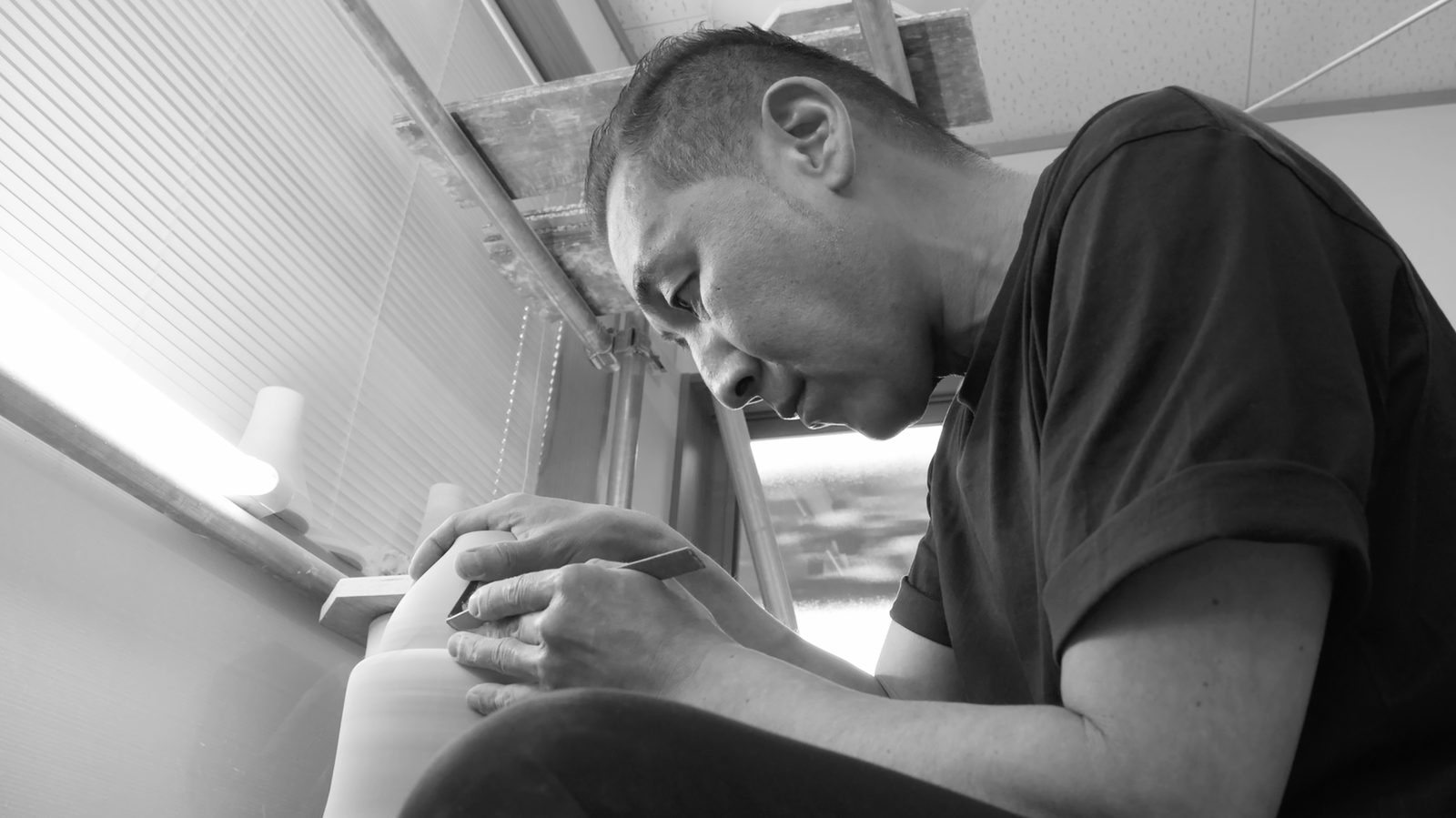
The moment clay meets the potter’s fingertips, the mass begins to move as though alive. Before long, supple curves begin from the spinning clay. The movement of the hands is delicate yet powerful, guided by complete assurance. As if giving form to a blueprint held in the mind, the potter continues shaping the clay with deep concentration.

“Throwing on the wheel is the work I enjoy most. What I am thinking about in my head takes form through my hands. Within that entire process, I feel a joy that is difficult to replace.”
So says Kutani ceramic artist Nakada Hiroshi.
Kutani ware, one of Japan’s representative ceramic traditions, is known for its splendid overglaze decoration executed with Japanese pigments in the five colors known as Kutani Gosai. In contrast, the porcelain that emerges from Nakada captivates through white alone, paired with pared-down forms that heighten the presence of that whiteness.
Some vessels use a flower bud as their motif, capturing the fleeting moment just before it opens. The instant of life poised on the verge of blooming is preserved. In Nakada’s vessels, which express that vibrant moment, there is a poetic beauty.

Born into a Kutani workshop specializing in overglaze decoration, what path led Nakada to become a ceramic artist? Why did he arrive not at colored decoration but at his own distinctive decorative method, shinju kosai (pearl luster)? And what thoughts lie behind the beautiful silhouettes he shapes?
Here, we introduce the story of the artist behind a singular expression of white.
The Path to Ceramics
The Joy Discovered in Clay
Takando, a district of Komatsu City, Ishikawa Prefecture, is one of the production centers of Kutani ware. It is here that Nakada Hiroshi was born into Nakada Kinen Kiln, an overglaze painting workshop with more than a century of history. His father is Nakada Kazuo, who in 2025 was recognized as a Holder of an Important Intangible Cultural Property—an honor often referred to as a “Living National Treasure.” Yet Nakada explains that becoming a ceramic artist was not something he had aspired to do from childhood.

“Of course, I understood that my father made his living through overglaze decoration. But I personally didn’t feel a particularly strong desire to work with my hands. I entered the Crafts Department at Ishikawa Technical Senior High School intending to go on to university, but drawing was something I found particularly difficult. During those high school years, I wasn’t a very diligent student, and in the end, I didn’t pass any of the university entrance exams.”
The turning point came a year later, after spending time preparing to retake the exams, when Nakada enrolled at Osaka College of Art and encountered clay for the first time.

“Although my family ran an overglaze decoration workshop, Kutani ware production is highly specialized, so working directly with clay was entirely new to me. On the wheel, the shape gradually rises, and from there the piece is further refined. I simply found the whole process enjoyable. I still remember the excitement of touching clay for the first time. Until then, I had never really had anything I wanted to pursue, so being praised for something I had made myself was also a new experience. That joy meant a great deal.”
Captivated by clay, Nakada devoted himself fully to his studies over the three years at vocational school and the two years after transferring to the ceramics program at Kyoto Seika University. He explains that the work he pursued at the time was not utilitarian craft, but sculptural pieces with a stronger emphasis on artistic expression.
“My mentor at vocational school, Ito Hitoshi, had originally been a member of the Kyoto-based avant-garde ceramic group Sodeisha. My professors at university had also studied under Yagi Kazuo and Suzuki Osamu of Sodeisha, so it felt like a natural progression to gravitate toward avant-garde expression.
During my university years, I devoted myself to making sculptural works alongside a group of highly motivated classmates. We challenged one another constantly, driven by the determination not to fall behind.”
From Conceptual Art to the Beauty of Use
Although Nakada had immersed himself in avant-garde sculptural work, he decided to enter the world of craft at the age of 27. Looking back, he explains that several factors lay behind this decision. He felt that he had taken his exploration as far as he could, and he had also begun to question the direction of sculptural work in which concept alone seemed to take the lead. Yet more than anything, the strongest influence was a simple realization: he genuinely liked people.

“During my years as a student, I traveled to various ceramic production regions all across Japan. Through those experiences, what I came to understand was that I really do like people. In Japan, some people remain rooted in their land, shaping things from scratch and embodying their convictions in the work they leave behind. I admired the strength they possess and the weight their words carry, and before long, I began to feel that I, too, wanted to become part of that world. I also began to feel that by making vessels intended to be used, rather than purely self-expressive sculptural objects, I might be able to form a closer connection with people.”
Having chosen the path of craft at 27, Nakada received the Newcomer’s Award at the Japan Traditional Crafts Exhibition just two years later, at the age of 29. He soon began to attract attention as a rising presence in Kutani ware.
Hope and Order in Nature
For Nakada, the process begins with kneading Kutani clay and setting it on the wheel, where the form begins to rise. Once the body has dried, guidelines are marked in vermilion ink, and the surface is shaved along them using a carbide trimming tool. After firing transforms the vessel into white porcelain, a mineral-based glaze is applied.


Nakada’s vessels are created through these many meticulous stages of handwork. Among them, he says the one he enjoys most is throwing on the wheel.
“There is a real satisfaction in seeing what I have in mind gradually take form through my hands. There was a time when I couldn’t handle the clay the way I wanted and even felt that I wasn’t very good at the wheel. For a time, I worked with slip casting instead of throwing. But after thousands—tens of thousands—of repetitions, I gradually came to develop a feel for the clay and became able to shape the forms I had imagined. Now, I truly love throwing on the wheel.”

What, then, are the forms Nakada envisions? One recurring source of inspiration is the presence of plants.
“For example, Shinju Kosai Round Vase takes as its motif the bud of Michiko Renge, a double-flowered magnolia. Winters in Ishikawa, where I live, are extremely cold and damp, but when spring arrives, many different plants begin to sprout. I want to embody in my work the sense of hope I feel at that moment, as well as the order that exists in the natural world.”

Rounded, organic volumes that evoke the hope of life. Precisely structured, symmetrical forms that seem to speak of the order of nature. What brings these elements into sharper focus is the expression of white. As Nakada himself says:
“White allows no disguise; it reveals form with the greatest clarity.”


The beautiful contours he draws from clay, laid bare by an uncompromising white surface, are the essential appeal of Nakada’s work.
Shinju Kosai: Pearlescent Luster on White
The works that embody hope and order gain an added depth through Nakada’s original technique, shinju kosai. This method lends the surface an elegant, pearl-like luster alongside a matte texture. It utilizes a property that occurs during high-temperature firing: the transparent glaze of the white porcelain, softened again by heat, merges with a mineral-based glaze known as pearl glaze.
Nakada applies multiple strips of masking tape to the porcelain body, carefully adjusting the paths along which the pearl glaze will appear. In this way, he finely controls the texture of each vessel.

“Kutani ware places surface embellishment at the center of expression. But in order to bring out the form of the work itself, I didn’t want to apply the colors of Kutani Gosai. Instead, I began thinking about working white upon white. Since my student days, I’ve never been good at drawing, and even now I’m almost embarrassed by how poorly I draw. But on the pieces I shape myself, I’m able to draw the lines I have in my mind.”
Although Nakada was born into a lineage of overglaze enamel decoration, it was not painting but form that captivated him. In that sense, shinju kosai may be the natural direction he arrived at because of that background.


In a tradition that often makes abundant use of Kutani Gosai, Nakada’s works are sometimes described as either “unconventional” or “a new direction in Kutani ware.” While he keeps a certain distance from such characterizations, Nakada speaks of the influence he has received from Kutani tradition:
“For example, choosing not to leave the work as plain white porcelain, but instead to introduce an element like shinju kosai, is also a result of having been born and raised here. The Kutani artists around me, including my father, work and rework their pieces relentlessly, refining them without compromise. From that discipline, I have learned a great deal as an artist.
At the same time, Kutani today is home to many independent artists, and many of them are engaged in bringing entirely new ideas into being. Rather than being bound by traditional techniques, each person develops freely in their own way. I think that openness is one of the strengths of Kutani ware.”
The Japanese novelist Inagaki Taruho once observed that poetry stands vertically against history. Against the long and rich horizontal axis of Kutani ware’s history, Nakada’s white porcelain stands upright as a distinct expression of its own. Holding both reverence for tradition and a personal determination to move beyond it, his porcelain carries a quiet radiance and a firm presence.
Nakada Hiroshi is known for bringing forth a beautiful expression of white. When asked about the future direction of his work, he spoke with lively curiosity: “I’m also interested in working in monochrome,” he said, adding that he would like to try making pieces in which form does not lead to ornamentation, but where ornamentation instead guides the form.
Those words called to mind something he had said earlier during the interview:
“In Japan, some people remain rooted in their land, shaping things from scratch and embodying their convictions in the work they leave behind. I admired the strength they possess and the weight their words carry, and before long, I began to feel that I, too, wanted to become part of that world.”
Following a path that only he himself can walk, Nakada Hiroshi continues to shape new works. It is difficult to look away from where his practice will lead next.
Stay close to the craft
Now and then, a quiet letter — new stories, seasonal notes, and the hands behind the work.
Gilded Lines and Expanding Forms: The Work of Ishitomi Shunjiro
Explore the Kutani ware art of Ishitomi Shunjiro, where black lines, gold detailing, and…

Taka Toshifumi: Bringing All Things Into Balance
Read about Taka Toshifumi's passion for Kutani ware, his family's rich legacy, and his…
Painter of the Northern Seas, Art and Life of Kitamura Takashi
Kutani ware master Kitamura Takashi speaks on his journey and taking inspiration from Edo-period…
Leave a comment