

Wakunami Madoka: In Dialogue with Jomon Pottery
Meet ceramic artist Wakunami Madoka, whose hand-shaped works reinterpret ancient Jomon pottery.
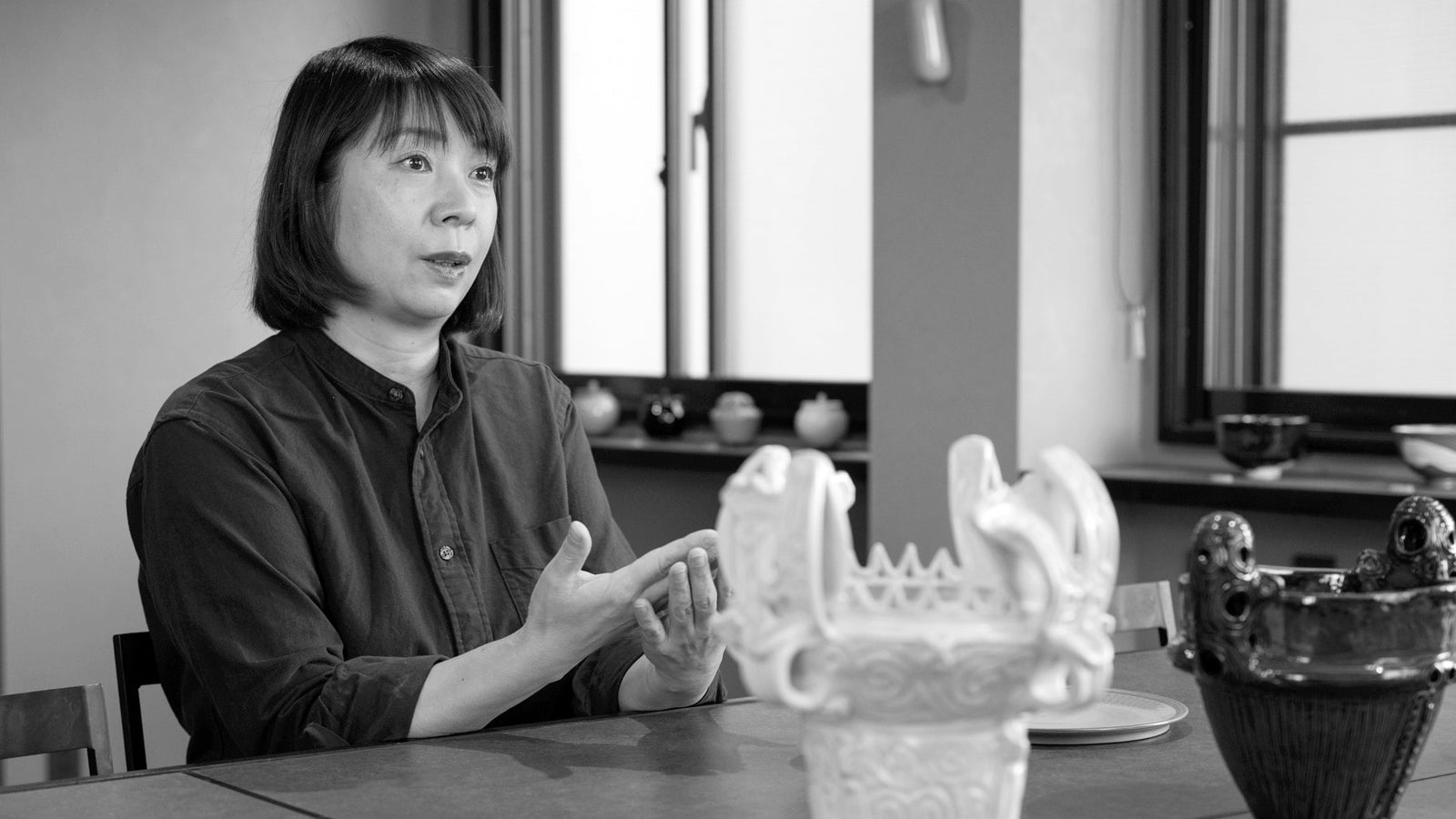
Before words, before written history, there was form, leaving its trace as a record of ancient life.
In the vessels of the Jomon people, created more than 10,000 years ago, function alone cannot explain the intensity of their shapes. These objects exceed utility, suggesting a way of being inseparable from imagination, belief, and lived experience.

Kyoto-based ceramic artist Wakunami Madoka approaches Jomon pottery not as a style to be replicated, but as the origin of her creativity and craft.
Each one of her works is shaped by an internal vision and fascination. Entirely hand-shaped, creation is guided by a long familiarity with clay, structure, and firing.
Discovering Beauty in Ancient Forms
The seeds of inspiration sometimes fall closer than one might expect.
Wakunami’s encounter with Jomon pottery began not through academic research or curatorial intent, but through a middle school summer assignment brought home by her son. Asked to create something related to society and crafting, he chose to look back to the origins of pottery itself, growing up as the child of a Kiyomizu ware kiln. Understanding how difficult it is to give physical form to an imagined idea, Wakunami helped her son work with the clay.
What started as a small project quickly deepened. As Wakunami looked more closely at Jomon pottery, she found herself increasingly absorbed. The complexity of the forms, the confidence of their construction, and the sheer ambition embedded in objects made thousands of years ago felt startling. They were complete, assuredly expressive, and made to be used.

“I became completely absorbed in the beauty of that world. It felt as though it had come from the very peak of making.”
At the time, Wakunami had already spent many years working within the context of Kiyomizu ware alongside her husband, the fourth-generation Soryu, immersed in daily production and long-established techniques.
Precisely because she knew what it meant to sustain a ceramic practice, the encounter with Jomon felt significant. Rather than seeing ancient pottery as a stylistic reference, she began to view it as a reminder of a moment before categories—before “use,” “decoration,” or even “tradition” were clearly separated.
Importantly, she did not approach Jomon pottery with the intention of understanding or explaining it. Archaeology acknowledges that while much is known about how Jomon vessels were made, much remains unresolved. For Wakunami, this uncertainty was not a limitation.
“My work begins with respect for the Jomon people. I reimagine the different forms, and by applying glaze, bring them into the present.”
Shaping Imagination Through Mature Craftsmanship
Wakunami’s Jomon-inspired works are inseparable from her accumulated experience as a maker. Born into a family of ceramic artisans in Fukuoka, within a lineage associated with Koishiwara pottery, she grew up in an environment where clay and kiln work were part of daily life. Yet as the third daughter in a family of four sisters, she was never positioned as an heir.
Ceramics thus became a conscious choice. She studied pottery at Saga University and, after graduating, left Kyushu, choosing Kyoto to further her training.
In Kyoto, she entered formal ceramic training and later joined the working life of Kiyomizu ware through marriage. For nearly a decade, she worked largely out of view—supporting production, assisting, and making without public authorship. This period grounded her in the realities of sustaining a kiln, managing materials, and negotiating the tension between continuity and change.
This background informs her current practice. Her work is not a conceptual exercise layered onto craft, but a process rooted in long familiarity with clay, structure, and firing—an imagination supported by repetition and risk.
Reinterpretation as Respect, and Creating for the Present
All of Wakunami’s Jomon works are built entirely by hand. She does not use a wheel. Like the ancient vessels that inspire her, each piece is constructed through coil-building, rising gradually from the base.
The completed form exists first as an internal image, fully formed in her mind, and is realised through a slow, physical process. Rather than approaching Jomon vessels symbolically, Wakunami looks at them from a maker’s perspective: how they stand, how weight is supported, how elaborate forms were assembled without a wheel.


Her study of Jomon pottery is visual and experiential rather than academic. She does not work from diagrams or typologies, nor does she begin with historical classification. Instead, she visits museums and archaeological collections when time allows—traveling to regions such as Nagano and Yamanashi—and responds to what moves her.
Rather than using the iron-rich clay typical of ancient Jomon pottery, Wakunami works with a semi-porcelain clay—a blend of stoneware and porcelain clay. This choice allows greater structural control and clearer expression of glaze, while avoiding the fragility and high loss rates associated with pure porcelain. While Jomon pottery is unglazed, Wakunami chooses glazes as an artistic decision—one that allows ancient forms to quietly enter the present.
A sense of structure and awe emerges through flame-like forms that rise from the vessel’s body. In her piece Homura, meaning flame, these elements are carved rather than applied, creating a presence shaped by balance and tension rather than replication.

Attention then turns inward, toward movement and depth. In Suien—literally “water smoke”—hollowed spaces and a restrained blue glaze allow variation to surface naturally, through pooling, fading, and abrasion during firing.


The most direct emotional resonance appears in rounded volumes formed around an internal cavity. In Taido, translating to “womb” and “clay,” this structure evokes birth and emergence—an intuitive response to a time when life was felt as profoundly vulnerable.
“Life must have felt unbearably precious then. That feeling is what I wanted to touch.”


Jomon at the Scale of the Hand
To step into Wakunami’s work is to step back into the deep history of one of the world’s earliest potteries, reinterpreted through an artistry rooted firmly in the present. Wakunami does not position herself as an expert on Jomon history. Her knowledge is practical, visual, and intuitive. She observes, absorbs, and responds, allowing the imagination embedded in ancient pottery to remain active.
Asked how these works differ from tableware, Wakunami describes not a switch in practice, but a difference in emotional intensity.

“With these pieces, I’m able to pour my love into the work more freely. They’re extremely demanding to make—but that’s what makes them so enjoyable.”
At its core, her practice is driven by a pure admiration for the beauty of fully realized Jomon pottery. There is a clarity in that fascination, paired with the skill of a seasoned ceramic artist who knows how to give form to what moves her.
Stay close to the craft
Now and then, a quiet letter — new stories, seasonal notes, and the hands behind the work.
Nakada Hiroshi: Shaping Nature in White Porcelain
Enter the world of Nakada Hiroshi, where budding forms and pearl-luster surfaces create a…
Hariya Kinuyo: Soft in Form, Powerful Beneath
Meet maki-e artist Kinuyo Hariya and discover the story behind her maneki neko, made…
Nishikata Ryota: Forging Beauty in Motion
Learn more about Nishikata Ryota’s rare tsuiki metalwork, crafted with precision and sculptural beauty.
Leave a comment
@Ann – Thank you so much for taking the time to read the article so closely and share such a thoughtful response. Your perspective as an art historian brought a new dimension to how these works can be experienced. Wakunami has a strong attachment to Taido and will be deeply moved to know how it resonated with you.
It’s very encouraging for us to see the work connect in this way, and it means a great deal to know that the artist’s world and philosophy came through. We hope to continue sharing work of this kind with you and to bring more of these stories in the future.
As an art historian focussing on the arts of Japan, i encountered the Jomon ware and was amazed by its exuberance and assurance of form. It is wonderful to see an artisan interacting with these ancient styles, and I love the way the glazes highlight the carved and moulded articulation of each piece. They speak deeply to me, and I am sure that the original Jomon creators would be thrilled to see the glazed interpretations of their works. I particularly love the ‘Taido’ bowl—-it is luminous and very moving.