

Behind the Scenes of Our Original Ramen Bowls
Discover how our original ramen bowls were born in Tajimi, blending Mino ware tradition with modern design.
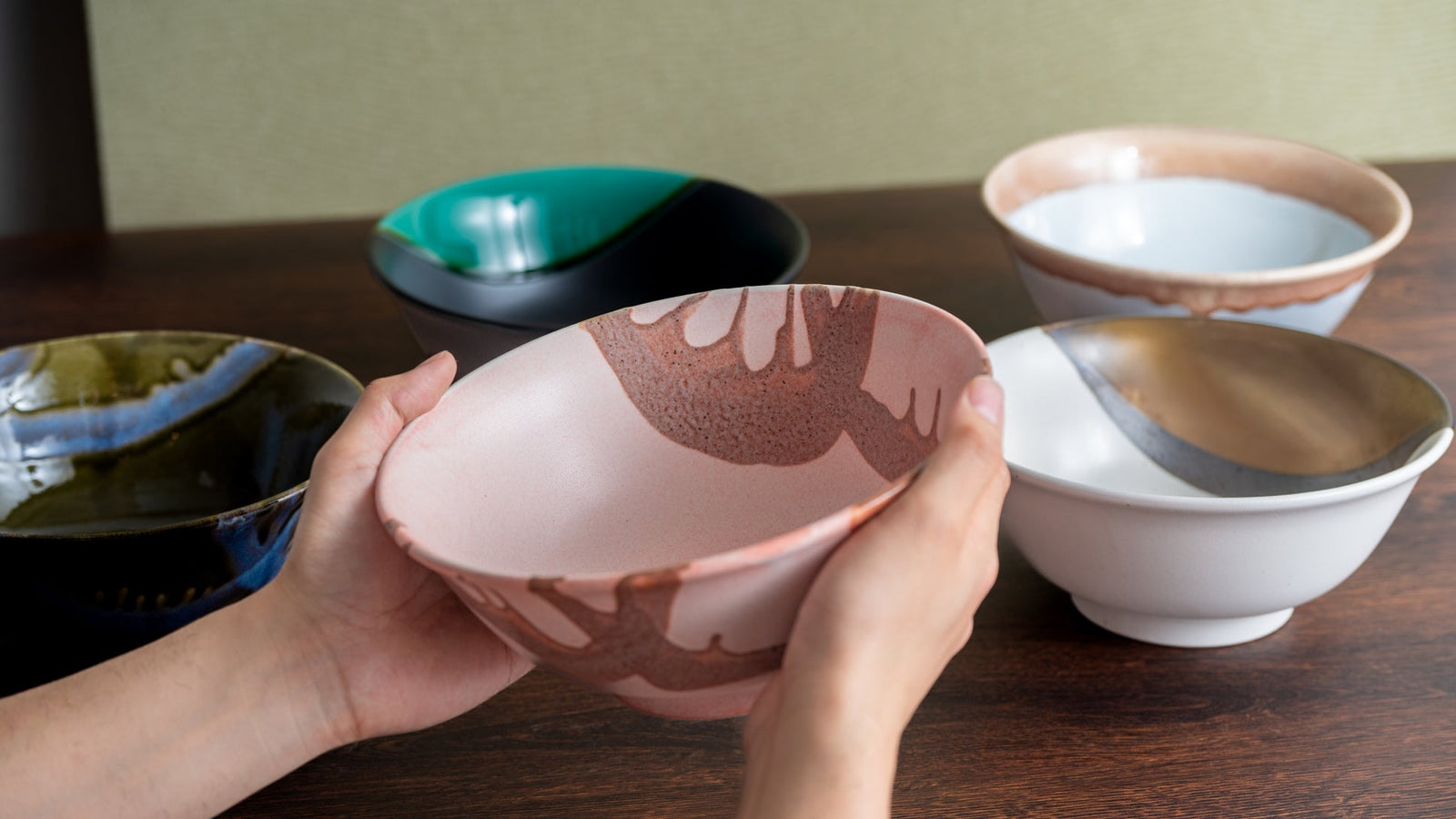
The sweltering heat of late August in Japan couldn’t dampen our excitement as we stepped into Tajimi City, where the culture and craftsmanship of Mino ware have been passed down for generations. With temperatures soaring and the summer sun beating down relentlessly, we embarked on an extraordinary journey to witness the birth of our original ramen bowls, a process that revealed the meticulous artistry and dedication behind each piece.

This remarkable collection represents the perfect marriage of two exceptional artisan kilns, each master in their own craft. After extensive research and careful consideration, we chose to collaborate with DAITOUA Ceramic Co., Ltd., renowned for its exceptional firing techniques that give our bowls their fundamental strength and character. Working in perfect harmony with them is Genbei Kiln Co., Ltd., whose glazing expertise transforms each piece into a work of art with its signature finishes and lustrous surfaces.
What you're about to discover is not just the technical process behind our original ramen bowls, but the soul and passion that goes into every single piece—a story of tradition, collaboration, and the relentless pursuit of perfection.
Where the Story Begins: Our Original Ramen Bowls
Late August in Japan is the kind of heat that makes the air feel thick. The sun doesn’t so much shine as press down—bright, insistent, and strangely intimate. Tajimi City was no exception. If anything, its reputation as one of Japan’s hottest towns felt like a rite of passage for what we were about to watch be born here: our original ramen bowls.

Our bowls started as a simple but stubborn idea. We wanted something that could carry ramen the way ramen deserves to be held—generous, comforting, and visually grounded. Not a decorative bowl that happens to fit noodles, but a ramen bowl that understands the experience of ramen: the heat of the broth, the heft in your hands, the way toppings spread across the surface, the quiet satisfaction of finishing the last sip.
And because this project is meant for kitchens outside Japan, size had to be part of the conversation from the very beginning. Umehara, the person in charge of this project, put it plainly when we discussed our starting point: these bowls are for people who eat ramen in a different rhythm. In many American homes, ramen lands on the table closer to a full meal than a light late-night meal. A standard Japanese home bowl can feel small if you’re used to larger portions, more broth, or simply the visual comfort of a wide surface that lets the ingredients breathe. So the silhouette we imagined needed to be “American-friendly” without losing the Japanese logic behind it.

That tension—between honoring a Japanese craft tradition and meeting the everyday habits of an English-speaking audience—became the heartbeat of the whole project. We weren’t trying to “make Japanese bowls bigger.” We were trying to translate a way of eating into another home culture without flattening what makes it Japanese.
It’s easy to romanticize ramen bowls as objects. But the more time we spent thinking about them, the more we realized that a bowl is a kind of stage. It frames a meal. It changes how the food reads. It sets expectations before a spoon even touches broth. In Japan, that framing is not separate from daily life; it’s part of what makes daily life feel considered. We wanted to offer that same chance to people elsewhere—not a lesson in aesthetic purity, but a practical invitation: you can eat well and beautifully even on a Tuesday.
So with that spirit, we stepped into our first stop: DAITOUA Ceramic Co., Ltd., where the bowls would take their physical form.
DAITOUA Ceramic Co., Ltd.: Craftsmanship at Scale
If you’ve ever held a ramen bowl and felt that almost unexplainable confidence in it, the way it sits solidly in your palms, the way the rim feels inevitable rather than arbitrary, you’ve felt the results of invisible decisions. At DAITOUA Ceramic Co., Ltd., those decisions are made in sequence, each one depending on the last. The process looks smooth when explained quickly. In practice, it’s a long chain of controlled variables that can make the whole process go wrong if even one slips.
We began our interview with a deceptively simple question: Once you receive a plaster mold, what happens until the bowl is finished? The answer came with a calm efficiency that only experience can produce. First, there’s the raw material: haido, a type of ash clay. The clay is fed into a kneading machine, where water and pressure bring it to the right texture. That clay isn’t shaped by hand in this case—it goes into a fully automated forming machine that presses it into its bowl form.
It sounds straightforward. But in the middle of that explanation, the DAITOUA team kept returning to one word: management.
“The first critical point is the clay’s hardness,” they told us. Clay, to most of us, is a single material. At the kiln, it’s a shifting substance that responds to water almost too sensitively. Add a little too much moisture, and the shrinkage will change during firing. Too little and the clay stiffens, affecting thickness and pressure in the mold. Either way, the bowl risks deforming later.

Water is the quiet protagonist here. If its ratio is off, the bowl’s shrinkage curve changes. That curve is what determines whether the final piece emerges round and stable—or warped, cracked, or subtly skewed enough to fail inspection.
From there, forming takes over. Even in automation, the machine doesn’t “just run.” Rotation speed, room temperature, and the day’s humidity all influence how clay settles into the mold. Summer in Tajimi is not a neutral environment; it’s a living condition that forms part of the recipe. The team described constant micro-adjustments, little recalibrations made by feel—because even with machines, you’re still negotiating with nature.

What fascinated me most was how they talked about our bowls’ size. These are larger than standard Japanese home bowls. In their words, “the bigger the piece, the more severe the management becomes.” Large forms amplify every small mistake. Shrinkage differences become more dramatic. Weight stresses the clay more during handling. Drying takes longer and risks becoming uneven.
When we asked whether large bowls change during firing, the answer didn’t veer into mystery. It returned to basics: shrinkage depends on the clay’s moisture from the very first kneading stage. If the water ratio is inconsistent, shrinkage varies, and thickness changes, which can lead to warping, tearing, or cracking later. Large bowls don’t create new problems; they magnify old ones.
They also explained something about cultural design that felt quietly profound. In Japan, household bowls often look smaller than they are. They’re designed to be compact, so they store easily, but their inner depth gives them capacity. Space in Japanese homes is limited; tableware has to earn its place by being multi-purpose and efficient.
Restaurant bowls, on the other hand, often look big but hold less. The aim is visual satisfaction—making a serving look abundant while controlling ingredient cost and soup waste. Broth is expensive and frequently left behind. So restaurants use bowls that appear generous but are engineered to hold less liquid.

Our ramen bowl asked for something else entirely: a bowl that looks big and truly is big. A wide, confident profile that holds enough broth for the way many Americans eat ramen at home, while still feeling refined rather than oversized. It’s not just a size adjustment. It’s a cultural translation built into the form.
There were technical hurdles tied to our specific silhouette, too. Our design includes a shoulder area that curves in a way that isn’t typical for automated forming. In the mold, one side becomes convex while the clay body needs to become concave. That condition can cause clay not to fill properly, tear during release, or even break the mold itself. “It’s not a common forming condition,” they said, “so defects happen easily. That part requires especially severe control.”

When we left DAITOUA Ceramic Co., Ltd., what we carried with us wasn’t just a set of notes about clay hardness and shrinkage. It was a deeper appreciation for how much discipline lives inside work that looks effortless. Now, our bowls had their bodies. Next, they needed their skin—the surfaces that would make them unmistakably ours.
That brought us to Genbei Kiln Co., Ltd.
Genbei Kiln Co., Ltd.: Artistry in Detail

If DAITOUA Ceramic Co., Ltd. is where the bowls gain their strength, Genbei Kiln Co., Ltd. is where they learn how to speak.
Glaze is often described as “color” in casual conversation. At Genbei Kiln Co., Ltd., it’s closer to chemistry, mood, and risk management rolled into one. Their studio felt different the moment we walked in: smaller scale, quieter movements, shelves full of test pieces that looked like a painter’s palette in three dimensions.

We asked them to explain their glazing approach. They started with balance—both visual and structural. When a bowl carries multiple glazes, each glaze has its own expansion and contraction rate during firing. Even a single white glaze layered next to another color can create stress because the materials want to move differently in the kiln’s heat. One glaze wants to stretch; another wants to shrink. That difference turns into a literal pull between surfaces. If the tension is too strong, the piece can crack with a sharp, sudden fracture.
So whenever they plan a design, they examine two things first: Does the finish look right? Can the bowl survive it?
That survival question is not theoretical. If the combination is wrong—even if the color is gorgeous—the bowl might crack in firing, or worse, later in shipping. For a project that needs to travel across the world, durability isn’t optional. A beautiful bowl that arrives broken is just a story of regret.

Genbei Kiln’s process for selecting combinations sounded less like picking colors and more like building a relationship. They make samples, fail them, adjust, fire again, and slowly narrow down to “the one.” It’s incremental, almost stubbornly patient. “Once the theme is set, the combinations are endless,” they said. “We keep testing until one becomes right.”
Layering techniques added another level of nuance. They described pouring, half-and-half splitting, 3:7 area ratios, and finishing the rim with a transparent glaze ring that can encourage delicate crackling. Each technique is a different way of persuading the glaze to form.

Timing is another hidden skill. For multi-layer glazes, the second layer must be applied before the first fully dries. Too early, and the colors flood together. Too late, and the surface traps air or forms bubbles, leaving pits in the final finish. With rim crackling, the time window is even narrower. If the rim dries too much, air enters, holes open, and the effect fails. They said, “You can’t see it—it's a feeling.”
What made our bowls even more challenging, they added, was their scale. This isn’t a size Genbei Kiln Co., Ltd. handles every day. A ramen bowl this wide and deep is rare in their usual production, and glazing it by hand changes the entire setup. To coat a piece like this evenly, they can’t rely on the small jars and troughs they use for standard wares; they have to prepare larger vessels just to hold enough glaze for dipping and pouring. The volume of glaze itself becomes a different order of planning—more material, more careful mixing, more attention to how viscosity shifts as the batch sits.
In practice, that size also makes the physical act of glazing less forgiving. Holding a bowl this large with one hand while pouring or splitting glazes with the other can throw the angle off by a hair, and a hair is all it takes for a 3:7 ratio to turn into something unintended. There’s the risk of the bowl slipping, the risk of the glaze running heavier on one side, and the risk of your own strength giving out halfway through a clean line.

They said all of this almost casually—until they handed me one. “Try it,” they laughed. The moment I lifted the bowl, I understood. I tried to imagine pouring glaze across that surface while keeping the balance precise, and it felt instantly humbling. What looks like a straightforward motion from a distance turns out to be a full-body negotiation: weight, timing, angle.
They praised DAITOUA Ceramic Co., Ltd.’s forming work with genuine admiration: “The body is thin, and still so clean. They’re really skilled.” Thin walls are hard to form evenly, but they make the bowl lighter to hold and more elegant in profile.

This kind of cross-kiln dialogue is rare, and it only works because the people behind it are exactly that—people: the ones who start their mornings checking a bucket of glaze by smell and viscosity, who know from a glance whether a surface is ready for the next layer, and who keep adjusting, testing, and worrying in small, practical ways because they care what happens to a bowl once it leaves Tajimi and ends up in a stranger’s hands across an ocean.
If you’ve been looking for a way to bring a touch of Japanese craft into your daily routine, we’d love for you to start here. Make your next bowl of ramen in one of our original ramen bowls. Let it carry your noodles the way it was designed to—spacious, comforting, and quietly beautiful. And as you eat, remember that what you’re holding is not just a product, but the result of real hands, real heat, and a shared belief that good design belongs in real life.


Stay close to the craft
Now and then, a quiet letter — new stories, seasonal notes, and the hands behind the work.
How Ramen Bowl Design Works: Exhibition Visit
Explore the “Art of the RAMEN Bowl” exhibit and discover how design and culture…

Otsuki Yosuke’s Art of Glass: Layering Colors, Engraving Memories
Step into Otsuki Yosuke’s world of multi-layered glass, where color, memory, and time are…
Nakada Hiroshi: Shaping Nature in White Porcelain
Enter the world of Nakada Hiroshi, where budding forms and pearl-luster surfaces create a…
Leave a comment