

Gion Matsuri: Many Hands, Lasting Impressions
Follow the Gion Matsuri from Kyoto's night market to the float turns, and the many hands that keep it moving.
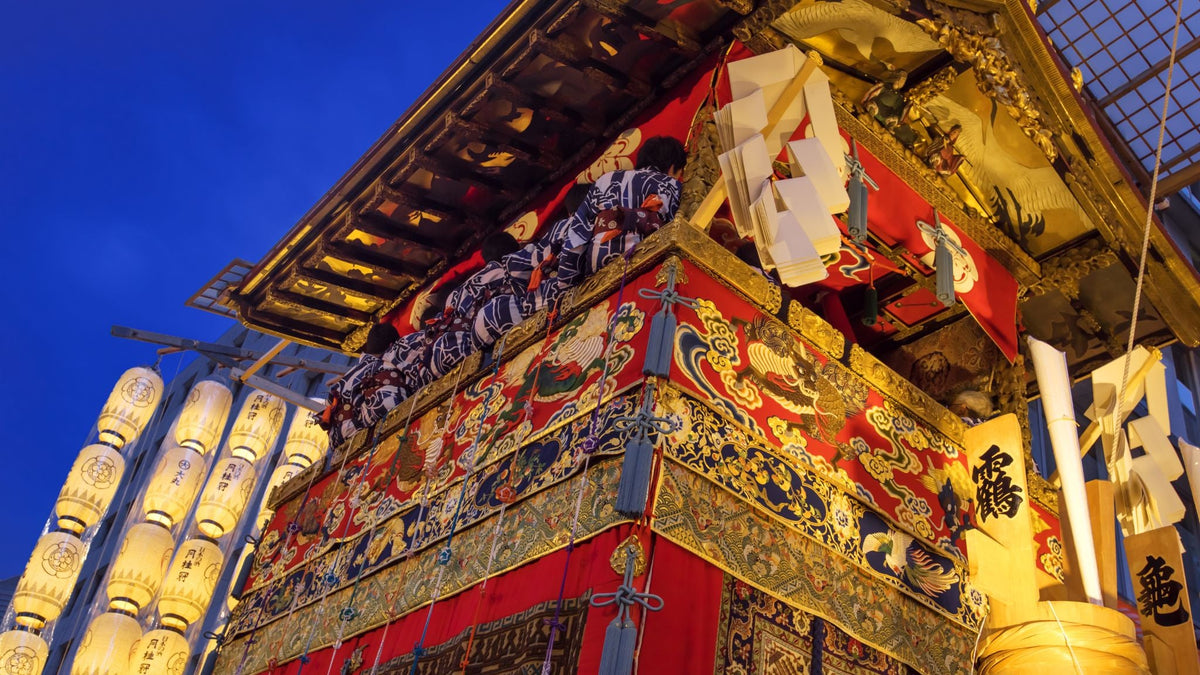
Eleven years ago, feet already soaked with rain, I walked out of the Kyoto City Subway into a crowd of umbrellas and a cloud of flute music. Before me, over the heads of hundreds of people, was the biggest parade float I had ever seen. Roughly the size and shape of a cottage on wheels, it had a mast nearly as high as the seven-story Kyoto City Hall it stood in front of. Dozens of people tugged thick ropes until the float found its new course. I was captivated.
This was my first taste of the Gion Matsuri, the 1,100-year-old festival that takes over Kyoto’s streets every July. Though I never found the friends I was supposed to meet up with that day, I stayed until the very end, chasing the final float until the streets were barred.
Now, over a decade later, I had the chance to experience the festival again. New discoveries have come into focus, deepening that sense of awe. This is what an ancient ritual looks like in practice, carried on by real people into today.
Lanterns and the Night Market

Though many events scattered throughout the month make up Gion Matsuri, its beating heart is its two processions, held every year on July 17 and July 24. The first procession is the largest, and that is what I had come to see.
A night festival is held the three nights before each procession. I arrived on the eve of the first procession. Street sellers called out their wares: juicy slices of grilled pork, whole cucumbers on sticks, extra-long fries, cold cans of beer dewed with condensation. Crowds flowed like a river down streets given over to one-way pedestrian traffic, unstoppable. Cutting through the night was the glow of paper lanterns. Approach, and a float would come into view, draped in intricate brocades.
There are two types of floats: hoko, which are roofed structures with wooden masts, and yama, generally outfitted with a wide umbrella and pine branches. Collectively, the thirty-four floats are known as yamaboko or yamahoko. Dubbed “moving museums,” each is designated as an Intangible Cultural Property.

The night market allowed me to get up close and see the details: dragon embroidery here, seigaiha wave patterns there. Intricate woodwork plated with gold. Shinto paper streamers zigzagging among sacred sakaki leaves. Then the flow of the crowd carried me on and away.
As the night got later, the crowd at first swelled, then thinned out all at once, sandaled feet making their way back to the subway to head home in preparation for the main event: the next day’s procession.
A Festival in Motion

The next morning: a main street empty of cars, lines of people clutching sun parasols in the heat, necks craning to gaze down the avenue. The city held its breath.
We could hear the procession before we saw it. Floating in on snatches of breeze in the muggy July air came the high whistle of bamboo flutes. Slowly, the sound became clearer. The crowd leaned in, trying to catch the first glimpse.

There—the first banner, reading “Gion Festival.” Then a group of men in hakama (formal pleated trousers worn over kimono) walked by, flat bamboo hats in hand. As they passed, the flute music got closer and closer. Two lines of ropes emerged, pulled by young men. Each year, university students from across Kyoto are recruited for this task. Many hands are needed; the rope just kept coming. The sound of drums and high-pitched gongs joined the meandering melody of the flutes. Then, the source of the music emerged: the first float, the Naginata-hoko.

Although other floats draw lots to determine procession order, the Naginata-hoko always comes first. The brocades and gold we saw in lantern light the night before now shone under the late morning sun.

At the tip of its mast—which I learned later reaches 25 meters (82 ft) in the air—glinted a curved blade, a Japanese halberd known as a naginata that gives this float its name. Perched front and center atop the platform was a young boy in ceremonial white face paint and a phoenix crown. For the duration of the festival, this child is considered a messenger of the gods.

A Shinto festival, the Gion Matsuri’s purpose is to ward off epidemics and disease. According to Yasaka Shrine, which hosts the festival, it is believed the yamaboko floats were originally created to appease plague gods. The music that fills the streets is intended to calm those vengeful spirits.
The most popular spots for spectators are the three corners where the floats turn. This is where good old-fashioned manpower truly shines. The wheels of the tall hoko floats do not pivot on their own. Instead, the entire float must be manually dragged to face a new direction.

We watched as bamboo slats were placed under wheels as tall as a person. Water was brought in by the bucketful and splashed on the street. This reduces friction, helping the floats turn. Two to four men stood at the front axle of the float, large folding fans in hand, observing closely.

Movement, bustle, bated breath. The swirling melody slowed down, sped up. Finally, the signal. With a shout, the folding fans snapped forward, directing those who held the ropes. Feet scrabbled against the ground as the ropes were pulled taut. The float turned slowly, ponderously, about twenty degrees, where it stopped. The crowd clapped, cheering on the procession. But the work wasn’t over yet; the float needed to turn a full ninety degrees. And so the process began again.

The amount of collaboration involved was breathtaking. Finally, after multiple rounds of laborious turning, the float found its new path. It rolled along, as serene as anything, mast waving gently with its movement, as if it hadn’t just been dragged into a new position by fifty-some-odd people sweating under the hot sun.
Engineering Across a Millennium
The city of Kyoto itself makes way for the festival. Nets are set up in advance on electricity poles to prevent the high roofs and masts from damaging the lines. Carpenters with each hoko float sit on its roof, taking care to prevent accidents.
During the procession, the water that helps the floats turn is poured from fire department hoses into thigh-high wooden buckets before being carried toward the wheels.

Many floats—especially the hoko—are taller than the traffic signals, which have to be moved out of the way to allow the floats to pass.
As soon as the last float rolled its way into the final side street, I watched as a truck with the Kansai Signal Service sprang into action. Helmeted workers went up in a crane lift to reset the traffic signals, turning them back over the road. The whole effort took mere minutes. I was amazed at the timing and efficiency.

At the end of the procession, each float returns to its preservation society. These buildings are permanent fixtures of Kyoto’s downtown, their modest two stories and tile roofing seemingly incongruous with the sleek high-rise office buildings that flank them.
The very street itself lies in wait for the floats. In front of the preservation societies are square holes in the road. Ninety-nine percent of the year, these are covered by metal lids. But at the end of the parade, it’s a different story.


The metal lids are lifted, and the “feet” of the floats are lowered inside. Why? The floats have to be taken apart immediately after the procession. This is to disperse the plague spirits that are drawn to the yamaboko during the procession. Placing the feet of the floats into the holes in the streets allows them to be attached to a pulley system and levered onto their sides to take off the mast.

As I watched three of the hoko floats—the Naginata-hoko, Tsuki-hoko, and Kanko-boko—get taken apart, I was struck by what feats of engineering they are. Once the brocades were taken off, the inner structure was revealed. Around crossing and interlocking beams of wood are wound miles and miles of rope—literally. For instance, the Kanko-boko is held together with as much as 5–6 kilometers (3.1–3.7 mi) of rope, according to its preservation society’s website. Not a single nail is used in the assembly.
The task is so extensive that the floats take two to three days to completely disassemble. Once the disassembly is complete, the pieces are stored within their preservation society until the following year’s Gion Matsuri.


Looking carefully, I noticed that many of the beams are labeled with their position carved into the wood, such as “northwest corner” and “north interior.” The mast of the Tsuki-hoko carried the name of its creator, a record that will remain until years later when the wood reaches the end of its lifespan as a mast. Other pieces were carved with the year they were presumably replaced: dates like Heisei 20 (2008) and Showa 36 (1961).
What emerges is a story of construction and collaboration, layered and renewed over years. Each generation adds their own mark. As each piece wears out, a new one is created. Like this, the baton has been passed over hundreds of years.

That night, as I lay in my futon, I could still hear the whistling melody of the flutes. The silent sound was still there: ringing in my ears, in the touch of the air, in the hum of the air conditioner. It was the musical equivalent of the way you feel like you’re still on a boat when you lie down to sleep the night after being at sea. Moving, but still. Audible, but not.
Just like the sound in my ears, the festival would stay with me long after it ended.
Back in Tokyo, I pondered how Gion Matsuri turns “tradition” into a verb. It isn’t something that’s preserved in museums. Rather, it is something in motion, actions taken year over year by real people. Like this, Gion Matsuri continues to ring down the generations.
Stay close to the craft
Now and then, a quiet letter — new stories, seasonal notes, and the hands behind the work.
Kyoto Chronicles: Adventures in Art and Appetite
Join Team Musubi in Kyoto to discover pottery, savor delicious food, and explore crafts…
Shirata Ai
Kyoto Chronicles: Inside the Workshops of Master Potters
Discover Kyoto’s pottery at Tosen Kiln’s vintage glazes and Touan’s revival of the rare…
Rebecca Menasché
Exploring Artistic Kyoto’s Ceramic Culture
Take a trip to Kyoto with Team Musubi, exploring the ancient city's renowned artisans…
Zhao Minyi
Leave a comment