

How Chrysanthemums Bloom in Jonamagashi Sweets
Watch a fourth-generation Tokyo artisan shape autumn chrysanthemum wagashi petal by petal, with no mold.
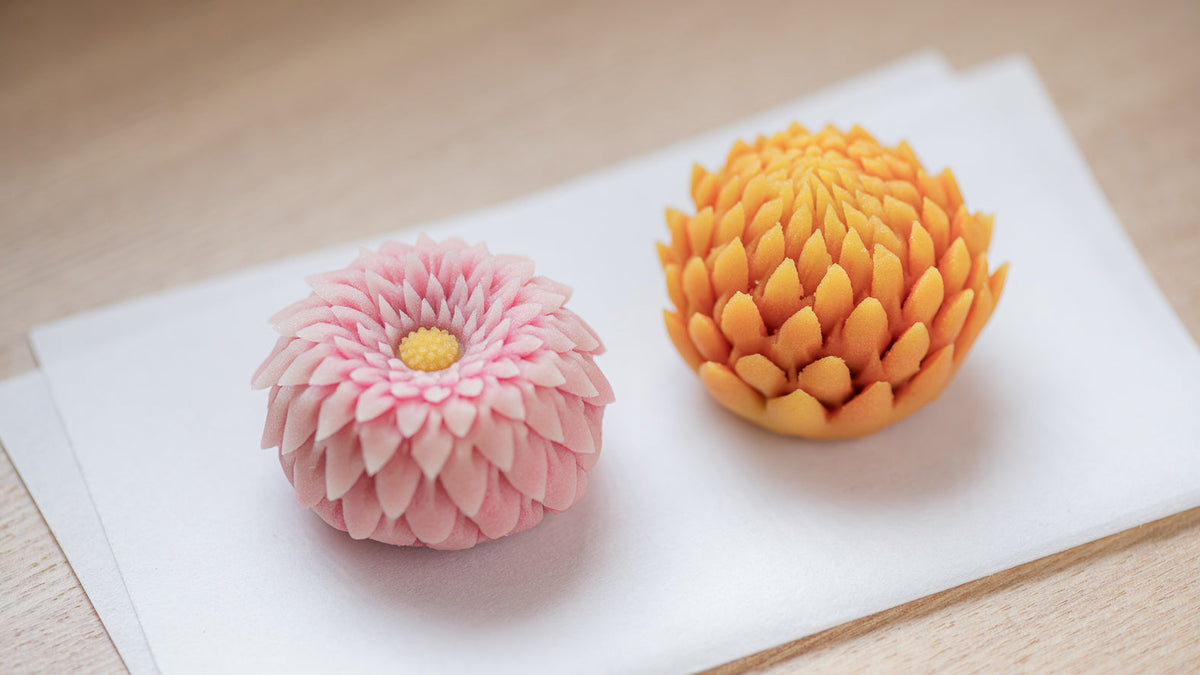
For just a few weeks each autumn, Inoue Takeshi transforms a ball of nerikiri dough into a chrysanthemum using nothing but a pair of specialized scissors and a wrist motion refined over years of practice. Fourteen petals emerge in each row, cut one by one in a single, continuous rhythm. There is no mold, no template, and no second chance once the scissors touch the dough.
The chrysanthemum is one of autumn’s most recognizable motifs in jonamagashi sweets, a category of seasonal fresh wagashi, appearing in confectionery shops only briefly before disappearing again. While its form is instantly familiar, few people stop to consider how those delicate petals are created. Behind each blossom lies a technique that demands years of repetition, careful judgment, and an almost instinctive feel for the dough.
At Kagurazaka Baikatei, fourth-generation wagashi artisan Inoue Takeshi carries on this tradition with the same pair of scissors once purchased by his grandfather nearly a century ago. We visited his workshop to see how a seasonal technique practiced for only a few weeks each year is refined and passed on—one precise cut at a time.
The Chrysanthemum: A Symbol of Autumn

The chrysanthemum is one of Japan’s most well-known autumn blooms. During Choyo-no-Sekku, the traditional festival held on September 9, chrysanthemums are celebrated as a symbol of long life and good health, with their petals floated in sake as part of the festivities. The flower has also long appeared in wagashi, where its layered petals offer a natural way to express the changing seasons.

As a wagashi motif, the chrysanthemum takes many forms, from simple shapes pressed into the surface of a sweet to flowers built petal by petal by hand. Its familiar silhouette makes it immediately recognizable, but its appearance can vary greatly depending on the artisan and technique.
At Baikatei, Inoue Takeshi shapes this flower by hand using a technique called hasami-giku—literally “scissors chrysanthemum.” He learned it from his grandfather and has spent decades refining it.
Shaping Life Into Chrysanthemums

Inoue specializes in two kinds of hasami-giku jonamagashi sweets. At Baikatei, these are called Chiyogiku and Chomeigiku. Both share the same fourteen-petal design, but the way each flower is cut is different. Before the scissors touch the nerikiri—the soft dough made from shiroan (sweet white bean paste)—there are already decisions to be made.
Preparing the Nerikiri

The dough begins as shiroan: the beans are boiled, strained, and mixed with sugar. Once it reaches the right consistency, gyuhi, a soft mochi made partly from rice, is worked into it, giving it enough elasticity to hold its shape once the scissors touch it. For hasami-giku, he prefers the dough to be kneaded a little firmer than usual. Rather than adjusting his technique to the dough, he has it prepared specifically for cutting.
This balance becomes particularly difficult in winter, when dry air can quickly draw moisture from the dough. The ingredients and preparation are adjusted according to the season so that the nerikiri is in the right condition before he begins.
Layering Color


Color is another part of the flower’s character. Inoue changes the colors of his jonamagashi throughout the chrysanthemum season, from early August into December. He adjusts them roughly every fifteen days, taking the changing season into account while also considering the overall balance of the six to eight jonamagashi in the shop. Only natural colorants are used, including gardenia and safflower. For our visit, the wagashi artisan chose light pink for the Chiyogiku and a yellow variation for the Chomeigiku.


The white nerikiri for the Chiyogiku is flattened and wrapped around the pink nerikiri. Inoue gently rounds the layered dough in his hands, allowing the colors to blend slightly, before flattening it again, revealing the gradation between the two colors.


In that colorful layer, the koshian (smooth sweet red bean paste) is placed inside and shaped into a smooth ball by hand. The Chiyogiku is then marked at the center with a special wooden stamp. At this stage, it still looks like a simple ball of dough. The flower is only beginning to emerge.
Cutting in Two Directions
This is where the two chrysanthemums begin to diverge. Only three artisans at Baikatei can perform what comes next. The shaped nerikiri is now ready to be cut, with each type taking a different approach.

Inoue begins cutting the Chiyogiku—petal by petal—from above, using straight-bladed scissors. He starts with fine cuts, gradually making them larger.

After the first row, the stamped center is filled with yellow nerikiri. He continues cutting around the dough with controlled movements of his wrist.

The next chrysanthemum he is working on is the Chomeigiku, which is cut from below using curved scissors. Here, he begins with larger cuts, gradually making them smaller toward the top.

Rather than moving the scissors constantly, Inoue rotates the nerikiri, bringing each new section to the blades. For the Chomeigiku, he places the nerikiri on a small container and rotates it instead of holding the dough in his hand, which would get in the way when cutting from below. The movement is small and controlled, but the finished flower depends on the accumulated effect of each cut.

Fourteen petals in each row, across eight rows—for Inoue, it’s less a design he repeats than a rhythm his hands have learned to trust, turning nerikiri into a piece of edible art almost too beautiful to eat.
Finding the Rhythm
Inoue makes around twenty pieces of each type of jonamagashi each day. By now, he has made both chrysanthemums so many times that he no longer consciously thinks through each movement.
“My mind naturally becomes empty, and I just focus on what’s right in front of me. I don’t play music while I work. … But I do try to keep a certain beat, or rhythm, as I make each cut. If that rhythm falls apart, the shape will fall apart too, so I make sure to keep the rhythm consistent. … I try to avoid [interruptions] as much as possible. It changes my state of mind.”

The Chiyogiku is more physically demanding, putting greater strain on the wrist. Over years of making these chrysanthemums, the wagashi artisan has learned how to manage the strain through regular hand exercises.
The most difficult moment comes at the end. After thirteen petals have been cut, the fourteenth has to meet the first and close the circle.
“When you’re just continuing the cuts one after another, it’s relatively easy. The difficult part is making sure the first and last petals connect properly. At the end, I have to adjust the timing so that they meet, and that comes down to the width of each cut.”
It is a small detail that is easy to miss when looking at the finished flower. But in the process of shaping it, the entire circle depends on that final movement.
Carrying the Craft Forward
Inoue began practicing the art of making wagashi when he was around sixteen. His father had passed away when he was ten years old, so it was his grandfather who taught him the craft. He remembers him as a gentle teacher who did not simply point out what was wrong, but showed him what was right and let him work toward it himself.
Since he was given the opportunity to start making jonamagashi from an early age, he was able to master the scissors-cut chrysanthemums relatively quickly. Eventually, his grandfather told him, “When it comes to hasami-giku, you’re already better than I am, so you’re fine on your own.” With that, Inoue was left to continue exploring the technique for himself rather than simply reproducing what he had been taught.

The scissors themselves, however, remain a link to his grandfather, who bought them as a young man. Inoue estimates they may now be around a hundred years old, and he has used the same pair throughout his career, providing a physical thread back to the person who first taught him the craft.
To care for these inherited tools, he had a paulownia-wood box, known as a kiribako, custom-made in Kyoto. Paulownia naturally regulates humidity, and according to Inoue, the box also helps keep the scissors from rusting. The case gives them a fitting home, complete with a chrysanthemum drawn on its lid.
His chrysanthemum jonamagashi, however, have changed over the years. The wagashi artisan says that his earlier flowers were more angular, with straight, sharp petals. Today, he wants them to feel more like flowers in bloom, with a sense of vitality. “I want to create a form that feels full of life, as if the flower is blooming,” he says.

That sense of vitality is shaped as much by his training as an artist as by his years with the scissors. Thanks to Inoue’s background in art, which began at university, he can take on custom wagashi orders that go beyond a fixed design—sweets commissioned for tea gatherings, where some come with detailed drawings, while others begin with only a theme or a few clues, which he interprets through shape, color, and texture. He keeps catalogues of the designs he has created, building a record of these one-off pieces over time.
Some of the designs he makes today have been passed down over generations, but most are his own creations. The technique he inherited from his grandfather has become a foundation for developing his own expression.

Just as his grandfather once gave him room to find his own way, Inoue now offers that same freedom to others. Today, he has ten apprentices, and he hopes to pass the technique on to as many of them as possible. Learning to make wagashi takes time, and some apprentices spend around five years training before returning to their family shops. Others hope to open shops of their own. Around thirty people who trained under the artisan now work at wagashi shops around Japan.
For Inoue, passing on hasami-giku means more than teaching a technique. He hopes the next generation will carry it forward while finding their own way of creating wagashi with the same sense of vitality that he continues to pursue.
Wagashi as a Form of Communication
Inoue began studying the way of tea at the age of forty, after years of making wagashi. He had wanted to learn since childhood, and eventually found the opportunity to study with a tea master alongside other young wagashi artisans. For him, the two crafts were a natural pairing: learning how tea is prepared and served could deepen his understanding of the sweets made to accompany it.

Through tea, Inoue began to see wagashi in a different way. A tea gathering unfolds as a story. A hanging scroll, flowers, the design of a tea bowl, and other details each offer a clue. “It’s almost like solving a puzzle,” he says. “Then the wagashi is served, and little by little, you get closer to the answer.” He began to think of wagashi not simply as something to eat with tea, but as part of a story created in the tea room.
This way of thinking has also shaped how Inoue teaches wagashi to an international audience. During a workshop for a French family, for example, he asked them to make a sunflower and an asagao (Japanese morning glory). The sunflower was familiar to them, but the morning glory was not. “You can’t make something you’ve never seen before,” he realized. Since then, he asks where participants are from before his workshops and chooses flowers accordingly, working with interpreters to introduce wagashi through references that are familiar to each group.

During a visit to the UK, he found another point of connection. Many of the people he met were interested in vegan food, which gave him a way to introduce wagashi through Japan’s history of plant-based eating. Rather than presenting wagashi simply as a traditional Japanese sweet, he could connect it to ideas and experiences that already meant something to his audience.
Perhaps that is what keeps him returning to hasami-giku, year after year.
“Wagashi is a form of communication. It’s not enough for it to convey only what we, as artisans, want to express. How the person receiving it feels matters just as much. Just like with words, when someone says, ‘I’m happy,’ ‘It looks delicious,’ or ‘It’s beautiful,’ that means the communication has been successful. As long as there are people who feel that way, I believe there’s a reason to keep making it.”

Kagurazaka Baikatei Main Store
Kagurazaka Baikatei Building, 6-15 Kagurazaka, Shinjuku-ku, Tokyo, Japan
Stay close to the craft
Now and then, a quiet letter — new stories, seasonal notes, and the hands behind the work.
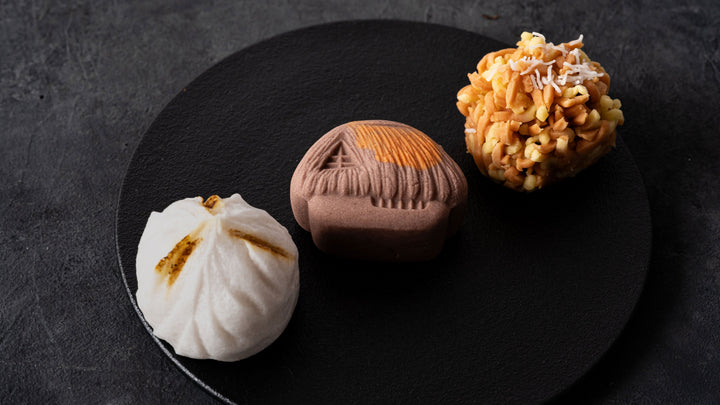
Wagashi: Japanese Sweets and Aesthetic Tradition
Learn about traditional Japanese sweets, celebrated for their delicate beauty and seasonal designs.
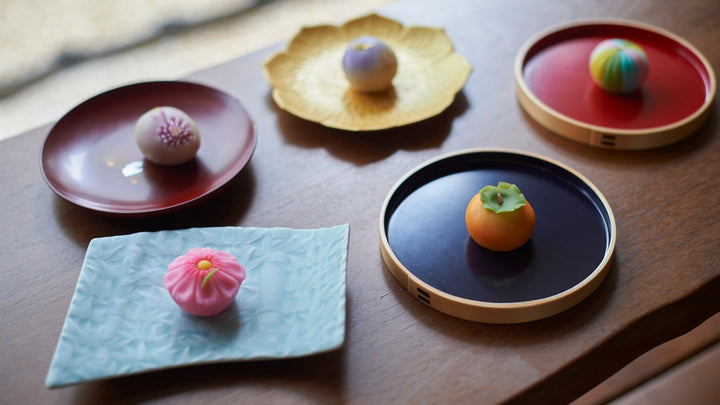
What is Nerikiri? All About Japan's Traditional Confection
Discover fall wagashi that embody the flavors of autumn in Japan. Learn about nerikiri,…
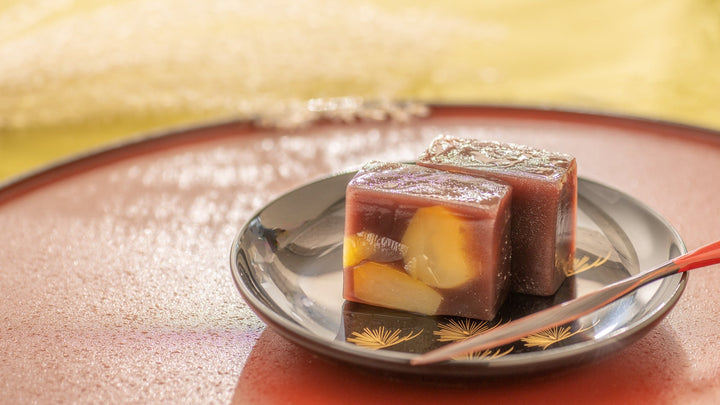
A Harvest of Sweets: Discovering Fall Wagashi
Discover fall wagashi that embody the flavors of autumn in Japan. Learn about nerikiri,…
Leave a comment