

How to Brew an Excellent Cup of Gyokuro Green Tea
Learn how to brew Gyokuro green tea with easy steps, ideal water temperature, and the best tea tools.
Do you know gyokuro?
Gyokuro is one of Japan’s finest green teas, carefully cultivated through a unique growing method. What sets it apart is its gentle sweetness and deep umami—smooth, rounded flavors that feel richer and more nuanced than ordinary sencha. The taste is soft yet layered, inviting you to slow down and pay attention.
It may look a little intimidating at first, but gyokuro is surprisingly simple to brew once you grasp a few essentials. In this blog, I’ll show you how to bring out its full character and elegance with confidence.
What is Gyokuro?

The name “gyokuro” is said to come from the way the leaves are finished during processing—tightened into small, rounded shapes that resemble glistening drops of dew. It is a high-end and rare green tea prized for its especially intense umami and sweetness. With only a restrained edge of astringency or bitterness, its greatest appeal lies in the richness, rounded mouthfeel it delivers.
According to the Ministry of Agriculture, Forestry and Fisheries’ report, released in April 2025, gyokuro accounts for just 0.8% of Japan’s total aracha (crude tea) production. Because only a tiny amount is made, gyokuro is, by that fact alone, an exceptionally precious tea.
What creates this distinctive flavor is gyokuro’s hallmark hifuku saibai (shade-growing method). By covering tea fields with materials such as kanreisha (shade cloth) to block sunlight, the plant accumulates theanine—the compound responsible for umami. This brings out a concentrated, elegant taste that sencha simply doesn’t develop.
That said, shading the fields takes substantial time and labor. Moreover, gyokuro can only be produced in a handful of regions, including Uji in Kyoto, Yame in Fukuoka, and Okabe in Shizuoka. It’s this combination of painstaking cultivation and limited output that ultimately explains why gyokuro is considered so expensive.
How to Brew Gyokuro?
Just as each kind of tea has its own ideal brewing temperature, gyokuro also has a temperature at which it shows its best character. Gyokuro is brewed at a low 50–60°C (122–140°F). Rather than watching a thermometer and waiting for boiling water to cool, here’s a simple, dependable way to prepare gyokuro at the right temperature without using a thermometer at all.
Prepare your tools

Set out a kyusu (teapot), yunomi (teacups), a tea canister, and a tea scoop.
Pour boiling water into the teapot to warm it and keep it heat-retentive. Since gyokuro is usually brewed for one to two cups at a time, a smaller teapot is recommended.
Prepare the hot water

Tap water is fine, but when brewing Japanese teas such as gyokuro, the key is to start with soft water—water with low mineral content.
From the teapot, pour about 30 cc (1 oz) of hot water into each teacup to warm them. Then discard any water left in the teapot. Warming the cups helps keep the temperature from dropping too quickly while brewing and pouring, so the tea’s aroma and flavor won’t be lost.
Add the leaves to the teapot

Empty the teapot and add the gyokuro leaves. For two people, use 8 g (0.3 oz)—about one heaping teaspoon.
Pour water into the teapot

Pour the warmed water from the teacups into the teapot. By this point, the water should have cooled to just the right temperature. Let it steep for about 2½ minutes. Because gyokuro leaves are thick, giving them time helps draw out their umami.
Pour out every last drop

When serving several cups, pour a little at a time into each cup in turn, so the stronger tea that settles at the bottom of the teapot is distributed evenly. Be sure to pour out every final drop. If water remains in the teapot, the flavor of the second infusion and beyond will be diminished.
In Japanese tea culture, it is also proper to pour with both hands—one holding the teapot, the other steadying the lid.
Enjoy the second infusion

Again, pour little by little, alternating between cups to keep the strength even. The first infusion is rich and sweet; the second is lighter and more aromatic.
The Best Tea Items for Gyokuro
Japanese Teapot
Soft-Sheen Japanese Tea Set

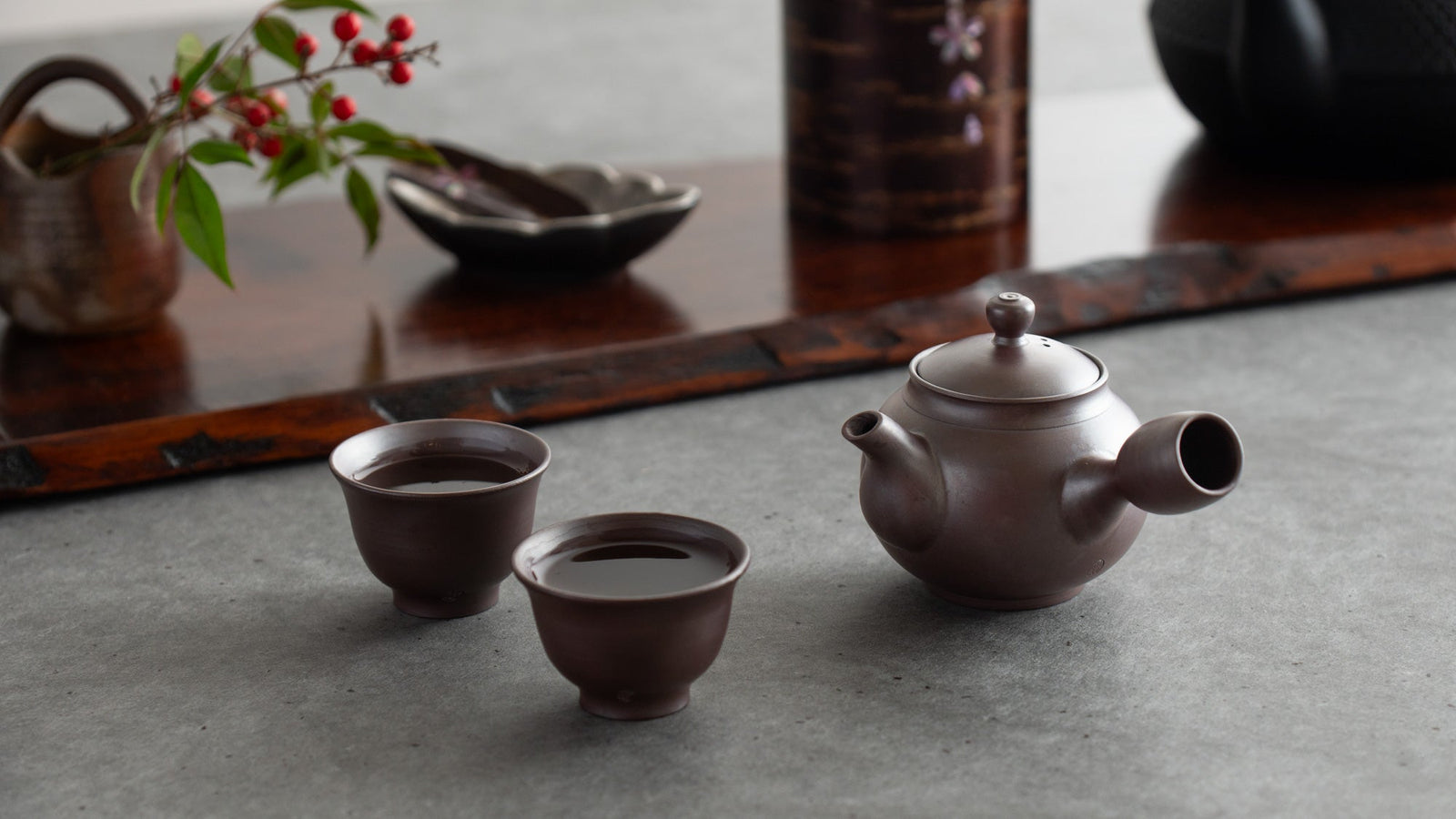
To bring out gyokuro’s natural umami and aroma in full, choosing the right tea ware matters. A Banko ware tea set made by Tachi Masaki, a traditional craftsman from Shiga Prefecture, includes tools that are exceptionally well-suited to brewing gyokuro. Purple clay retains heat well and also manages moisture, which makes it an ideal material for a tea that requires such delicate control of water temperature. The calm, understated texture unique to Banko ware further highlights gyokuro’s refined flavor.
Sakura Shiboridashi Japanese Tea Set

For gyokuro, a shiboridashi can be a quietly perfect partner, and this Tokoname ware shiboridashi teapot and teacup set is a beautiful example. The pieces have a mellow, reassuring weight that settles naturally in the hands, encouraging slower, more mindful tea moments. Hand-painted cherry blossoms drift across the warm Japanese red clay, and each cup carries its own subtle floral variation, making the set feel refined. The shiboridashi’s wide body and carefully shaped crescent spout give tea leaves plenty of space to open fully, drawing out gyokuro’s aroma and layered flavor with ease.
Tea Canister
Pink Shell Inlay Sakura Fubuki Tea Canister

To keep gyokuro leaves in their best condition, the canister itself needs dependable sealing and protection. A well-made tea canister keeps out moisture and oxygen through its airtight construction, slowing the natural fading of flavor and aroma. Because tea leaves readily absorb humidity and stray odors, a tightly sealed canister also helps preserve their fragrance for longer. And with proper light-blocking, it shields the tea from quality loss caused by exposure.
This tea canister is an ideal example of a vessel with exactly these qualities. The cherry bark used in Kabazaiku “breathes,” so while the canister remains well sealed, it also regulates internal humidity naturally. With its excellent resistance to both dampness and over-drying, it carefully protects gyokuro’s fine taste and scent.
IROIRO Tea Canister 8.1 fl oz

If you’re looking for a tea canister that’s as beautiful as it is practical, this compact canister from JINSUI is an excellent choice. It sits naturally in the hand, and it’s easy to care for day to day: the opening is wide enough to reach inside, so wiping it clean feels effortless.
Its shape is minimal, yet the surface carries the warmth you only get from natural materials. The ultra-fine sand finish gives it a soft, velvety touch, and if you look closely, tiny mineral grains glimmer gently in the light. Beyond its understated elegance, it’s highly functional as well—the stoneware body absorbs moisture effectively, helping protect tea leaves. When you close the lid, it settles into place with a clean fit and a subtle click, a small detail that speaks to its impressive airtight seal.
When brewed properly, gyokuro becomes a tea unlike anything you’ve tasted before. It holds a deep sweetness, a bright, graceful aroma, and a full, rounded umami. In Japan, its delicate flavor has long been highly prized, and it has been enjoyed as a luxury tea for special occasions.
The process is simpler than it looks, and with a few steps, you can make a truly delicious cup. Tea time isn’t only about quenching thirst. It carries a spirit of consideration for others and a kindness toward yourself. Why not choose gyokuro for your next tea moment?
Stay close to the craft
Now and then, a quiet letter — new stories, seasonal notes, and the hands behind the work.
Guide to Japanese Tea Sets
Turn tea time into a mindful ritual with Japanese tea sets. Explore styles, traditions,…

Guide to Japanese Teapots
Discover the different types of Japanese teapots. Explore various shapes, handles, strainers, and care…
How to Brew Premium Japanese Tea with a Houhin Teapot
A teapot created to brew only the finest of Japanese tea leaves. The ""houhin""…
Leave a comment