

Meet the Incense Masters: Awaji Island’s Art of Healing Aroma
Discover Awaji Island’s incense heritage and learn how traditional craft shapes refined fragrances for modern life.
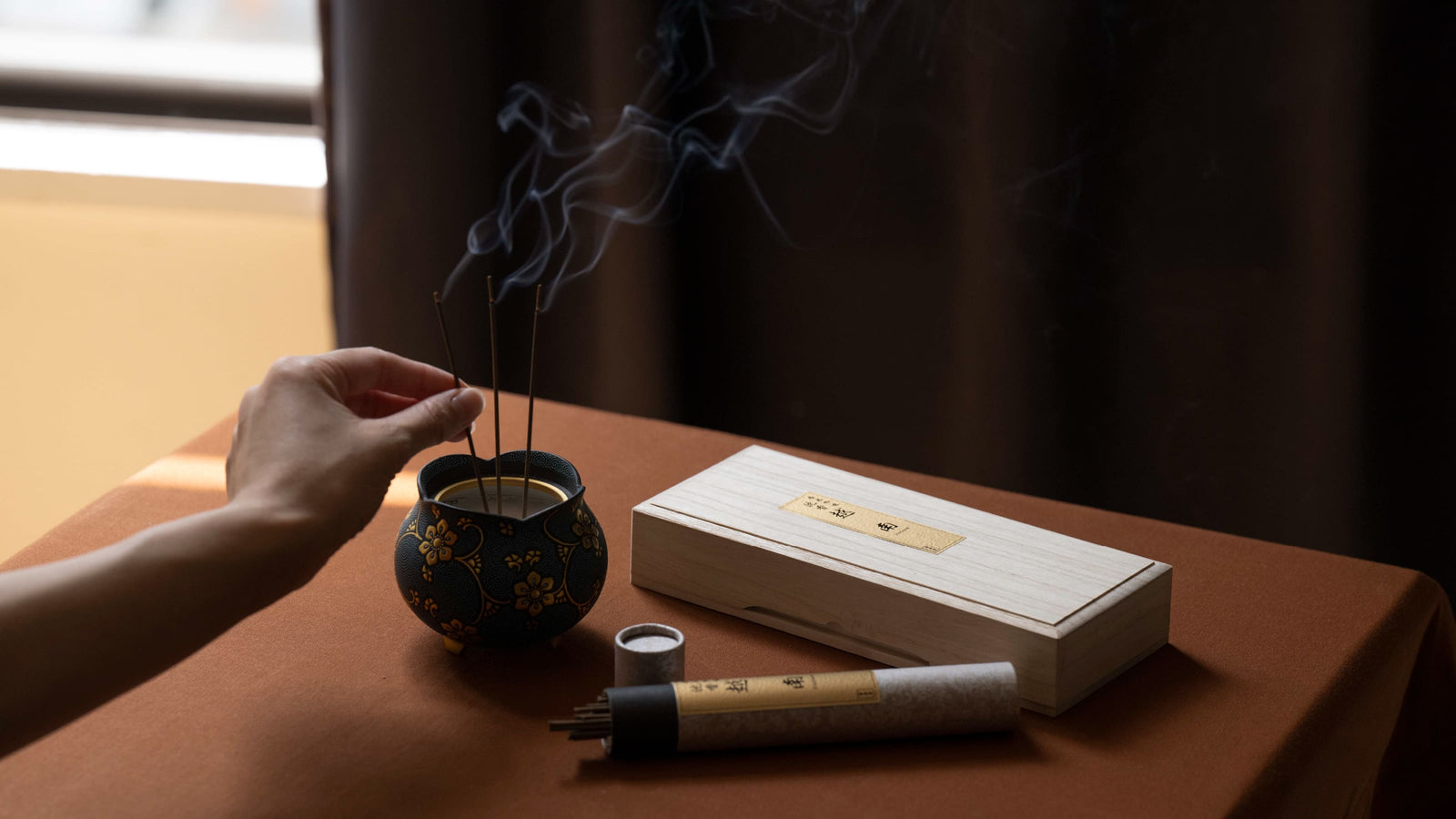
On Awaji Island, the birthplace of Japan's incense tradition, Kikujudo has been crafting fine incense for over eighty years. Across four generations, the company has honored its founding commitment to creating products of excellent fragrance and the highest quality, rooting its work in tradition while evolving to attune to modern life. This blend of generational expertise and an intuitive understanding of scent is why MUSUBI KILN partnered with Kikujudo to bring our ma organic incense to life.
To explore the philosophy behind their craft, Team Musubi spoke with Fujiwara Yujiro, the company's representative and a certified koshi (incense master). This prestigious title is held by only fourteen artisans on the island, each entrusted with the most critical step in incense making: blending raw materials to realize a fragrance exactly as envisioned.

In this interview, we delve into the techniques and sensibilities that shape Kikujudo's work and discover how fragrance, formed by human hands, can quietly enrich our everyday lives.
Born on the “Island of Incense”
Awaji Island, nestled in the Seto Inland Sea off Hyogo Prefecture, is known as an island of fragrance. Home to approximately 130,000 residents, Awaji is one of the most populated outlying islands of Japan and boasts the country’s highest incense production.

The connection between Awaji Island and fragrance dates back to ancient times. According to the Nihon Shoki, one of Japan's oldest historical chronicles completed in 720 CE, "In the summer of the fourth month in the third year of Empress Suiko's reign (595 CE), a piece of jinsui drifted ashore on Awaji Island."
Jinsui refers to jinko, or agarwood—a precious aromatic wood. When burned, it released a beautiful fragrance, and the wood was presented to the imperial court. At Kareki Shrine on Awaji Island's western coast, believed to be the place where fragrant wood first arrived in Japan, this sacred agarwood is still enshrined and venerated today.


Though such ancient tales connect Awaji to fragrance, actual incense production on the island began in the late Edo period (1603–1868 CE). The western part of Awaji shares a similar climate with Sakai in Osaka, which was Japan's largest incense-producing region before World War II, making it an ideal location for a new production center. With the sea to the west, Awaji's wind patterns and temperatures proved well suited to the drying process essential to incense making. Furthermore, as a port town where seasonal winds prevented fishing at certain times of the year, home-based crafts took root, and incense artisans multiplied across the island.
Fujiwara grew up in the Ei district of Awaji City, where incense manufacturers, including Kikujudo, are concentrated and a quarter of the population is involved in incense production. As the fourth generation of his family business, he says incense making was always close to him from childhood.
“I never consciously thought, ‘I’m going to inherit the business.’ Incense making was simply woven into daily life. Only when I look back do I realize how close it always was—family conversations, local events, the scent of raw materials. I absorbed the names and aromas of woods and spices without even trying. The craft was part of the landscape, and that path naturally became mine.”
The Koshi: Rarity and Responsibility
A koshi certified on Awaji Island is someone who bears complete responsibility for incense making, from blending to finishing, with pride and refined skill. The Japanese word “koshi” means “one who presides over fragrance.”
Certification as a koshi involves several criteria, including requirements that incense be completed entirely on Awaji Island, from formulation to finish; that only approved materials and raw ingredients be used; and that environmental standards be met.

Awaji Island's incense is born from time-honored traditional methods, rigorous quality control, and the skill and pride of the koshi. Currently, only fourteen artisans hold this qualification. As craftspeople pursuing a profound world of fragrance that mass production could never replicate, they continue to create incense of the highest quality.
Skill and Sensibility in Handcraft
Team Musubi asked Fujiwara to walk us through the production process and the craftsmanship embedded in each step.
Selecting Raw Materials
Quality fragrance cannot be achieved without quality materials, so the aromatic woods and other ingredients that form the foundation of the scent must be of the highest grade. The powdered bark of the tabu-no-ki, a primary binding agent, is carefully chosen so as not to interfere with the fragrance. Since these are natural products, quality naturally varies by origin and season. Amid this variation, Fujiwara relies not solely on numerical data but on experience and intuition to maintain consistency in the finished product.

Blending, Mixing, and Kneading
Raw materials are blended according to each formula, then kneaded with dyes and water while carefully monitoring temperature and humidity. For MUSUBI KILN's ma organic incense, essential oils are incorporated at this stage. “Fragrance isn't about being stronger or more intense,” Fujiwara notes. "Beyond technique and formulation, it's essential to listen to the resonance of the scent with your own senses and to respect the natural fragrance inherent in the materials."

Forming the Dough
The kneaded material is shaped into a cylindrical mass called neridama to prevent drying.

Extrusion and Cutting
The neridama is placed in an extrusion machine, pressure is applied to form long sticks, and these are received on a wooden board and cut with a bamboo spatula.

Shaping
The incense sticks on the board are arranged without gaps on drying boards and cut to the specified length with a cutting machine.

Drying
After cutting, the sticks are placed in a climate-controlled room to dry for about half a day.
Bundling and Completion
After drying, each stick is inspected by hand, gathered into the designated quantity, and boxed. “Incense is an extremely delicate product," Fujiwara explains. "Each stick must be handled with care to prevent breaking or bending—this is why human hands remain essential to the very end.”

From Incense for Prayer to Fragrance for Daily Life
Over the more than eighty years since Kikujudo's founding, Fujiwara has observed a significant shift in the role of incense and fragrance. In the past, the primary use was as offerings at Buddhist altars, but in recent years, incense for relaxation has become common, and more people now enjoy fragrance in their daily lives.

When asked how he feels, as the fourth generation, about adapting to these changing customer lifestyles and values, he replied: “Within this evolution, I want to discern what should remain unchanged and what can be gently updated, so that the world of incense continues to accompany people's lives.”
Originally, fragrance in Japanese culture played an important role in sensing the seasons and nature, calming the mind, and shaping spaces and relationships with others. Times have changed dramatically, but something remains constant for us: the wish for people to experience moments of peace through fragrance,” says Fujiwara. What he inherited from previous generations is not just technique, but a way of connecting hearts—between fragrance and people, between fragrance and place.

Finally, Fujiwara shared his thoughts on Kikujudo's approach to craft:
“Taking over the family business is not about preserving the past—it's about accepting responsibility for the future, with the resolve to make decisions and bear accountability. To ensure that what I receive doesn't end with me, I must not simply trace the techniques and values of my predecessors—I must bring my own sensibility. Only then can I take on challenges with the next generation in mind.”

Fragrance, they say, connects to memory and emotion. “I want to deliver the power of fragrance to accompany people's emotions and memories to as many people as possible, creating products that help people find calm and feel enrichment in their daily lives.” With these words, Fujiwara continues to hone his skills day by day, embrace new challenges, and create ever finer fragrances—all to deliver a timeless sense of peace that transcends eras.
When we quiet our minds, light the flame, and watch the gentle fragrance drift through the room, perhaps we are seeking solace in the ma—that space between past and present, stillness and motion, where true healing resides.
Stay close to the craft
Now and then, a quiet letter — new stories, seasonal notes, and the hands behind the work.
Experiencing Shibori Tie-Dyeing with Suzusan: Traditional Textiles Made Modern
Discover Suzusan’s modern take on 400-year-old Arimatsu shibori through a hands-on tie-dye workshop.
Rebecca Menasché
Discovering the Art of Bizen Ware: A Journey Through Hozan Kiln's Legacy
Step into Hozan Kiln and explore Bizen ware’s rich history, fiery craftsmanship, and beauty…
Meet the Tool Specialists Who Support Seto Ware Artisans
Go behind the scenes in Seto and meet the toolmakers and experts whose skills…
Leave a comment