

The Living Art of Bonsai
Why bonsai are landscapes rather than miniatures, and what century-old trees at Seikou-en teach about time and care.
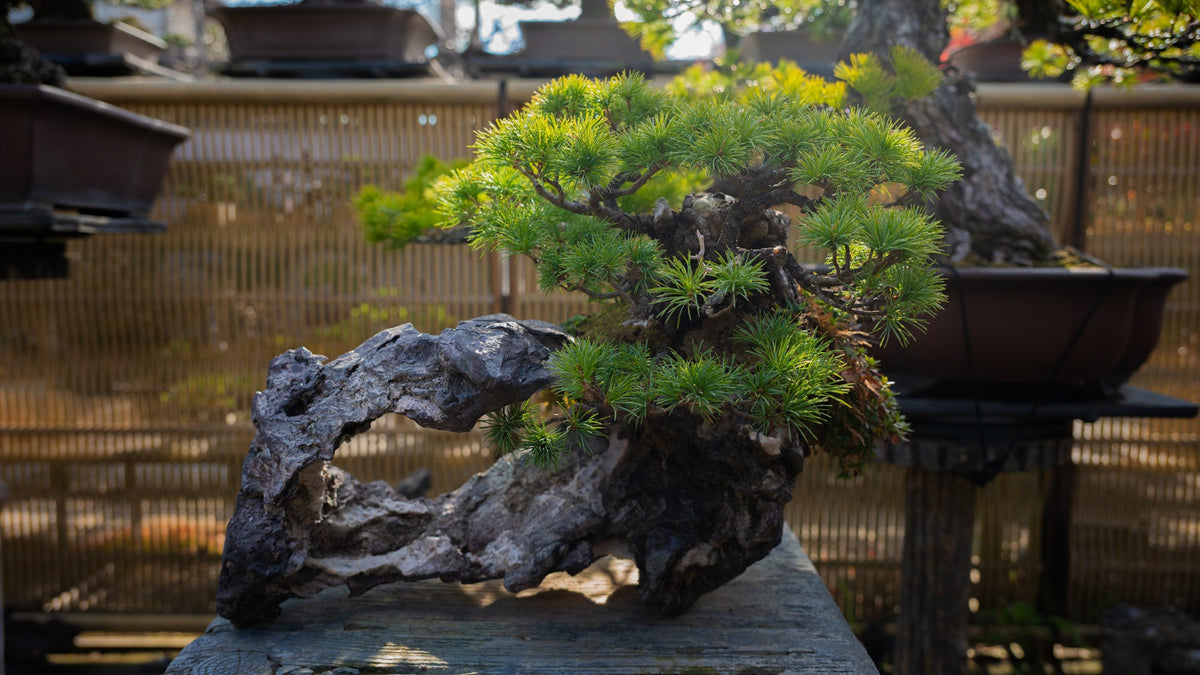
After starting to take a few photos in the showroom at Seikou-en, a bonsai garden, studio, and village in Saitama, just north of Tokyo, the Senior Managing Director, Yamada Torayuki, gently corrected me. “You’re not really getting it,” he said.

He gently pulled my sleeve so that I stooped down until my eyes were level with the bonsai pot. He pointed up into the thin trunks growing out of the nebari root base. When I was in the correct position, he let my sleeve go.
What happened then was the same feeling I get when reading a novel or watching a film—I was transported into the story. Yes, bonsai is the art of small trees, but it’s also an artistic narrative that plies your imagination and engages your senses.

As Yamada-san explained, looking from too high keeps you outside. From above, the trunks, branches, and base feel static and separate. But from the right angle, the composition of branches, trunks, roots, and leaves comes into focus, and the dynamic energy of bonsai opens up and sweeps you inside.
Outside the showroom in the sunny garden, I strolled with Yamada-san along the narrow rows of planks overflowing with hundreds of bonsai. Again and again, I stooped down to enter the displays with my imagination, marveling at the unique tensions and delicate arrangements.

These weren’t teensy trees—they were landscapes. Finding a viewpoint on them gave me the same feeling as reaching the top of a mountain to gaze over a vast valley or scrambling over a beach dune to take in the full breadth of the ocean.
Unlike some Western aesthetics, where miniatures often seem made for children, the hundreds of bonsai at Seikou-en revealed an expansive artistry that extends far beyond the playful microcosms of, say, a dollhouse. The living dynamism of bonsai can be experienced with extraordinary profundity because it’s so much more than just an art of scaling small.
Bonsai involves surprisingly complex techniques to create a distinctive object. The bends, twists, and shapes are formed not just with the skill of special bonsai tools, but through extensive knowledge of the natural forces of growth. A bonsai master must know not just how to wield the cutters, pliers, and secateurs, but also how sun, water, fertilizer, and soil impact growth and enhance the beauty of each part of the trees.
A bonsai master balances the effect of human-made tools with the natural forces acting on living trees. Knowing how those two realms interact takes years, even generations, to learn. As living entities, bonsai develop through the creative complicity of artistic and natural forces.

That pursuit stands in startling contrast with the modern age, where gushes of images race by on miniature screens, reducing the world for consumer purposes. In contrast to mini screens, bonsai express themselves through a slower and more expansive conception of time. Creative achievement is measured in decades, not seconds. Time is perhaps the element the bonsai artist works with most closely, not to hurry, but to slow down.
Viewing bonsai is to get a single glimpse of an ongoing process rather than a completed product. One sees a moment of the decades of ongoing work and care with, say, a hundred or more years of artistically shaped growth yet to come. The bonsai is a record of the shapes, sizes, and arrangements at that single moment, but its history lies on a continuum from the past into the future. Some of the trees at Seikou-en were 100 years old, others even older. I was there for a couple of hours.

In our experience of nature, we marvel at a forest for its size and history. We look at trees and wonder how many years it took for them to reach their height and canopy. With a bonsai, that time is known fairly precisely, since all bonsai contain records (not unlike humans) of when they were started and who cared for them over the generations. Forests impress in one way, and bonsai in another, but the common point is the awe of nature’s richness in concert with human care.
I asked Yamada-san how far ahead he planned as a bonsai artist. Did he imagine the result after three or four years? He laughed, no, at least thirty or forty, he told me. In short, one’s working lifetime. That made me wonder how he saw himself and his relationship to the works. Some he’d inherited from his father, some from his grandfather, and others from even farther back. The skills and knowledge are passed along together with the trees themselves.

It struck me that he would be in charge for only a short time—a few decades at most—and that those of us visiting would appreciate the works for even less time. In the world of bonsai, the aging process becomes a central focus of appreciation and respect. It’s not just that they’ve lasted long; they’ve changed again and again in slow, incremental steps through seasons and years of attention.
Though aging and history are essential, bonsai trees also reflect the moment of experience, as objects of meditation and wonder. They also accentuate the season’s most characteristic aspects—some peak in winter, others in summer. Blossoms bloom in spring, fruit ripens in summer, and leaves turn magnificent colors in the fall. Bonsai refocus attention on the beauty of the changing seasons.

Winter, the season I visited Seikou-en, doesn’t feel barren but rather a good chance to see the pattern of branches, trunks, and roots. Like many Zen-influenced art forms, open space is an essential element. The spaces between trunks and branches are just as important as the branches and trunks themselves. A bonsai in winter offers a clearer glimpse of the emptiness behind the spring and summer fullness. Emptiness, like aging, becomes a positive characteristic, giving the viewer space to enter and reflect.
The variety of bonsai is wide. Some are wildly shaped and planted in craggy rocks that extend up from the base like a miniature mountain, one of Seikou-en’s specialties. With others, the trunk becomes the central display, as with the swirling, twisting juniper trunks. Bonsai brings out a tree’s inherent characteristics, accentuating and enhancing them. Pines glimmer with green elegance year-round.
Leaves take special care. Each leaf, bud, and pine needle feels cared for individually. Some branches flow from a central trunk, while other trunks grow from separate points over the entire span of the ground, like a forest. Fruit and flowers require special care, too. Their vibrant color and rounded shapes are carefully juxtaposed with the flowing trunks and angled branches.

Whatever the unique balance of elements, the dynamic interplay of shape, emptiness, color, and texture creates a little world. It’s a microcosm, but it’s also a microscope. Bonsai lets us see how nature expresses itself up close. That understanding, which can be a kind of wisdom, lets us reposition ourselves. It is not humans who dwarf the trees—it is nature that dwarfs us, humans.
Even the most dedicated bonsai master is ultimately a temporary caretaker. The bonsai live for so long that a master can only care for a tree for part of its life, which can be most or all of the master’s working life. The ancient saying, “Art is long, life is brief,” is especially true of bonsai.

Gazing at the bonsai one after another, I was struck most by the brevity of our human existence, not as a depressing thought, but as a reminder to appreciate the beauty of nature and of time’s passing. Viewing bonsai teaches us to shift the angle and position from which we view the world, leading to a fresh conception of our place in the living world around us.
Bonsai gives us a world within a world, a fresh view of time, aging, size, and beauty. They contain the harmony that comes not from perfect symmetry, but from the patterns that nature presents. Whether one considers bonsai as philosophy, meditation, narrative, or artistic technique, it is a truly living art that celebrates life.


Presenter: Michael Pronko
Michael Pronko is a Tokyo-based writer specializing in murder, memoir, and music. He is renowned for his writings on Tokyo life and character-driven mystery novels, such as “The Last Train,” which have earned awards and received five-star reviews.
Stay close to the craft
Now and then, a quiet letter — new stories, seasonal notes, and the hands behind the work.
Journey into the World of Bonsai in Tokyo
Join a hands-on bonsai workshop in Tokyo at Seikoen and explore the beauty of…
Life in a Kamakura Kominka with Two Gallery Owners
Inside a Kamakura kominka where French vintage furniture meets Japanese ceramics in everyday life.
Okano Makami
Uncover Japanese Distilled Gin at Fukagawa Distillery
Explore Fukagawa Distillery, a Tokyo-based gin maker blending scientific glasswork, Japanese botanicals, and artistry.
Nakazawa Hiroko
Leave a comment