

The Subtle Presence of the Number Five in Japanese Culture
Explore how the number five shapes Japanese cuisine, tea gatherings, and tableware traditions still cherished today.
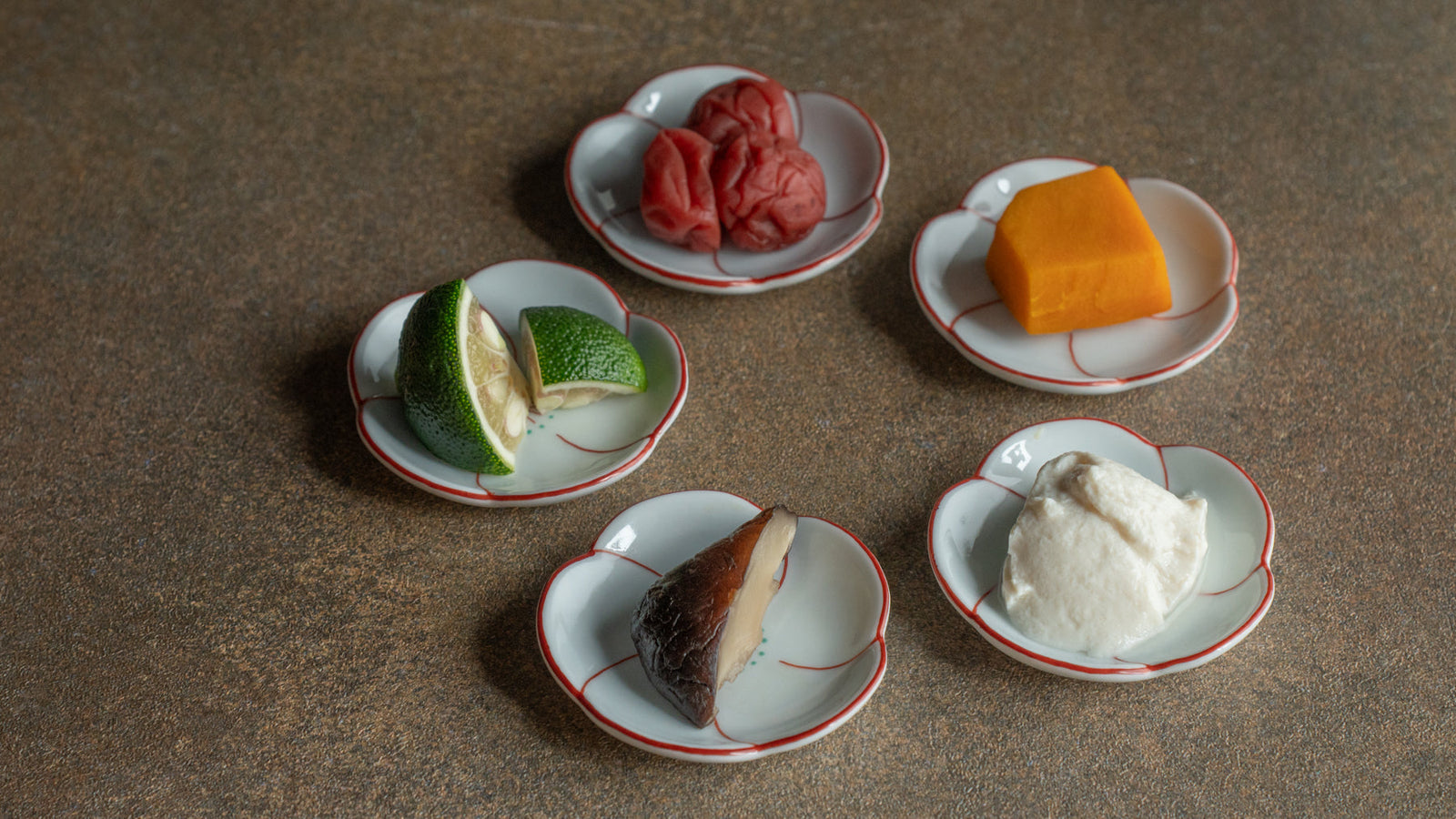
While symmetry and even numbering are often emphasized in Western cultures, Japan has long embraced odd numbers, weaving them into traditional celebrations, poetry, religion, and culinary traditions. Among them, the number five holds a particularly significant place, carrying meanings shaped by centuries of spirituality, hospitality, and everyday life.
Join us as we explore the enduring presence of the number five in Japanese culture and discover how it continues to shape traditions that remain alive today.
Spirituality & History: The Connection to Yin and Yang and the Five Elements
The cultural significance of the number five in Japan can be traced in part to the ancient Chinese philosophy of Yin-Yang and the Five Elements (Inyo Gogyo in Japanese), which was introduced to Japan in the sixth century. This system taught that the natural world is governed by the dynamic interactions of five elements—wood, fire, earth, metal, and water—whose continuous cycles are maintained through constant change. Because this philosophy viewed the natural world through a framework of five interrelated elements, it helped establish the number five as an important organizing principle in East Asian thought.

At the same time, Yin-Yang philosophy also distinguished between odd and even numbers. Odd numbers were associated with yang, representing activity and vitality, while even numbers were linked to yin, representing stillness and receptivity. As these ideas spread throughout Japan, odd numbers—especially three, five, and seven—came to be regarded as particularly auspicious.

The influence of this preference for auspicious odd numbers can still be seen today. Religious ceremonies such as Shichi-Go-San (Seven-Five-Three) celebrate childhood milestones for three- and seven-year-old girls and five-year-old—and in some regions, three-year-old—boys; while haiku poems follow a five-seven-five syllable structure.

Odd numbers also shape customs such as monetary wedding gifts, which are commonly given in odd-numbered amounts because they cannot be divided evenly in two, symbolizing an unbreakable bond.
Among these auspicious odd numbers, however, five came to hold a particularly prominent place. As the following sections explore, its influence extends far beyond symbolism, shaping Japan’s cuisine, hospitality, and everyday life.
Dining Culture: The Principles of Five in Japanese Cuisine
Beyond its spiritual associations, the number five has long served as a guiding principle in Japanese cuisine, shaping not only how food is prepared but also how it is presented.


Traditional dining styles such as honzen—a highly formal style of banquet dining once served at samurai and aristocratic gatherings, in which dishes were arranged on individual legged trays—and kaiseki—a refined multi-course banquet meal that emphasizes seasonality and visual appeal—reflect this pursuit of harmony through a careful interplay of cooking techniques, flavors, colors, and arrangement.
In honzen cuisine, the appreciation for the number five was expressed through the most elaborate style of service, known as go-no-zen, in which five serving trays were arranged according to established etiquette. The structure of the meal itself demonstrates how deeply the number five became embedded in formal Japanese dining.
The influence of the number five extended beyond the structure of the meal itself to the principles that guided its preparation. The five cooking methods (goho)—cutting, simmering, grilling, steaming, and frying—formed the foundation of a balanced menu, and traditional multi-course meals often feature dishes prepared using each of these techniques, showcasing a wide range of textures and flavors.

Balance is further expressed through the five flavors (gomi)—sweet, sour, salty, bitter, and umami—and the five colors (goshiki): red, yellow, green (or blue), white, and black. Incorporating both principles into a meal creates a dish that is as harmonious to the palate as it is to the eye, highlighting the natural beauty of seasonal ingredients. This pairing of colors and flavors is especially central to shojin ryori, Japan’s Buddhist vegetarian cuisine, where every dish is composed to reflect both.
Together, the five cooking methods, five flavors, and five colors reveal how deeply the number five has shaped Japanese cuisine.
Hospitality: The Ideal Gathering
Traditional tea gatherings were intentionally kept small, creating a calm atmosphere in which the host could devote real attention to each guest rather than entertain a large group.

This ideal took shape in chaji, the formal tea gathering largely established during the sixteenth century. A chaji includes cha-kaiseki—the simple seasonal meal served before tea (not to be confused with the banquet-style kaiseki cuisine discussed above)—and traditionally lasts around four hours. Typically attended by about five guests, it creates an intimate setting in which the host can personally attend to everyone present.

Some explanations suggest that this custom also influenced the tradition of producing tableware in sets of five—enough for every guest at a chaji to be served in turn. While the exact origin is uncertain, the number five came to be closely associated with an ideal of hospitality centered on giving each guest individual attention.
The Tradition of “Five” in Modern Homes
Although Japanese lifestyles have changed considerably over time, the custom of five-piece tableware sets has proven remarkably persistent. Many contemporary artisans still make these sets, carrying forward a practice passed down for generations while adapting their designs to modern homes.

Several factors may have contributed to the tradition’s continued popularity. One points to postwar family life. During this period, the typical Japanese household often consisted of two parents and three children—a family of five—making a five-piece set a practical choice for everyday use. While this is only one of several theories, it may have helped reinforce the appeal of five-piece tableware in the modern era.
A five-piece set also remains practical today. It comfortably serves four people—two pieces for the hosts, two for the guests, and one piece in reserve, so an unexpected visitor is never turned away.

Smaller households are now the norm, yet the tradition of five-piece sets still carries the values that shaped Japanese dining culture for centuries. These sets show up at tea, at shared meals, at a round of sake—each one an everyday sign of the care that goes into hosting someone at the table.
Stay close to the craft
Now and then, a quiet letter — new stories, seasonal notes, and the hands behind the work.

The Wit of Ukiyo-e: Humor and Riddles from Edo
Meet the comic side of ukiyo-e: dressed-up animals, stretched faces, and picture puzzles Edo…
The Enduring Beauty of Fine Imari Porcelain
Discover the origins and traditions of Imari porcelain, from Kakiemon to Nabeshima ware, and…
Sen no Rikyu’s Wabi: The Spiritual Source of the Japanese Aesthetic
Discover how Sen no Rikyu transformed the Japanese tea ceremony into a philosophy of…
Iwata Mana
Leave a comment