


Chestnuts in Japan: From Autumn Staples to Everyday Life
Explore chestnuts in Japan, from autumn rice and wagashi to moon-viewing rituals and a timber valued for millennia.
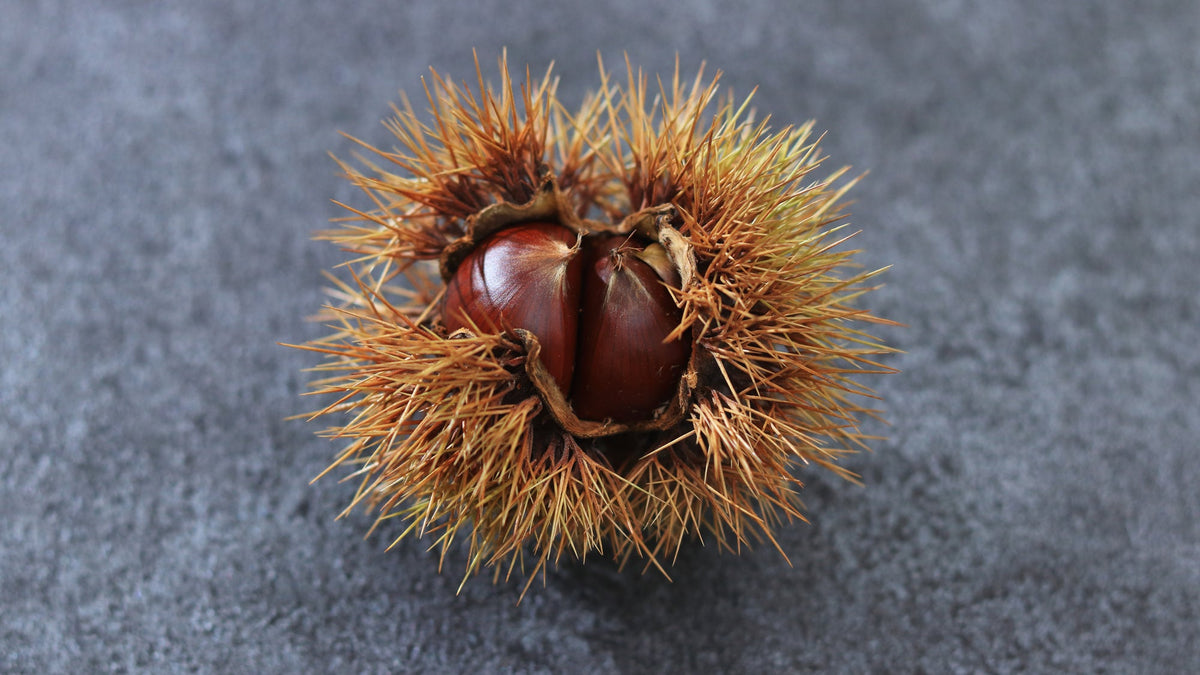
Few foods capture the taste of autumn in Japan quite like chestnuts. Whether cooked with rice or folded into sweets, they are enjoyed to the fullest during their short season. But chestnuts have a place in Japanese life that goes far beyond the autumn table. They appear in familiar sayings and the chestnut tree’s wood has been valued as a durable timber for thousands of years.
From food and seasonal traditions to folklore and architecture, this article explores the many ways the chestnut has become woven into Japanese culture.
A Taste of Autumn

Most chestnuts grown and enjoyed in Japan are Japanese chestnuts (Castanea crenata). Cultivated across the country, they vary in size, sweetness, and texture depending on the region and variety.
Well-known varieties include Tanzawa, which ripens early; Tsukuba, known for its large size and rich flavor and accounting for around thirty percent of domestic production; and Ginyose, cultivated for generations and prized for its quality. By contrast, some names, such as Tanba, refer not to a single cultivar but to chestnuts grown in a particular region.

Japanese chestnuts are larger than their European counterparts and have a soft, crumbly texture when cooked. They can be tricky to peel, however, as the thin inner skin tends to cling to the flesh. This characteristic gave rise to shibukawa-ni, a dish in which the chestnuts are simmered with their inner skin still intact.
To make shibukawa-ni, the hard outer shell is removed while the thin inner skin is left in place. The chestnuts are boiled and drained several times to remove their bitterness, then simmered with sugar. The result is somewhat similar to the French confection marrons glacés, although the inner skin is left on.

Chestnut rice, or kurigohan, is another autumn staple. Chestnuts are cooked together with newly harvested rice, their golden color standing out against the white grains. It is a simple but satisfying dish that reflects the flavors of the season, with a soft, crumbly texture and gentle sweetness.
Chestnuts also take on a sweeter form. Kuri kinton, for example, is a wagashi made with just chestnuts and sugar. Steamed chestnuts are mashed into a smooth paste and sweetened. Small portions are then wrapped in a cloth and shaped by hand into chestnut-like forms. The sweet is especially associated with the cities of Nakatsugawa and Ena in Gifu Prefecture, where it is a hit with customers at local confectionery shops each autumn.

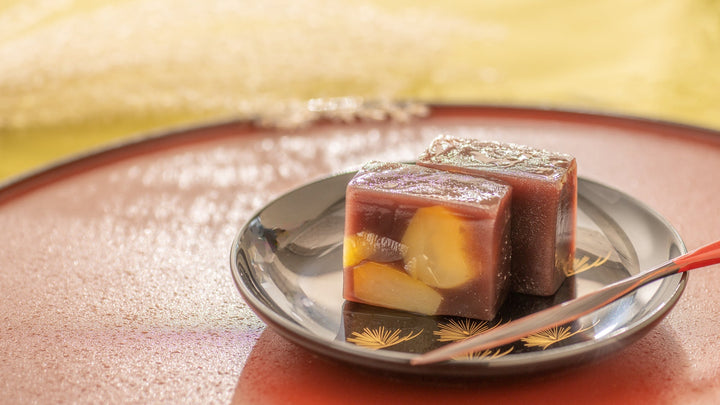
Chestnuts are also used generously in kurimushi-yokan, a traditional wagashi. It is made by combining red bean paste with wheat flour or kudzu starch, then steaming it with plenty of chestnuts simmered in sugar. Unlike shibukawa-ni, the chestnuts are peeled completely before simmering, allowing their golden flesh to stand out beautifully against the deep brown of the red bean paste.
Steamed chestnuts, or mushi-guri, are perhaps the simplest way to enjoy them. With nothing added, their natural sweetness and texture come through on their own. In autumn, freshly steamed chestnuts are sold at stalls in popular tourist destinations, where they are a classic snack to enjoy while strolling.
Chestnuts and Seasonal Traditions
Beyond the table, chestnuts have long been part of Japan’s seasonal customs.
The thirteenth night of the ninth month of the lunar calendar, which today falls between mid-October and early November, is known as Jusanya, a night for otsukimi, or moon viewing. Jugoya, the fifteenth night of the eighth lunar month, is also widely celebrated in Japan as a night for moon viewing. While the Jugoya custom was introduced from China, Jusanya is thought to have originated in Japan.

This time of year coincides with the harvest season for chestnuts and beans, which were traditionally offered to the gods while people admired the moon. For this reason, the thirteenth-night moon is also known as kuri-meigetsu, or “Chestnut Moon.”

Chestnuts have ties to Choyo-no-Sekku as well, the seasonal festival held on the ninth day of the ninth lunar month. Also known as the “Chrysanthemum Festival,” it is a time to pray for good health and longevity. Chrysanthemums are displayed and chrysanthemum sake, or kikuzake, is enjoyed with chrysanthemum petals floating in the drink. The custom of enjoying kurigohan during chestnut season has also given Choyo-no-Sekku another name: the “Chestnut Festival.”
Chestnuts were also traditionally offered alongside newly harvested rice and beans at autumn harvest celebrations. Through these connections with seasonal rituals, chestnuts have become closely associated in Japan with the arrival of autumn.
Chestnuts in Japanese Sayings
Chestnuts have also found their way into Japanese sayings.

Momo kuri san-nen, kaki hachi-nen translates literally as “peaches and chestnuts, three years; persimmons, eight years.” It refers to the time it takes these trees to begin bearing fruit after planting. Over time, the saying came to express the idea that good things take time. Its exact origin is unclear, but the phrase already appears in Yakusha Hyoban Gejigeji, a 1674 book recording reviews of Kabuki actors and plays.
Another expression, kachu no kuri o hirou, literally “picking chestnuts from the fire,” describes taking a risk for someone else without receiving anything in return. The saying comes from The Monkey and the Cat, a fable by seventeenth-century French poet Jean de La Fontaine, inspired by Aesop’s Fables.
In the story, a cat is tricked by a monkey into reaching into a fire to retrieve chestnuts, only for the monkey to take them for himself while the cat gets burned. La Fontaine’s original story carries the negative implication that it is foolish to risk danger for the sake of others. In Japanese, however, the expression is also used with the more positive nuance of deliberately taking on a difficult or dangerous task.
Chestnut Wood: A Timber Used for Thousands of Years
Chestnuts are not only part of Japanese cuisine and sayings. The trees that grow naturally throughout Japan have also been used as timber since the Jomon period (ca. 10,000–300 BCE).

At the Sannai Maruyama Site in Aomori Prefecture, large chestnut trees were used as structural pillars in a settlement dating back around 5,000 years. The reason lies in the high durability of chestnut wood. Withstanding decay even in damp environments and naturally resisting termites, chestnut wood was well suited to Japan’s hot and humid climate.

A remarkable example of this durability can be found in the gassho-zukuri houses of Shirakawa-go in Gifu Prefecture and Gokayama in Toyama Prefecture, known around the world for their steep, thatched roofs. In these houses, which must withstand the enormous weight of heavy snowfall, sturdy chestnut wood was often used in areas exposed to water, helping to support the structure for more than a century.
Chestnut wood is still used today in places where durability matters, including the foundations of traditional houses and railroad ties.
The Many Roles of the Chestnut Tree in Japanese Life

The chestnut has taken many forms in Japanese life: a golden addition to the autumn table, an offering to the gods beneath the moon, a metaphor for time and risk, and a durable material used in traditional homes.
The many ways the chestnut tree has been used reflect a long tradition of making the most of what nature provides.
This autumn, the next time you enjoy a chestnut, take a moment to look beyond its familiar sweetness. Behind the fruit is a tree that has played a part in Japanese food, traditions, sayings, and architecture for generations.

Aromatic and Alluring: Hot Chestnut Rice in Classic Banko Ware
Chestnuts, with their iconic spiky shells, epitomize nature's creativity and announce autumn's arrival.
A Harvest of Sweets: Discovering Fall Wagashi
Discover fall wagashi that embody the flavors of autumn in Japan. Learn about nerikiri,…

Akari’s Sake-Steamed Hamburg Steak Recipe
Akari's sake-steamed hamburger steak with cherry tomatoes. No eggs, no breadcrumbs, just a simple,…
Hasegawa AkariStay close to the craft
Now and then, a quiet letter — new stories, seasonal notes, and the hands behind the work.

Leave a comment