


Inherited Objects and Lasting Memories: Stories from Team MUSUBI
Five Team MUSUBI members share inherited objects, from a 1967 tea bowl to a 1950s coat, and the memories they hold.
On holidays and other meaningful occasions, our thoughts often turn to loved ones, whether they live far away or are no longer with us. We feel their presence in many ways, sometimes through the things they left behind or passed on to us. These items had a life long before they became ours, carrying stories of the people who once owned and treasured them.
For this article, I spoke with members of Team MUSUBI about objects they have inherited or received from their families. One colleague, for example, puts on her great-aunt’s coat from the 1950s each autumn and imagines her wearing it as she walked the streets of Tokyo more than seventy years ago.
Each object offers a glimpse into a different family history, and the value of them extends beyond their original purpose, shaped by the memories and experiences attached to them. In time, they may become meaningful to another generation, carrying forward a part of their stories and reflecting the spirit of MUSUBI KILN’s motto: “Crafted to Be Passed On.”
A Mother’s Engagement Ring Becomes a Treasured Necklace

Ai from Merchandising wears a beautiful necklace every day. When I asked her if she owned something special that she had inherited or received from a loved one, she pointed to the very necklace she was wearing.
She explained that the necklace was made from her mother’s engagement ring, which dated back to the 1970s and had gone unworn for decades. Having worked as a nurse and later in a school infirmary, her mother rarely wore jewelry, and Ai had never seen her wear the ring. As the years passed, they began to wonder what to do with it, and eventually decided to have it redesigned as a necklace. Her mother paid for the work, happy to see Ai wear it and knowing that it would one day become her katami, a keepsake associated with someone who has passed away.
“Rather than taking it to a large department store, my mother suggested a small, long-established jewelry shop in our hometown in Shimane Prefecture. She had known the owner for years, so I liked the idea of having someone familiar remake the ring. I could choose the design, the chain length, and whether to use silver, platinum, or gold,” she explained.

The ring’s stone was set in the center of a horseshoe-shaped pendant. “The horseshoe is a symbol of good fortune and happiness. My older brother used to ride horses, too, so it was a motif I’ve always liked,” she said.
Today, she wears the necklace every day, even when she sleeps. When I suggested that it must feel like having her mother with her, she agreed: “It feels like my mother is always with me.”
She hopes to pass the necklace on to someone in the next generation, perhaps her son’s future wife or a grandchild. What began as an engagement ring that rarely left its box has become part of Ai’s everyday life, and may one day carry her family’s story into another generation.
From a Grandfather’s Collection to a Family Tradition

When I spoke with art director Harumi, she introduced me to a tea bowl that had belonged to her paternal grandfather. Although she never met him, the bowls he collected have been part of her family life for as long as she can remember, brought out by her father on special occasions.
Harumi told me that her grandfather spent some time working away from his family in Nagoya City during the 1960s. After playing golf, he would often stop by Kato Kiyoharu’s pottery workshop to browse tea bowls. The bowl Harumi showed me dates back to 1967. Both her grandfather and Kato were born in 1918, and Harumi believes their shared birth year may have contributed to her grandfather’s interest in the potter’s work.
Although her grandfather did not practice chado, the Japanese tea ceremony, he enjoyed collecting tea bowls. After his death, the collection passed to Harumi’s father, who took up chado partly to better understand the bowls. At the time, he was studying landscape design at university, and learning about the tea ceremony also gave him valuable insight into Japanese gardens, where elements such as stepping stones, stone water basins, and lanterns play an important role. What began as a way to deepen his understanding gradually became a lifelong hobby, and he still uses his father’s tea bowls today.

Harumi remembers seeing the bowls brought out on special occasions. “We didn’t usually have formal tea ceremonies at home, but around New Year, my father would prepare matcha and bring out some sweets. He would choose a bowl for each of us, saying things like, ‘Harumi, you can use this one today,’” she recalls. Through these small family rituals, her grandfather’s collection became part of Harumi’s childhood.
The tea ceremony has a long history in Harumi’s family. Her maternal great-grandmother was a tea ceremony instructor, and her parents met at a tea ceremony class. Her father has continued practicing chado as a hobby ever since, and Harumi hopes to learn it herself one day and use the bowls her grandfather collected.
An Obi Waiting for Its Next Occasion

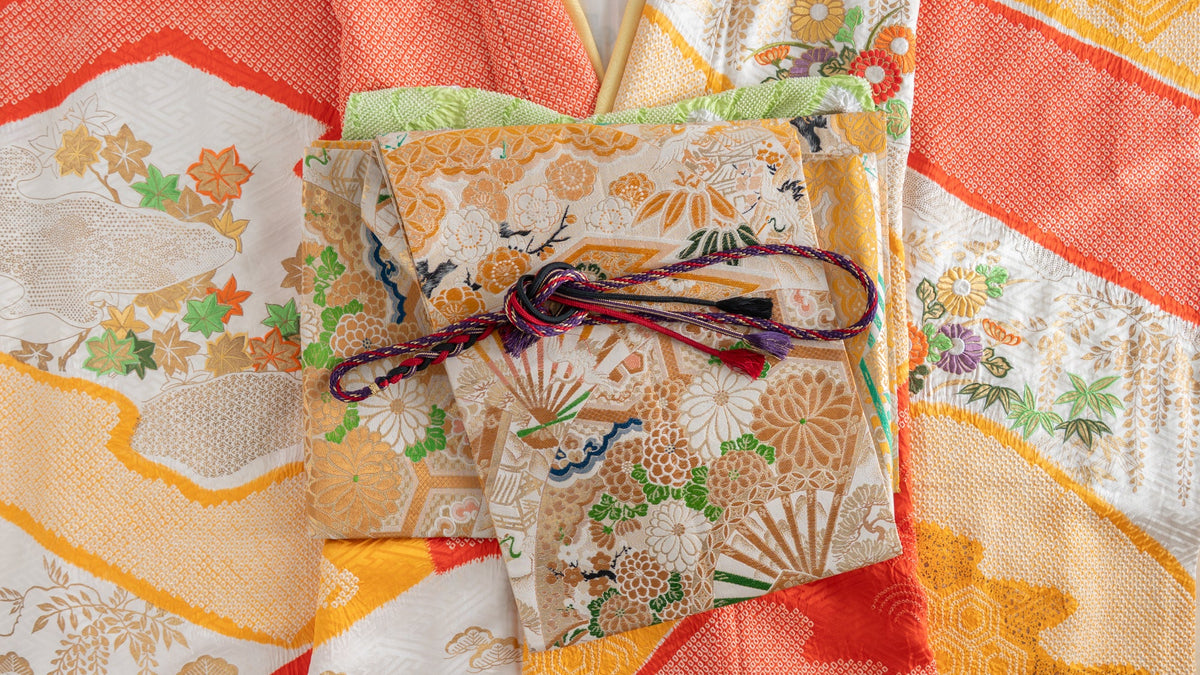
Miho from Merchandising, who often comes to the office wearing a beautiful kimono, brought a large package to our meeting. As we unwrapped layer after layer of protective paper, an obi (kimono sash) with intricate patterns emerged. She told me that it had been part of her family for around seventy years. Her maternal great-grandmother bought it for her own daughter’s wedding in the 1950s.
After Miho’s grandmother wore the obi for her wedding, her younger sister, Miho’s great-aunt, wore it a few years later at her own wedding. Miho’s mother also wore it to a friend’s wedding, pairing it with a furisode, a long-sleeved kimono traditionally worn by unmarried women for formal occasions.
The obi remained wrapped in its protective layers for decades, and Miho rediscovered it after her own wedding ceremony. Given its elaborate design, which she feels is better suited to a younger woman, Miho hopes her daughter might wear it one day. “Perhaps my daughter could wear it for a special occasion, like jusan-mairi,” she explained. Jusan-mairi is a traditional celebration marking a child’s growth, held around the age of twelve or thirteen.

The obi is a maru obi, an elaborate type of sash with patterns woven across both sides. Its design brings together auspicious motifs such as pine, bamboo, plum blossoms, cranes, chrysanthemums and fans, alongside landscapes. Gold thread runs throughout the textile.
Maru obi are rarely made today, partly because they are costly to produce and heavy to wear. Their thickness also makes them difficult to tie without assistance. Having passed through several generations of women in Miho’s family, the obi may yet be worn by another.
A Leather Bag That Recalls a Gentle Autumn Afternoon

After living in Japan for just over a decade, I have a story of my own to share. When I visited Germany a few years ago, I needed a bag to take on an outing, and my mother gave me this brown leather shoulder bag.
As soon as I saw it, I was reminded of an autumn day from my childhood, when I went for a walk with my parents through a park in my hometown. Family outings on weekends were not very common, and autumn often brought dark skies and rain. That day, however, we walked beneath the colorful leaves in the golden light of late afternoon.
I also remember a photograph of us from that day. I was sitting on a wooden hippopotamus-shaped structure at the playground, while my mother stood beside me in a light pink coat with big round buttons, carrying the exact bag. I must have been only around three years old, but the image has stayed with me.

The bag was probably bought in the early 1990s, when my mother was in her late twenties and I was still a toddler. It remains in very good condition, and I now take it with me on autumn outings of my own. Whenever I carry it, I’m reminded of that afternoon with my parents. Living around 10,000 kilometers away from them, carrying the bag makes me feel a little closer to home.
A Great-Aunt’s Coat and a Lasting Influence

When I met with Mina from the editorial team, she walked into the meeting room wearing a beautiful coat in autumn colors. She told me it dated back to the 1950s and had belonged to her grandmother’s younger sister, who was like a second grandmother to her. Mina had always admired her great-aunt’s distinctive style and independent spirit, and the coat still reminds her of both.
Her great-aunt never had children of her own and lived independently after losing her husband during the war. She was a fashionable woman who always dressed up, wearing heels and carrying a leather bag to match her outfit. She rarely, if ever, wore kimono. Instead, her style was modern and very different from that of Mina’s more conservative grandmother.
For around twenty years, she worked as an assistant to Iida Miyuki, a well-known cooking researcher and artificial-flower artist. The two traveled the world together, introducing Mina’s great-aunt to different places and ideas. Her work reflected her interests in fashion and the arts, and Mina remembers her as someone who was always willing to try something new.

Her influence extended beyond fashion. When Mina was learning to cook, her great-aunt praised the homemade lunches she prepared and encouraged her to continue. “She told me, ‘Why not? Keep going. I think it’s a good thing.’ I still remember her saying that to me,” Mina recalled. Mina also went on to work as an assistant to a culinary researcher for around twenty years, and her great-aunt’s encouragement stayed with her.
When her great-aunt passed away in 2006, Mina inherited the coat she saw in her wardrobe. Its buttons and pockets still remind her of how carefully her great-aunt dressed. Though the coat dates back several decades, its style still appeals to Mina. She wears it at the beginning of autumn each year, and it has its own place on the left side of her closet. When she puts it on, she recalls not only her great-aunt’s distinctive style but also the woman who encouraged her to follow her own path.
What we inherit from family is not always something precious or rare. It might be a well-used bowl, a tool marked by years of work, or a small object kept in a corner of the home. Each carries traces of someone else’s life, and as it becomes part of our own, it collects new memories. Perhaps these items remind us to look a little more closely at the things we live with every day, and at the people and moments that have become part of their story.

Ask Team Musubi: Real New Year’s Resolutions in Our Home Kitchens
Get inspired by real New Year’s kitchen resolutions, from healthy cooking and meal prep…
Buyer's Choice: My Memories with Kokeshi Dolls
Today, I'd like to share with you my deep fascination and attachment with beloved kokeshi…
Umehara Haruka
Obon: Japan’s Summer Festival of Remembrance
More than a seasonal festival, Obon is a time when families across Japan honor…
Stay close to the craft
Now and then, a quiet letter — new stories, seasonal notes, and the hands behind the work.

Leave a comment