

Interview with Potter Kosako Hajime: Carrying Omi Shimoda Ware Forward
Discover how Kosako Hajime is reviving Omi Shimoda ware through traditional clay, gosu glaze, and handcrafted tools.
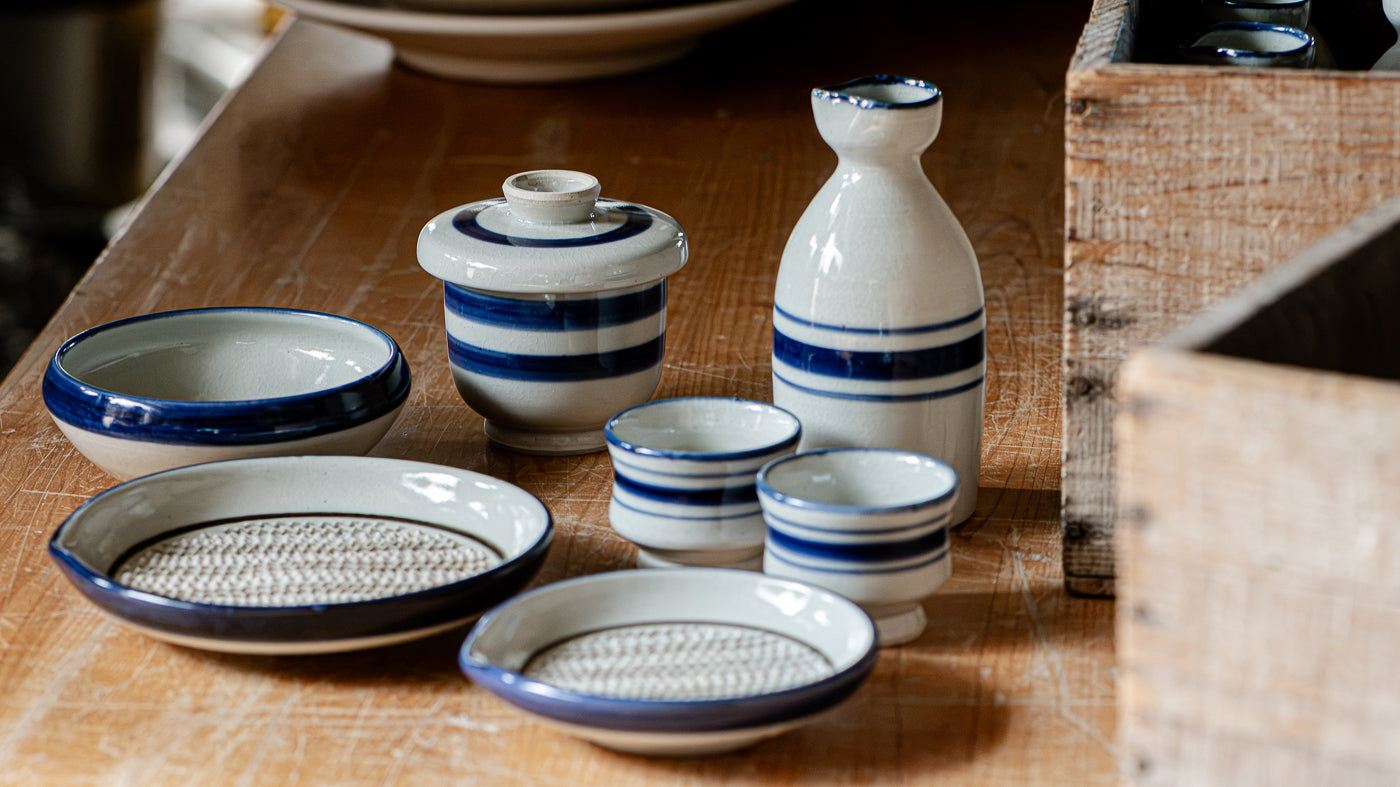
The story of Omi Shimoda ware is not one of innovation, but of preservation. Once nearly lost, this pottery tradition continues today through the work of Kosako Hajime, who has dedicated himself to carrying forward the forms, techniques, and spirit entrusted to him by his teacher.
Speaking from Omi Shimoda-yaki Toubou, his workshop in central Japan, Kosako shares the history of Omi Shimoda ware, the craftsmanship behind its enduring designs, and the philosophy that guides his work. His story offers a glimpse into how a centuries-old craft survives—not through dramatic change, but through the steady practice of making pottery for everyday life.

The Story of Omi Shimoda Ware
Omi Shimoda ware traces its origins to the mid-eighteenth century, when a suitable clay deposit was discovered in the Shimoda area of present-day Konan City, Shiga Prefecture. Over time, the region became home to a thriving community of potters. At its peak, more than a dozen kilns operated there, producing practical vessels for everyday use and supporting a network of artisans specializing in clay preparation, glazing, and firing.
The tradition flourished for generations. Yet, like many regional crafts in Japan, it faced increasing challenges as industrial production expanded and lifestyles changed. Demand for handmade pottery gradually declined, and one by one, the kilns disappeared.
By the late twentieth century, only a single workshop remained. When the final potter passed away in 1989, Omi Shimoda ware fell silent.

Its revival began in 1994—driven not by a desire to reinvent the craft, but by a determination to preserve it. At the center of that revival was Kosako Hajime, who had trained under the last potter of Omi Shimoda ware.
The Potter Who Carried the Tradition Forward
Kosako Hajime's connection to Omi Shimoda ware began long before he ever considered becoming a potter. As a child, he often visited the kiln with his father. Although he was fascinated by the pottery, it was the potter himself who left the deepest impression.

“There was something about my teacher. I thought he was remarkable,” Kosako recalls.
What began as childhood admiration gradually grew into something more enduring. Drawn to both the pottery and the person behind it, Kosako chose to study under the craftsman he had admired for so many years. During his years of apprenticeship, Kosako came to see that craftsmanship was not simply about making objects. It was about dedicating oneself to a practice and carrying it forward with patience and consistency over time. That philosophy continues to guide his work today.
Even during the years when Omi Shimoda ware had fallen silent, Kosako never lost his connection to the tradition. He continued working with clay, carrying with him the techniques and values he had inherited. Among them, one holds special significance. In the final months of his teacher's life, Kosako was entrusted with the knowledge behind the distinctive gosu pigment used in Omi Shimoda ware.
Clay, Gosu, and the Art of Everyday Use
With its simple forms and subtle designs, Omi Shimoda ware carries a beauty that feels both timeless and contemporary. Although rooted in a long history, its pieces continue to bring a sense of freshness to modern life. The appeal of Omi Shimoda ware lies not in bold decoration or dramatic expressions, but in the small details that reveal the care behind each piece. Every shape, texture, and finish reflects a tradition built around creating vessels that naturally become part of everyday living.

For Kosako Hajime, this connection between tradition and daily life begins with the material itself, and one of the most important elements is the clay.
The story of Omi Shimoda ware began with the discovery of a high-quality white clay deposit in the mountains of the region. While the clay used today is not the same as that of the past, Kosako carefully adjusts and blends different materials to recreate the qualities of the original clay and the familiar character of traditional Omi Shimoda ware.

This respect for raw materials is also reflected in the use of gosu, the deep blue pigment traditionally used for decoration.
For Kosako, preserving the traditional method of making gosu remains an essential part of his work. Because many of its ingredients are natural, subtle variations can occur each time they are prepared. Adjusting the proportions and achieving the desired shade requires experience, patience, and an intimate understanding of the material.

Among the works that express this philosophy are the oroshi grater plates of Omi Shimoda ware. At first glance, they appear to be simple kitchen tools, but every detail has been carefully considered to support the way people use them in daily life.
The textured surface of each plate is created by hand using a tool made from a branch collected from the nearby mountains. The previous generation originally devised this wooden tool after local residents could no longer use traditional metal graters, which had been requisitioned during the war. Through experimentation, they found that a particular type of branch produced the ideal grating texture, and that method has been passed down ever since. Today, when the tool wears down, Kosako returns to the mountains to find another suitable branch and shapes it by hand. The process reflects a close relationship with the natural environment and a tradition that has been sustained through generations of observation, ingenuity, and craftsmanship.


Even the size of the grating surface is tailored to its intended use. A smaller plate is suited for ingredients such as ginger, while a larger one is designed for daikon radish. Though these differences may seem minor, they play an important role in how the pieces function in everyday use.
For Kosako Hajime, beauty and practicality are inseparable.
Preserving a Tradition, One Piece at a Time
In an era when many crafts are adapting to reach new audiences, Kosako has chosen a different path. He has little interest in dramatically expanding production, introducing entirely new collections, or reshaping Omi Shimoda ware to suit contemporary trends. While he occasionally creates new forms in response to specific requests, his primary goal remains unchanged: to preserve the tradition he inherited.
Asked about the future, his answer is straightforward.

“My job is simply to protect it.”
That attitude reflects one of the lessons he learned from his teacher. What impressed him most was not ambition or commercial success, but the sight of someone making pottery because he genuinely loved the material and the work itself.
The same belief continues to guide Kosako Hajime today.
He hopes that people who use Omi Shimoda ware will find moments of meaning in everyday life—whether preparing a meal, serving a favorite dish, or gathering around a table with family.

The effort to sustain Omi Shimoda ware extends beyond the kiln itself. Together with his wife, Kosako also conducts pottery workshops and painting experiences at local schools and community events. These activities offer participants an opportunity to engage directly with the craft, gain a deeper appreciation for the traditions behind it, and discover the appeal of Omi Shimoda ware through hands-on experiences. Rather than simply viewing the pottery as finished pieces, participants are encouraged to discover the care, skill, and history that shape each of them. In a world that often encourages convenience and speed, Kosako sees value in objects that invite people to slow down and appreciate simple experiences.
For Kosako, preserving Omi Shimoda ware is not about recreating the past exactly as it once was. It is about carrying forward a way of making and a way of living that still has meaning today. The story of Omi Shimoda ware's survival and continuation is, in many ways, extraordinary. Yet its continuation depends on something remarkably ordinary: the daily act of shaping clay, firing kilns, and making vessels meant to be used.

Stay close to the craft
Now and then, a quiet letter — new stories, seasonal notes, and the hands behind the work.
Lacquer Craftsmen of Yamanaka
The process of lacquer coating is roughly divided into three different processes; base coating,…
What Is Wabi-Sabi? Discovering a Key Japanese Aesthetic
Explore wabi-sabi, the Japanese aesthetic of imperfection, aging, and care, and learn how to…
Guide to Japanese Pottery
Learn about the history of Japanese pottery, porcelain, stoneware, earthenware, and care tips for…
Leave a comment