


Karakusa: A Scrolling Vine through Time and Craft
Learn how one winding vine pattern took on new forms across centuries of Japanese ceramics, lacquerware, and textiles.
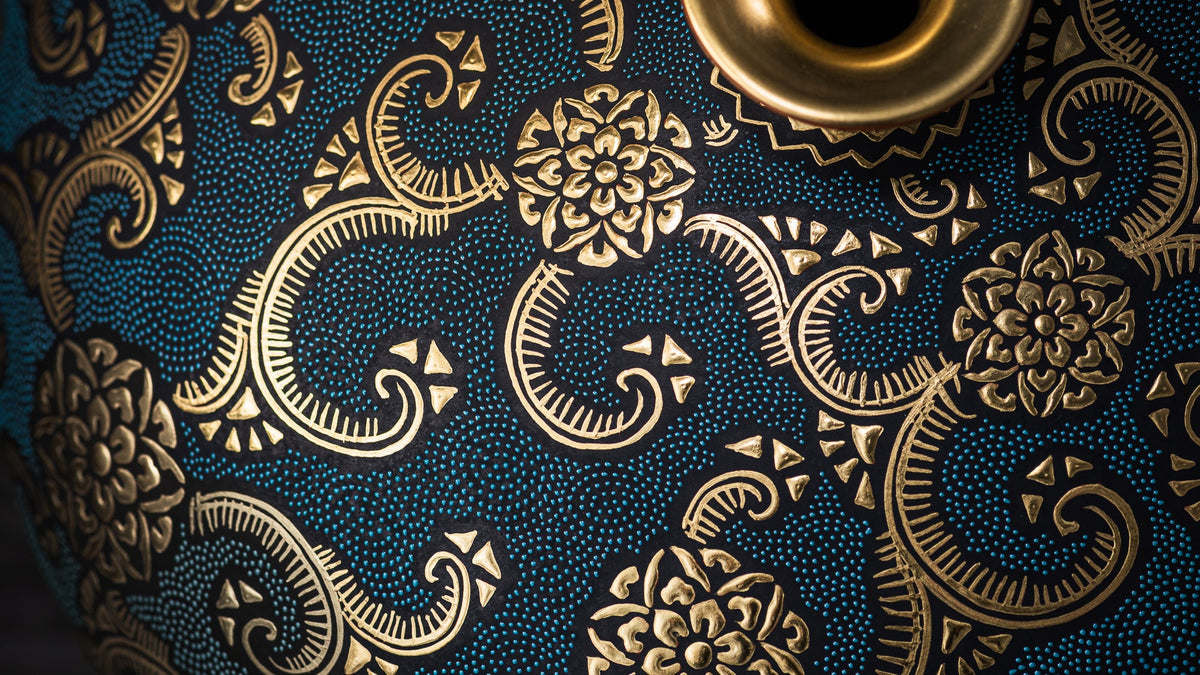
Vines curl across the surface, unfolding into leaves and flowers along the way. Follow one line with the eye, and it seems to lead naturally into the next.
This is one expression of karakusa, a familiar motif in Japanese decorative crafts often described in English as an “arabesque” or “scrolling vine” pattern. Yet karakusa has no single style. Across centuries of architecture, arts, and crafts, its appearance has shifted with the period, material, technique, and motifs with which it is combined.
From works made centuries ago to objects created today, we explore the many forms karakusa has taken and its enduring place in Japanese craft.
A Pattern with Roots Beyond Japan
Despite its close association with Japanese decorative arts, the roots of karakusa extend far beyond Japan. Its origins cannot be attributed to a single place or source, and several theories exist. Scholars have connected its development to plant motifs found in ancient civilizations, including the lotus of Egypt, the palmette of the ancient Near East, and the acanthus of Greece. As these designs traveled across regions, changing as they went, they eventually made their way eastward through Central Asia and India.

While China already had its own tradition of continuous, curving ornament, plant-based scrolls were gradually arriving from farther west. Palmette designs were present in Central Asia sometime between the first and third centuries, and archaeological evidence suggests that related forms reached China around the fifth to sixth centuries, during the Northern and Southern dynasties (420–589 CE), alongside the spread of Buddhist art. Palmettes and half-palmettes can be seen in Buddhist sculpture from this period.
By the Tang dynasty (618–907 CE), these influences had developed into compositions much closer to what we recognize as karakusa today, with winding stems, leaves, and flowers.

From China, these scrolling plant designs spread to Japan with Buddhism and related material culture. By the Asuka period (592–710 CE), karakusa motifs were being used on objects made in Japan, including temple roof tiles decorated with nindo karakusa, featuring palmettes and half-palmettes arranged along curving lines.

By the Heian period (794–1185 CE), the word “karakusa” itself had entered literature. References to the motif on carved wood and maki-e lacquerware show that it had become a familiar part of aristocratic life. Buddhist art continued to use it, as seen in the hosoge karakusa, a scrolling design featuring an imaginary flower, decorating the cover of this Heian-period sutra. The pattern also extended beyond Buddhist contexts, appearing in a growing range of decorative arts.

In China, these scrolling plant designs took on new forms over the centuries. By the Ming dynasty (1368–1644 CE), they had become a prominent decorative feature on blue-and-white porcelain from Jingdezhen, where intertwining vines were combined with peonies, chrysanthemums, and other flowers.

The Many Forms of Karakusa
By the Edo period (1603–1868 CE), karakusa could be found across a wide range of crafts in many styles. In many examples, the vines curve outward, branching into leaves and smaller shoots.

Some variations are distinguished by the way these lines are drawn. In tako karakusa, or “octopus karakusa,” the vine coils into tight curls that recall octopus tentacles. This variation is still popular today.

But karakusa does not always take center stage. Its extending lines can wind around a flower or bird, connect elements, or fill the spaces surrounding a principal motif. In this role, it acts as a supporting design, as seen on this large porcelain dish, where dense karakusa patterns weave around peonies.

Beyond its decorative role, the winding vine carries auspicious associations of its own. Its endless growth has long been linked with longevity, the continuation of the family line, and prosperity.
Karakusa in Craft Today
Centuries later, karakusa remains a familiar presence in Japanese craft, from ceramics to lacquerware and textiles. Its long history is still visible in the remarkable variety of ways the motif is used.
In this Kutani ware vase by Nakada Kingyoku, karakusa is at its most elaborate. Raised gold morikin traces the scrolling stems and flowers against a dense field of tiny blue aochibu dots. In his hands, the centuries-old motif takes on a distinctly contemporary character.

Across this Kutani ware tea set, karakusa flows over the teapot and cups, adapting to the shape of each piece while maintaining a unified design.

Broad cobalt brushstrokes depict curling stems and leaves on this Tobe ware bowl by Baizan Kiln, presenting karakusa in one of its most recognizable forms.

The detailed tako karakusa fills this yunomi teacup with densely packed cobalt scrolls and short, branching strokes. The close repetition creates a rich design from a simple combination of line and color.

Karakusa can take on a more restrained expression as well. On this porcelain box by Kinzan Kiln, fine white vines are built up in hakumori, creating a delicate raised pattern that emerges against the white ground. Small touches of gold punctuate the design, while the vines wrap around the rounded shape. Here, karakusa is defined as much by texture as by color.

On this lacquerware natsume matcha container, karakusa appears in simple curling strokes between gourds painted in colorful lacquer. Rather than filling the ground, the spare lines leave ample black lacquer visible around the larger gourds.

Meanwhile, in this hanging scroll, karakusa appears not in the painting itself, but in its textile mounting. Woven in gold, botan karakusa pairs winding vines with peonies in a flowing band, framing the central image of Mount Fuji without competing with it.

A Pattern That Continues
From bold brushwork on Tobe ware to the patterned borders of a hanging scroll, karakusa has found expression in different materials and techniques. Its winding vines may frame another motif, fill an entire vessel, or become decoration in their own right. After all these centuries, the line still goes on, carrying a history that reaches far beyond Japan.

7 Lucky Japanese Patterns
Discover eight traditional Japanese patterns that are used in kimonos, crafts, and more, plus…
The Art of Kitaoji Rosanjin: The Beauty of Cuisine
Rosanjin united ceramics, calligraphy, and cuisine into one vision of beauty, where tableware and…
Iwata Mana
The Aesthetics of the Written Character in Japanese Crafts
From auspicious 福 to hidden ashide poetry, explore how characters become decoration and meaning…
Stay close to the craft
Now and then, a quiet letter — new stories, seasonal notes, and the hands behind the work.

Leave a comment