

A Bowl of Stillness: Finding Sacred Rice Porridge in a Tokyo Shrine
Inside a Tokyo shrine, Shikizen serves okayu simmered in bonito, kelp, and hot spring water for a quiet ritual meal.
There is a particular kind of silence that settles over a Shinto shrine, the kind that makes you lower your voice without being told to, and seems to thicken the air just beyond the torii gate. At Togoshi Hachiman Shrine, a modest sanctuary tucked into a quiet corner of Shinagawa Ward, Tokyo, that silence extends into a dining room, where it lingers over a meal of almost monastic restraint.
The restaurant is called Shikizen, and its location is so unusual that, even in a city fluent in the art of the unexpected, it qualifies as a small marvel. Rather than standing along the approach to the shrine, where teahouses and souvenir stalls traditionally gather, it sits within the sacred precinct itself, inside a low wooden building that once served as the shrine’s administrative office. As far as anyone seems to know, there is nowhere else in Tokyo where visitors can eat okayu—the soft-simmered rice porridge that Japan has long regarded as both everyday sustenance and sacred offering—within the grounds of an active shrine.

On an early-summer afternoon, Team MUSUBI visited Shikizen to learn more about the shrine and this unique dining experience.
A Dish with a Liturgy of Its Own
Okayu has the unglamorous reputation of being food for the convalescent—Japan’s answer to chicken soup, gentle on the stomach and easy on the appetite.
Its history, however, reaches far deeper.
What appears to be one of Japan’s simplest dishes is, in fact, one of its oldest living traditions.
Okayu traces its origins back more than two millennia, emerging alongside the introduction of wet-rice cultivation to Japan. Over time, it came to carry meanings beyond nourishment—valued as a food for the sick, and, in the Zen tradition, served to monks as the morning meal known as shukuza. The tenth-century Engishiki, the code of regulations governing the Heian imperial court, sets out the ingredients for shichishu-gayu—a gruel of seven grains—offered to the emperor on the fifteenth day of the First Month. Separately, on the seventh day, court nobles ate seven spring greens as a soup to pray for a year of good health. Over the centuries, these traditions gradually blended, giving rise to nanakusa-gayu, the seven-herb okayu.

During the Edo period (1603–1868 CE), okayu gradually found its way into common households, developing regional variations while becoming known as a nourishing meal for those recovering from illness.
More than a thousand years on, the tradition endures. Across Japan, families continue to eat nanakusa-gayu every January 7, welcoming the first signs of spring while gently restoring the body after the indulgences of the New Year holidays.
Okayu’s place in Shinto ritual has proved even more enduring.
Rice has long been revered in Japan as a gift from the gods, making okayu an important ceremonial offering during festivals and religious observances. At Kyoto’s Shimogamo Shrine, azuki (red bean) okayu is still presented before the deities during New Year rites, accompanied by prayers for prosperity and good health. In Nara Prefecture, Tomi Shrine holds an annual divination in which rice and azuki beans are simmered in a large pot together with bundles of green bamboo tubes; priests then split the tubes and read the amount of porridge drawn into each as an omen for the coming harvest.


Such observances can still be found at shrines across Japan, reflecting the enduring bond between faith and food. For centuries, eating rice has never been merely an act of nourishment. It has also been a way of expressing gratitude, marking the seasons, and bridging the human and the divine.
Inside the Sacred Precinct
Togoshi Hachiman Shrine has stood watch over this corner of Shinagawa since 1526. Dedicated to Emperor Ojin, one of Japan’s most revered deified rulers, it has long served as a place where local residents come to pray for protection, prosperity, academic success, and good fortune.
Its present worship hall, built of keyaki (Japanese zelkova), dates back to 1855 and has been undergoing careful restoration since 2021.

The building that now houses Shikizen has been transformed into a dining room of remarkable restraint. Guests remove their shoes before stepping onto tatami floors. Tables and chairs provide modern comfort, while folding screens offer the only decoration.
There is no background music. No elaborate design. Nothing to distract from the food, the changing light, or the quiet presence of the shrine beyond.


According to Kanesaka Yasuyuki, the restaurant’s manager, the idea for Shikizen began when its owner was looking for a new location to open a restaurant. The owner approached the shrine, with which he had a longstanding connection, and the shrine offered to lease the space. This eventually led to the opening of Shikizen.
The priest’s initial idea was simple: a restaurant centered on pure white rice, long regarded in Shinto as a sacred food. But the owner, having encountered exceptional germinated brown-rice porridge during his travels, became convinced that okayu could serve as the restaurant’s defining dish.
The shrine itself plays no role in the restaurant’s daily operations. Yet its presence remains tangible. Folding screens and antique serving plates from the chief priest’s personal collection continue to link the dining room to its spiritual surroundings.
A Bowl Crafted for Reverence
What arrives at the table bears little resemblance to the okayu most people imagine.
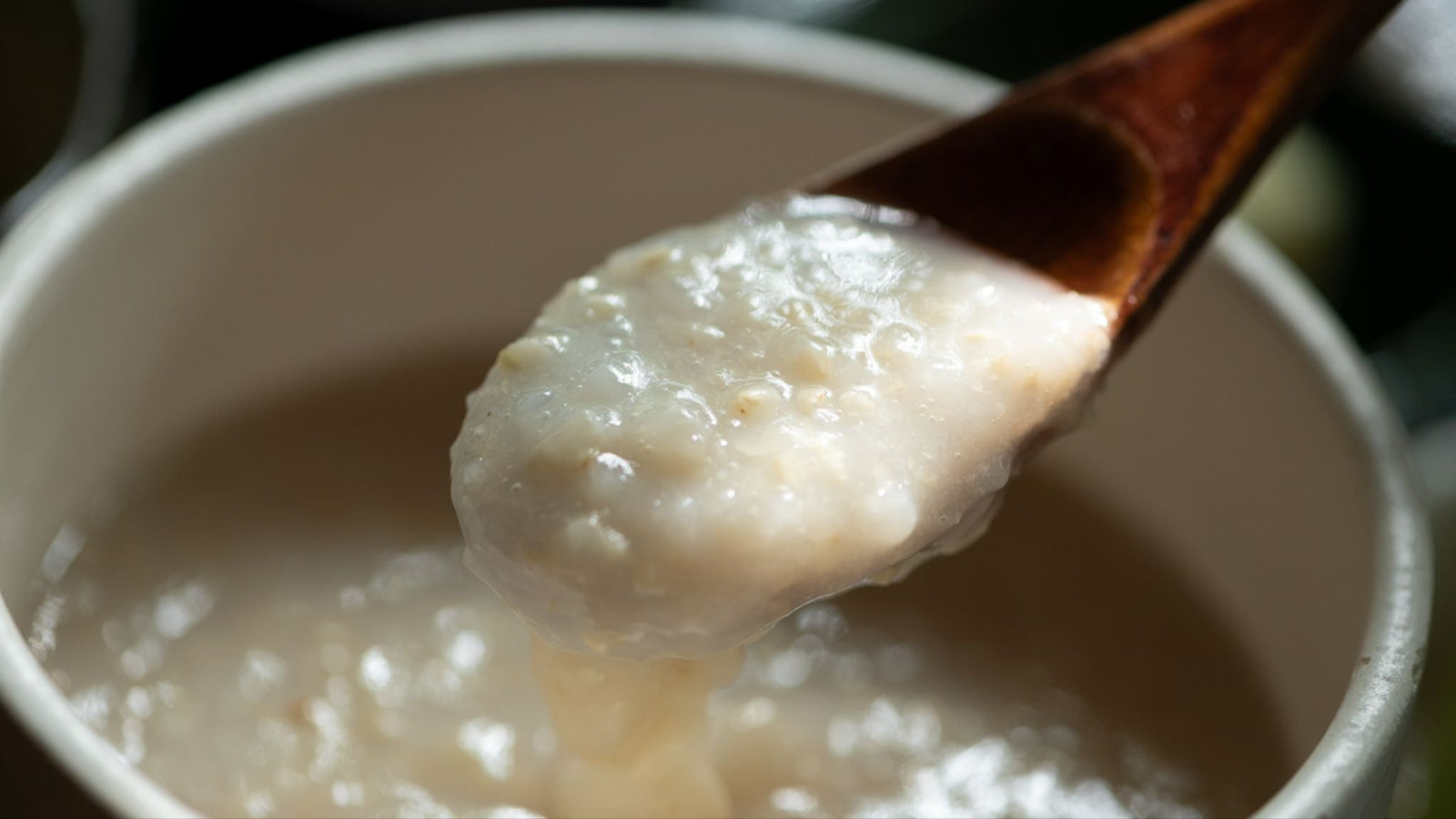
Most okayu is simply simmered in water. At Shikizen, however, the rice is cooked in a stock with honkarebushi, a prized aged bonito from Kagoshima in southern Japan; kelp from Rebun Island off Hokkaido’s northern coast; powdered dried scallops harvested from the Sea of Okhotsk; and a broth made from free-range chicken bones.
Even the water is carefully considered. It comes from a mineral-rich hot spring, drawn from 797 meters (2,615 feet) beneath the foothills of Sakurajima in Tarumizu, Kagoshima Prefecture.
Into this stock goes naturally cultivated brown rice from Minamiboso in Chiba Prefecture. The grains are germinated for thirteen hours before cooking, then simmered slowly until they reach a texture that balances tenderness with a gentle bite.

The flavor reveals itself gradually. Notes of kelp and scallops emerge first, followed by the mellow richness of chicken broth. The germinated grains retain a subtle crispness that contrasts beautifully with the porridge’s silky consistency.
This is not the bland food of convalescence. It is simplicity pursued with uncommon precision.

Head chef Watanabe Otowa still remembers her first encounter with it.
“The first time I tasted this okayu, I was struck by the sweetness of the rice itself,” she says. “We take great care when preparing the dashi so that the natural flavor of the rice has room to come through.”
Because the okayu appears so understated, the kitchen relies on seasonal side dishes, kobachi, to provide contrast and variety.

Ingredients arrive from contracted farms in Minamiboso and Hachioji in western Tokyo, with menus evolving according to the harvest seasons.

During our visit, zucchini appeared in several forms: lightly fried and steeped in dashi, paired with sweet new onions and beetroot, and pickled in house-made rice bran alongside carrots.


Though the same vegetable appeared throughout the meal, it never felt repetitive. Instead, each preparation served as a reminder that technique can transform an ingredient as profoundly as the ingredient itself.
“In-season vegetables already have their own sweetness and vitality,” Watanabe says. “We season lightly, just enough to let that come through.”
Among the standouts is the hiryozu, a delicate fried tofu fritter made with tofu from Tsubakiya, a respected tofu maker in Hiroshima Prefecture. Crisp on the outside and remarkably light within, it absorbs just enough dashi to enhance the flavor of the soybeans without overwhelming them.

The meal recalls the morning okayu traditionally served in Zen temples, where simplicity functions not as an aesthetic choice but as a form of discipline. The aim is not to impress the diner, but to sharpen awareness of what is already present.
That philosophy runs throughout the meal.

A Quiet Hour, Borrowed Back
Shikizen keeps modest hours, serving breakfast and lunch before transitioning into a café in the afternoon. Most of its guests come from the surrounding neighborhood, often visiting after paying their respects at the shrine.
Many families gather here to mark life’s traditional milestones, including okuizome, a ceremony held around a baby’s 100th day to pray that the child will never know hunger, and Shichi-Go-San (Seven-Five-Three), a centuries-old rite celebrating the healthy growth of children at the ages of three, five, and seven.
Yet word is beginning to spread beyond the neighborhood.
When Team MUSUBI visited near the end of lunch service, several guests were preparing to leave, and their conversation with the manager drifted softly through the room. One guest described the experience with a single word.
“Luxurious.”
Not luxurious in the conventional sense.
There are no rare truffles, extravagant tasting menus, or displays of culinary spectacle. Instead, the luxury lies in the absence of urgency, the stillness of the shrine grounds, and the opportunity to spend unhurried moments within a place shaped by centuries of devotion.

“It’s gratifying when someone says the food is delicious,” Watanabe says. “But the highest compliment is hearing that they were able to spend a truly peaceful and restorative time here. That’s the whole reason Shikizen exists.”
Tokyo is often celebrated for its speed, spectacle, and endless appetite for novelty. Yet places such as Shikizen reveal another side of the city, one rooted in continuity, ritual, and quiet care.
In such a setting, okayu feels less like a dish than a continuation of the shrine itself—another quiet ritual, performed with rice rather than prayer.
It is a reminder that in Japan, nourishment has long been understood as something that extends beyond the body alone.

Shikizen
Togoshi Hachiman Shrine
2-6-23 Togoshi, Shinagawa-ku, Tokyo
Go To Website
Stay close to the craft
Now and then, a quiet letter — new stories, seasonal notes, and the hands behind the work.

Akari’s Sake-Steamed Hamburg Steak Recipe
Akari's sake-steamed hamburger steak with cherry tomatoes. No eggs, no breadcrumbs, just a simple,…
Hasegawa Akari
A Late Summer Afternoon at the Table
Five simple dishes, one slow afternoon. Blue-and-white porcelain, glass, and Bizen ware hold the…
A Summer Energy Boost Meal: Karaage Recipe
Revive your energy this summer with crispy karaage in garlic-honey marinade and chilled tomato…
Leave a comment