

Seasonal Japanese Flowers and Their Meanings
Japan, located in a temperate climate zone, has for centuries followed a seasonal system introduced from China. It still retains the nijushi-sekki (the twenty-four solar terms), which divide the year into 24 segments. As a result, the Japanese people have long been highly attuned to changes in climate and weather.
In Japan, the seasons can be broadly understood as “four plus one”: spring, summer, autumn, and winter, along with the rainy season known as tsuyu, which falls between spring and summer. By decorating with seasonal flowers and plants or incorporating motifs inspired by them, one can express a uniquely Japanese sense of the seasons.
In this issue, we introduce plants and flowers associated with each season in Japan, along with their meanings. We hope this serves as inspiration for your seasonal home decorations and gift selection.
table of contents
Flowers for Spring, Haru: March, April, May
The arrival of spring is a truly delightful time for many people in Japan. It is a season filled with joy, as the sun warms the air, spring flowers and grass that have been sleeping under the snow begin to sprout, and the world slowly regains its color.
When people come across spring plants in nature or even on street corners, they naturally find themselves smiling as the blossoms begin to bloom. This season’s flowers often feature soft pastel tones such as white, peach, and the pale green of young buds, creating a gentle, spring-like warmth.
Sakura

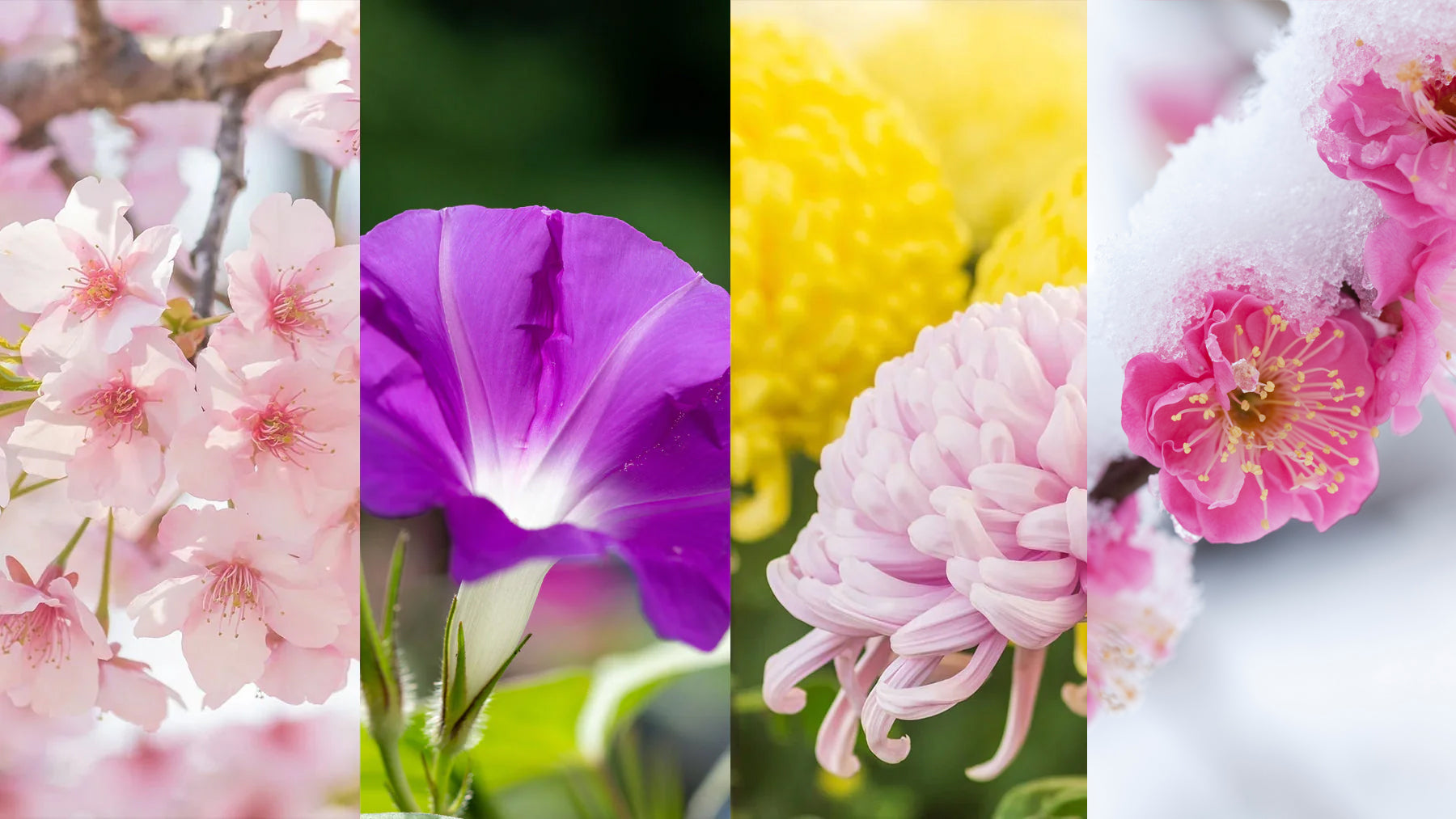
No flower captures the spirit of spring in Japan more deeply than the cherry blossom, or sakura. The cherry tree has been cherished since ancient times as heralding the arrival of spring, and up until the Edo period (1603–1868 CE), hanami—the custom of flower viewing—was primarily centered on wild cherry blossoms. The cherry blossom as a whole carries meanings such as spiritual beauty and purity. One of Japan’s unofficial national flowers, it has also come to embody the ideals of refinement and grace.
Because of their brief blooming period, cherry blossoms in Japan are also associated with a gentle sense of mono no aware—an appreciation of transient beauty tinged with gentle melancholy.
This teacup, inspired by falling petals, captures this sensibility. Rather than depicting blossoms in full bloom, the design focuses on the moment of scattering. Space is left between each motif, allowing the composition to breathe. As tea is poured, hidden details gradually emerge, echoing the fleeting nature of spring itself.

Peony

Spring in Japan is not only something to be admired in gardens and along streets, but also something gently woven into daily dining. This small blue-and-white plate featuring a boldly rendered peony captures this spirit with elegance.
Encircled by a chrysanthemum-shaped rim, the design unites two flower motifs long associated with beauty and auspicious meaning. Deep indigo against a soft white ground suggests the clarity of spring air, adding a refined accent to even the simplest dishes.

Japanese Iris

Among the flowers that grace the Japanese spring, kakitsubata (Japanese iris) is a late spring flower found around waterways that is admired for its refined beauty and elegant silhouette. Often associated with purity and sophistication, its slender petals have inspired Japanese poetry and painting for centuries.
Rendered on a furoshiki cloth, the motif gains a sense of movement through layered shades of blue arranged along a diagonal. The softly textured fabric enhances this visual depth, offering both tactile and visual appeal. Whether used functionally or displayed, it introduces a composed seasonal accent.

Flowers for Summer, Natsu: June, July, August
Summer in Japan brings intensity—heat, humidity, and rapid growth. While many summer blossoms appear in vivid, striking colors, those that evoke a sense of coolness are especially cherished—particularly flowers in white or soft, cool-toned hues. In Japan, people often seek a feeling of refreshment not only through the air but also through what they see.
Hydrangea

Among the flowers that define the Japanese early summer, hydrangeas hold a quiet, unmistakable presence. Blooming during the rainy season of tsuyu, they thrive in moisture, their clustered petals deepening in color under overcast skies. Shades of blue and pink shift subtly with the rain, creating a scene that feels refreshing.
This atmosphere is gently echoed in a matcha bowl adorned with hydrangea motifs. The blossoms appear both on the outer surface and within, revealing themselves gradually as one prepares and drinks matcha. Soft hues accented with delicate detailing evoke the coolness of rain-soaked gardens, while the rounded form of the bowl invites a moment of pause.

Morning Glory

Another beloved flower of the Japanese summer is the morning glory, which was introduced to Japan from China during the Nara period (710–794 CE). Blooming in the early hours and fading within a single day, it has long come to symbolize the fleeting nature of time and the beauty of impermanence. At the same time, its slender vines, reaching upward, evoke a sense of gentle perseverance.
These layered meanings have made the morning glory an enduring motif in seasonal design. Reflected in a glass soy sauce dispenser inspired by its form, the flower appears in a subtle, almost poetic way. As light filters through the faceted surface and liquid gathers within, it softly recalls petals opening at dawn—bringing an awareness of summer’s passing moments into view.

Lily

The lily holds a distinct place among summer flowers in Japan, valued for the clarity and composure it conveys. Its pristine form has long been associated with purity and dignity, often evoking a sense of order and strength. Unlike more ephemeral blossoms, the lily presents itself with a calm, unwavering appearance. From the Edo period onward, lilies were also appreciated by townspeople as potted plants, bringing their refined elegance into everyday surroundings.
The Colorful Floral Japanese Teacup is adorned with seasonal floral motifs. Among them, the lily emerges with understated delicacy, its form unfolding softly against a pale ground. As tea is poured, the blossoms seem to emerge through the surface, evoking the beauty of flowers reflected in water. In this moment, the symbolic purity of the lily is gently brought into focus, offering a calm and refreshing character amidst the intensity of summer.

Lotus

Because the lotus rises clean and unblemished from muddy waters, it has long symbolized purity, renewal, and spiritual awakening. In both Buddhist thought and broader cultural imagery, the lotus represents a state of clarity and inner calm, untouched by the surrounding world.
In this matcha bowl, inspired by the form of a lotus leaf, the blossoms and leaves unfold across the surface with a sense of stillness, while a small frog rests at the rim. Together, these elements create a scene that feels both serene and lively, echoing the layered meanings often found in summer motifs.

Flowers for Fall, Aki: September, October, November
In Japan, autumn is a season when flowers take on a quieter, more introspective beauty. Rather than the fresh vibrancy of spring or the lush abundance of summer, autumn blooms are often admired for their elegance and the sense of calm they evoke. Many of these flowers carry deeper symbolic meanings, reflecting the gentle passage of time and a contemplative appreciation of nature.
Chrysanthemum

The chrysanthemum has long stood as one of the most revered flowers in Japan, closely associated with nobility, longevity, and refined beauty. It has deep ties to the imperial family and appears on Japanese passports; it is widely regarded as one of Japan's unofficial national flowers, alongside the cherry blossom. The chrysanthemum has come to embody a sense of dignity and order through its layered, harmonious form.
This enduring admiration continues to find expression in decorative arts. In this small bowl inspired by classic Imari designs, the chrysanthemum appears in a vivid yet balanced composition, allowing its cultural significance to be gently expressed.

Balloon Flower

The kikyo, or balloon flower, is one of the aki-no-nanakusa—the “seven flowers of autumn” in Japan—and has long been admired in Japan for both its refined form and the meanings it carries. Its star-shaped bloom, opening into five pointed petals, conveys a sense of balance and strength. Traditionally, it has been associated with eternal love and dignity, values reflected not only in its enduring impression through the seasons but also in its calm, composed appearance. During the Sengoku period (1467–1600 CE), the stylized form of the kikyo was adopted as a family crest by certain samurai clans, further reinforcing its connection to nobility and honor.
In this side plate shaped like a delicate and charming balloon flower, carving techniques lend the surface depth, where light and shadow shift gently across its textured form. Viewed from the side, the sharply defined edges and exceptionally thin rim evoke the moment a flower comes fully into bloom, capturing a sense of poised stillness.

Dianthus

With its slender stems and finely fringed petals, nadeshiko (dianthus) embodies a delicacy that has long been cherished in Japan. Its small, graceful blossoms convey a sense of purity and softness, and have come to symbolize pure love and innocence. Rather than drawing attention through bold color or form, its beauty lies in restraint—a gentle presence that resonates with the reflective mood of autumn.
This understated charm is echoed in a small porcelain box adorned with a dianthus motif. The flower appears in a tender, almost intimate scale, inviting a closer look. Whether placed among dishes or kept close at hand, it introduces a note of refinement, mirroring the sincerity and unadorned beauty associated with nadeshiko.

Flowers for Winter, Fuyu: December, January, February
From December onward, winter settles over Japan, and most plants enter a dormant season. As many of the country’s trees are deciduous, the mountains take on a muted tone, and the landscape can feel somewhat subdued. Yet even in the depths of this cold, certain flowers continue to emerge, offering signs of life amid the stillness.
Plum Blossom

Even before winter has fully receded, the plum blossom begins to bloom, offering one of the earliest signs of change in the season. Known as ume in Japan, it has long been admired for its resilience—flowering in the lingering cold—and has come to symbolize renewal, perseverance, and the promise of new beginnings. Introduced from China, it was especially cherished during the Heian period (794–1185 CE), when its understated elegance found expression in poetry and courtly life.
A small teapot adorned with plum blossom motifs offers a gentle continuation of this imagery. Set against a deep-toned surface, the blossoms appear with clarity, suggesting life emerging from stillness. As tea is prepared and poured, its character unfolds subtly, hinting at the moment when winter begins to soften and give way to the first signs of spring.

Camellia

In the stillness of winter, the camellia, known as tsubaki, brings a vivid sense to the landscape. Its smooth, layered petals and rich hues—from pure white to deep crimson—have long been admired for their refined elegance. Blooming in the colder months, it offers a rare sense of warmth and vitality, standing out against the subdued tones of the season. In Japanese symbolism, the camellia is often associated with grace, dignity, and a composed strength. Because it blooms toward the end of winter, it is also a sign of the spring to come.
In a Mino ware ramen bowl adorned with camellia motifs, the blossoms unfold in soft contrast against the surface, their presence subtle yet unmistakable—an echo of winter’s quiet beauty, held within an everyday setting.

To understand the plants of a country is, in many ways, to understand its culture and values. In Japan, plants and flowers have been cherished for centuries, and even when shared with other parts of the world, they carry meanings and associations that are uniquely Japanese.
The examples introduced here offer only a glimpse into this rich tradition. When you come across an item adorned with a floral or botanical motif at MUSUBI KILN, we invite you to explore the meanings behind it—deepening not only your appreciation of the piece, but also your connection to the culture it reflects.

Popular posts
Popular posts


Categories
Categories
Leave a comment
This site is protected by hCaptcha and the hCaptcha Privacy Policy and Terms of Service apply.