

The Secret Meanings Behind Japan’s Regional Toys
Discover why so many Japanese folk toys are red, shaped like animals, or made to bounce back upright when knocked over.
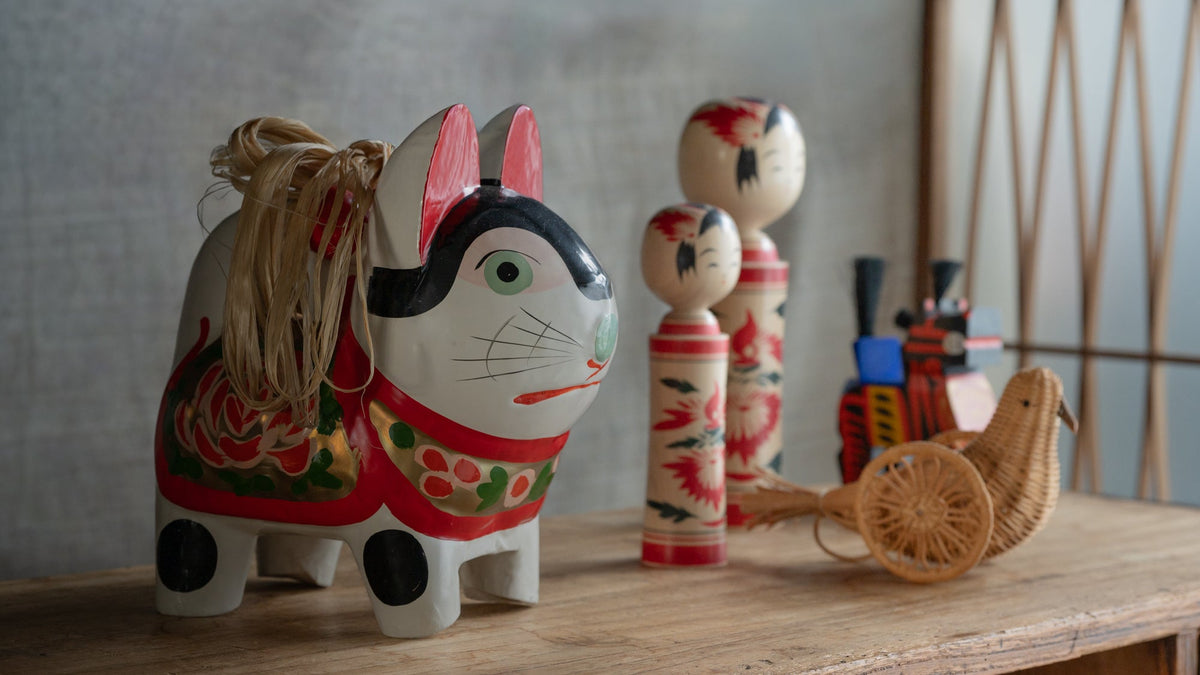
Cute figures in bright colors with rustic patterns and hand-formed shapes: these are some of the defining characteristics of traditional Japanese regional toys. But beneath the surface is a world of meanings hidden to the naked eye.
Not Just Cute: The Meaning Behind Different Animal Motifs
Many regional toys are shaped like animals, but they aren’t chosen just for their cuteness. Each animal carries its own symbolism, and each toy embodies specific prayers or regional beliefs. Looking at the shapes these toys take reveals some of the differences in local folk beliefs.
Dogs

Perhaps because toys are, at their heart, meant for children, they often carry wishes for children’s well-being, regardless of region. The inu hariko, for example—a dog figurine from Tokyo’s Arakawa Ward—often carries a pellet drum on its back tied on with hemp cord. The drum carries the wish for children to grow up to be honest and not two-faced (in Japanese, “lacking a front and back,” just like a pellet drum). The hemp cord symbolizes a child’s fast and strong growth.
A similar figurine comes from nearby Taito Ward. Known as the zarukaburi inu, it is a dog with a mini bamboo basket on its head. The basket lets water pass straight through, a wish that even if a child catches a cold, their nose won't get stuffed up. What an everyday concern! There’s something charming about how universal that is.
Horses

Japan also sports a rich array of horse toys, many from regions with a robust horse-raising culture. One of those regions is the former Miharu Domain in Fukushima Prefecture, home of the Miharu koma. Made since the Edo period (1603–1868 CE), these horse figurines originate from a legend surrounding a Heian-period (794–1185 CE) shogun, Sakanoue no Tamuramaro. As the legend goes, Sakanoue was given one hundred wooden horses by a monk before heading into battle near Miharu. As his forces struggled in the close fight, one hundred real horses appeared out of nowhere and helped turn the tide, allowing Sakanoue to emerge victorious.
That auspicious symbolism was carried over to the Miharu koma, but indirectly. Rather than signifying success or victory, as Sakanoue had in battle, beliefs around the Miharu koma instead center around children. Children who played with them were said to grow strong and healthy. Another local belief went that childless adults who offered three soybeans a day to a Miharu koma would be blessed with children. Because of this, Miharu koma are also known in the region as “child-rearing wooden horses.”
Tigers

Not all the animals that appear in regional toys are ones close to daily life like horses and dogs, however. Tigers, though they are not native to Japan, are a popular motif in local toys across the country, with different regions creating their own variations. Part of their cultural importance comes from their place as one of the twelve zodiac signs. In addition, they are thought to possess the power to ward off evil spirits, making them popular in Japan as amulets to protect against misfortune.
Tiger toys are often used as decorations and to pray for children’s health at seasonal festivals for children like Tango no Sekku. That includes the Izumo hariko, from Izumo, Shimane Prefecture, and the Kurashiki hariko from Okayama Prefecture. Both are bobblehead papier-mâché tiger figurines, and both of these regions have a custom of giving gifts of tiger figurines at children’s festivals, a custom that still continues on a smaller scale to this day.
You’ll notice that all of these animal toys embody some kind of wish or prayer centered around children. That is extremely common for Japanese regional toys. More than just cute things to play with, the toys themselves contain parents’ and communities’ desire for their children’s well-being.
Local Materials, Local Rhythms, Local Toys
Another of the distinct features of regional folk toys is that they use materials native to their region, usually ones that would have been easy for the common people to access. Wood scraps, paper, rice straw, clay—these are all main players in the world of Japan’s traditional toys.
Wood

One of the most distinctive examples is kokeshi dolls, originating from onsen hot-spring towns in the Tohoku region. Hot springs were popular destinations for local agricultural workers during the off-season, and became more accessible to commoners during the Edo period, when the ability to travel for leisure spread beyond the wealthy and ruling classes. Local woodworkers used scraps from their regular work to make kokeshi dolls as souvenirs for these travelers. Woods like Japanese dogwood, maple, and zelkova are common, reflecting the makeup of Tohoku’s forests.
Vine

Many agricultural workers themselves turned to handcrafting during the off-season, especially in snowy regions. One example is the hatoguruma, a pull-toy shaped like a dove with wheels on either side of its body. It hails from Nozawa Onsen, a mountainous and snowy village in northern Nagano Prefecture where farmers would weave baskets while snowed in during the winter season. Like the baskets, this toy is made from akebi vine harvested from nearby mountains. Today, few craftspeople still make the hatoguruma toy, while the number of basket weavers has shrunk as well. Yet the craft still lives on, with locally woven akebi goods on display at souvenir shops for those visiting the nearby ski slopes.
Clay

Areas with abundant clay and pottery kilns have also made their mark on the regional toys landscape. One of the oldest existing regional toys in Japan, the konohazaru, from Kumamoto Prefecture, is thought to date back to the Nara period (710–794 CE). These monkey-shaped figurines are hand-formed out of local red clay, which is dried, then fired in a wood-fired kiln, and then smoked to give it its dark color. Legend goes that after receiving a divine message in a dream, a man used the red clay of Mount Konoha to make ritual vessels. When he discarded the leftover clay, it transformed into monkeys.
The area was and is home to many pottery kilns, and the figurine spread throughout Japan along the post road that passed through during the Edo period. Today, the last remaining kiln that makes konohazaru still uses the same local red clay as was used nearly 1,300 years ago. True to its legendary roots, “the Konohazaru has long been cherished locally as a guardian deity that wards off illness and misfortune, promotes marital harmony, and ensures the prosperity of descendants,” according to Konohazaru Kiln.
Local legends, local materials, and the rhythms of local life. All of these are embodied within the vessels of regional toys.
Why Are So Many Regional Toys Red?
Papier-mâché owls with rabbit-like ears, rustic-looking cow bobbleheads, and pull toys shaped like a sea bream on a cart. Though diverse in shape and regional origin, each is painted a vibrant red. This color choice isn’t accidental. It has deep roots in Japanese spirituality and history.
Why red? In both Shinto and Buddhist traditions, red tends to be seen as a ward against evil and misfortune. It can also represent the power of an enshrined deity. The color itself therefore both expresses and carries spiritual power.
That power is carried over to traditional red toys in a way that spoke to the needs of children at the time. Many of these red toys share a common symbolism: the ability to ward off smallpox.
By the Edo period, smallpox was a children’s disease. With frequent outbreaks in populated areas, most adults had already gained immunity via previous infection. To manage the illness, households quarantined while their child recovered.

Local folklore made its way into the sickroom. Red clothes and red decorations were thought to either appease the smallpox god or drive it away through the color’s spiritual power. For the same reason, red toys were placed next to the sick child as encouragement.
One such toy is the aka-mimizuku, literally “red horned owl.” A papier-mâché figurine from Tokyo, it’s a good example of how symbolism was often embedded in every element of a regional toy. According to Osaki Ayame, a curator at the Japan Toy Museum, the owl’s wide-open eyes are a charm to prevent blindness, the Buddhist flame symbol painted on its stomach represents the granting of wishes, and the light, hollow body may denote hopes for a light illness. It’s a roly-poly toy, meaning it always rolls back upright when pushed over, a symbolic recovery. With this, even the toy’s playful function symbolizes wishes for the child’s healing.

Yet probably the most well-known example of red smallpox-warding toys is the akabeko, a bobblehead cow figurine from Aizu in Fukushima Prefecture. Its hollow body, made of wood or papier-mâché, combines the warding color of red with black and white spots that represent the scars left behind by smallpox, thought to be a sign of successfully surviving infection. The head is tied on with a string, allowing it to bobble up and down and side-to-side.
You can imagine that even a sick child—tired with fever, itchy, bored, and a bit scared—could use their limited energy to gently tap the head of the akabeko beside their pillow and enjoy a few moments of comfort as it nods back encouragingly, “You can do this.”
The idea that a red cow could ward off smallpox would turn out to be somewhat prophetic. The vaccine against smallpox—derived from cowpox, a similar but less dangerous disease—was first successfully used in Japan in 1849. The ultimate source? A cow.

Fall Down Seven Times, Get Up Eight
So far, we’ve seen many prayers and wishes held by toys. But perhaps the toys that embody their wishes the most physically are the category of toys known as okiagari koboshi: figurines that turn back upright every time they are pushed over. At least as old as the Muromachi period (1336–1573 CE), variations exist in every region, from Okinawa to Hokkaido. Whether made of papier-mâché, wood, clay, cloth, or even stone, all have a weighted base that allows them to “get back up” again.

Though there are many variations of okiagari koboshi, the most famous is the daruma doll, which most often appears as a round monk in a red cape. Often, the eyes are left blank. The owner fills in one eye when they make a wish. When it is fulfilled, the owner fills in the other eye. According to the Japan Toy Museum, they likely originated as charms against smallpox, hence the red color, but gradually came to symbolize other wishes like safety for one’s household, success in business, or to pass one’s exams.
Specific regional variations tend to be associated with different wishes. For example, Okinawa’s version represents hopes for a child to grow up strong and healthy, while Oita Prefecture’s hime (“princess”) daruma represents business success, and Niigata Prefecture’s sankaku (“triangle”) daruma is associated with things as different as successful silkworm cultivation and protection from misfortune at sea.

Yet regardless of the wish, there’s a sense of resilience behind these toys. They often appear beside the expression, “If you fall seven times, get up eight.” This conventional wisdom is embodied in physical form.
If you read signboards at historical sites in Japan, you’ll quickly see other evidence of the mentality of “getting back up again.” A temple that was rebuilt after an earthquake. A castle reconstructed after a fire. Edo Castle alone was burnt down and rebuilt at least five times. With frequent natural disasters, recovering after setbacks was, and is, a fact of Japanese life. Perhaps okiagari koboshi toys just bring this to life in miniature—a reassuring symbol that no matter how many times you’re pushed over, you can get back up again.
There may be fewer regional toy makers these days, but the tradition lives on. Local tourism boards promote their local toys, while workshops teach kids how to make them. And creative craftspeople across Japan are thinking up new ways to bring modern designs to toys hundreds of years old.
When we asked around the MUSUBI KILN office, many of our Japanese colleagues said, “Oh, I have a few regional toys at home,” or “They decorate a shelf at my parents’ house in my hometown.” The beloved shapes continue to bring character and hold nostalgic memories. Perhaps there is one that could find its way into your own heart.
Selected References: Allen, Laura W. “Contagious Disease.” UCSF Japanese Woodblock Print Collection. University of California San Francisco. Accessed October 5, 2026. https://japanesewoodblockprints.library.ucsf.edu/contag2.html. / “Chinzei Hachirō Tametomo Hōsōgami, kaku Utagawa Kuniyoshi, Tokyo shiryō 778-C18.” Tokyo Metropolitan Library. Accessed October 5, 2026. https://www.library.metro.tokyo.lg.jp/portals/0/edo/tokyo_library/modal/index.html?d=6360. / Isao, Toshihiko. “‘Hōsō-e’: ekibyo no tatakai to mayoke [Smallpox Pictures: Fighting off and Warding Against Disease.]” Atorie dangi. JAPAN Forward, February 22, 2022. Accessed October 5, 2026. https://japan-forward.com/ja/【アトリエ談義】「ほうそう絵」:疫病との戦い/. / Japan Toy Museum. “Fuyu no kikakuten: nihon ichi no tora kyōdo gangu [Winter Special Exhibition: Japan’s Best Regional Tiger Toys].” Japan Toy Museum, 2009. Accessed October 5, 2026. https://japan-toy-museum.org/archives/exhibition/plan/日本一の虎玩具展. / Japan Toy Museum. “Hōsō-yoke akaimimizuku [Smallpox-Warding Akai-Mimizuku].” Japan Toy Museum, Toys of This Month, April 2020. Accessed October 5, 2026. https://japan-toy-museum.org/archives/monthly/疱瘡除けの赤いみみずく / Rotermund, Hartmut O., and Royall Tyler. “Demonic Affliction or Contagious Disease? Changing Perceptions of Smallpox in the Late Edo Period.” Japanese Journal of Religious Studies 28, no. 3/4 (2001): 373–98. Accessed October 5, 2026. http://www.jstor.org/stable/30234471. / Saitō, Michiko, and Kayoko Sunano. 47 todōfuken no kyōdo gangu [Regional Toys of the 47 Prefectures]. 4 vols. Supervised by Nihon Gangu Hakubutsukan and Shigeyoshi Inoue. Ōtsuki Shoten, 2022. / Suzuki, Akihito. “Smallpox and the Epidemiological Heritage of Modern Japan: Towards a Total History.” Medical History 55, no. 3 (2011): 313–18. Accessed October 5, 2026. https://doi.org/10.1017/s0025727300005329. / “Tsukurite: Konohazarugama. [Maker: Konohazaru Kiln]” Chiiki Bunka Shōten Unagi no Nedoko. Accessed October 5, 2026. https://unagino-nedoko.net/maker/2678/.
Stay close to the craft
Now and then, a quiet letter — new stories, seasonal notes, and the hands behind the work.
On Tango-no-Sekku, We Celebrate the Health of Our Growing Boys!
We celebrate Boy's Day on the same day as Children's Day, with fun activities…
Buyer's Choice: My Memories with Kokeshi Dolls
Today, I'd like to share with you my deep fascination and attachment with beloved kokeshi…
Umehara Haruka
The Enduring Beauty of Fine Imari Porcelain
Discover the origins and traditions of Imari porcelain, from Kakiemon to Nabeshima ware, and…
Leave a comment