

Making Kanten: A Craft Shaped by Nature
Explore how a Tokyo kanten workshop blends seaweed from three Izu shores to preserve its natural texture and golden hue.
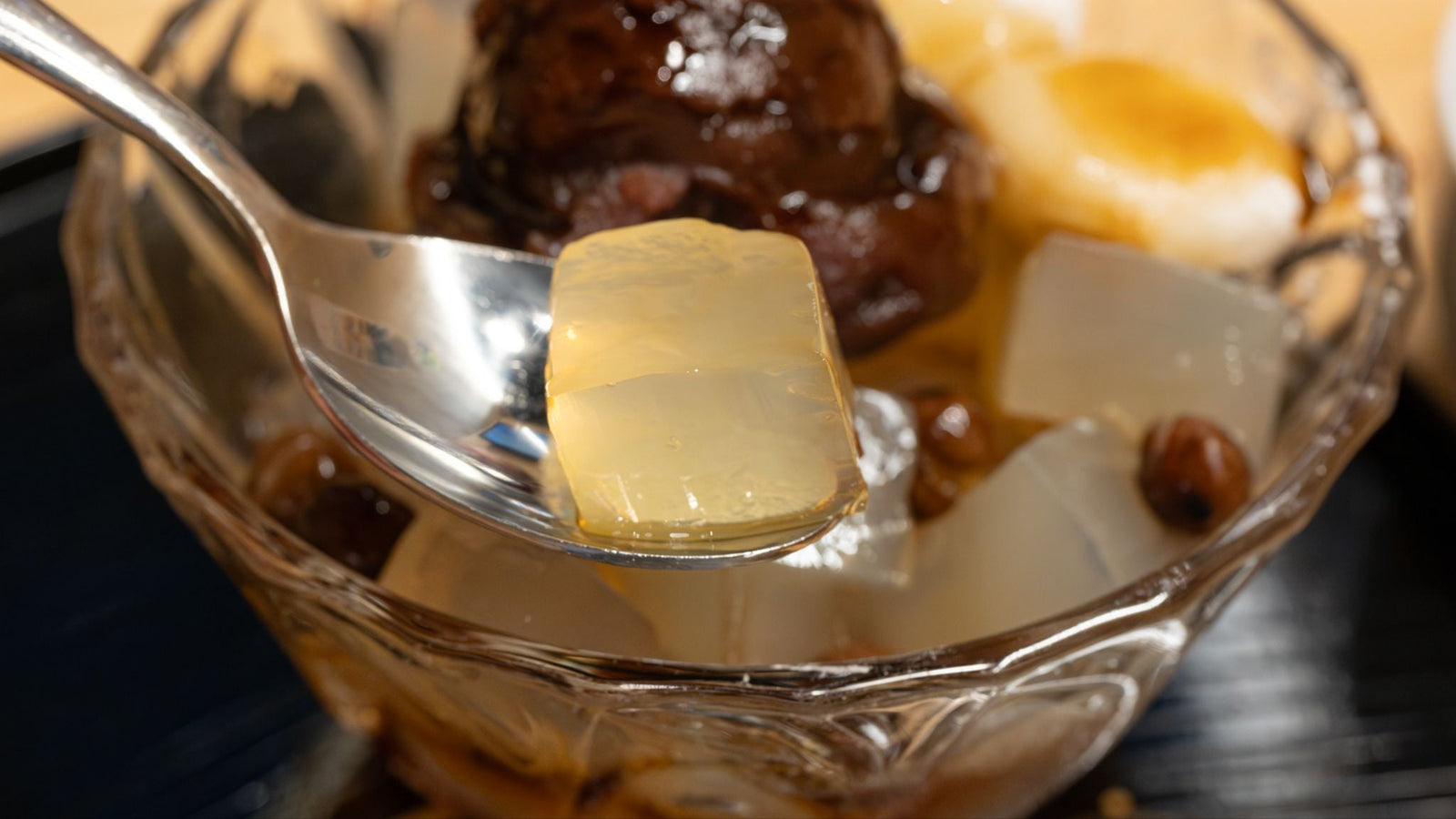
Kanten, commonly known as agar in English, has long been part of traditional Japanese sweets, yet it rarely draws attention to itself. Its story begins with tokoroten, a jelly made from red seaweed that was introduced to Japan from China more than 1,200 years ago.

Legend has it that kanten was discovered by chance in the seventeenth century. Leftover tokoroten was placed outdoors during winter, where it froze overnight. As it thawed in the daytime sun and gradually dried, it became lighter, more durable, and easier to preserve. This natural process gave rise to the kanten we know today.

To learn more, we visited Sanukiya, a kanten workshop founded in 1914 in Shinjuku, Tokyo. We expected to see a refined manufacturing process. Instead, we discovered that producing this seemingly simple ingredient requires more than technical expertise. It also depends on a deep understanding of nature and the changing conditions that shape each batch.
The Seaweed That Shapes Kanten

Before becoming the transparent blocks found in traditional sweets, kanten begins as tengusa, a type of red seaweed harvested from the sea. Unlike many modern ingredients designed for consistency, it remains deeply connected to the natural world. Its firmness, elasticity, texture, and aroma are influenced by where the seaweed grows, the season it is harvested, and annual variations in climate.
This close relationship with nature makes its production both fascinating and challenging. Even when the same methods are followed, the result can vary from one batch to the next.
As Fukuhara Tsuyoshi, the third-generation head of Sanukiya, explains:
“Kanten is made from natural tengusa, so the finished product can vary considerably depending on how it is boiled. In other words, it is difficult to make exactly the same kanten every time. I have been making kanten for more than 40 years, but even now, it is difficult to maintain consistency. Tengusa varies depending on its origin, the climate, and the season, so we have to adjust the pressure accordingly.”

Fukuhara made one thing clear: making kanten is not simply about following a recipe. It requires recognizing the natural variations in the raw material and adapting the process accordingly.
Finding Balance in Izu

One of the first things we learned at Sanukiya was that there is no single kind of tengusa.
Before our visit, we had imagined kanten beginning with a single, uniform ingredient—a red seaweed harvested from the sea and transformed through a carefully controlled process. Instead, Fukuhara showed us the dried tengusa used at Sanukiya. It is blended from three carefully selected sources across the Izu Peninsula—around 130 kilometers (80.8 miles) west of Tokyo: Oshima Island, Yagisawa on the peninsula’s western coast, and Inatori on its eastern coast. Seaweed from each growing area has its own characteristics, and together they contribute to the balance of the final kanten.

Oshima tengusa is relatively coarse and produces kanten with strong gel strength and a clean, light texture. Yagisawa tengusa offers a well-balanced combination of strength and elasticity, giving the kanten a pleasant bite, smooth texture, and delicate seaweed aroma. Inatori tengusa is somewhat firmer, making it especially important for Sanukiya's premium anmitsu kanten, where a satisfying bite is essential. Rather than relying on any one variety, Sanukiya blends the three to bring together their complementary qualities.
According to Fukuhara, one of the key indicators of quality is the state of the seaweed's branching. The tips of the branches contain a high concentration of the natural substance that gives kanten its structure. The more developed the branching, the greater its gelling power.
“The type of seaweed also differs depending on where it is harvested,” he explained.
His insight revealed an important point: making kanten begins long before the seaweed reaches the workshop. Ocean currents, water temperature, and the slow growth of the seaweed shape the material long before it reaches the hands of the craftspeople. By the time they begin their work, nature has already made many of the decisions.
What Only Experience Knows
If the sea determines the qualities of tengusa, the craftsperson's role is to recognize those differences and respond accordingly.
The process of making kanten may appear straightforward at first glance. Seaweed is boiled, the liquid is filtered, and the result is cooled until it sets. Yet between each step are decisions that cannot be reduced to measurements or written instructions.
Boiling
The most important adjustments begin during the boiling process. Because each batch of tengusa is different, the heat and steam pressure are adjusted according to the condition of the seaweed. Too much heat can affect the color and texture, while too little may prevent the seaweed from releasing its full potential.
“Even when we use the same method, it is difficult to produce exactly the same kanten,” Fukuhara explained. “We have to adjust the pressure and heating conditions each time.”

This is where experience becomes essential. The process is not about correcting mistakes after they happen, but about recognizing subtle differences before they affect the final product.
Filtration
The same principle applies to filtration, a stage that Fukuhara considers one of the most delicate parts of the production process.
After the tengusa has been boiled, the liquid contains not only the elements needed to create kanten, but also small particles and naturally occurring substances from the seaweed itself. Through precise filtration, these unwanted elements are removed, leaving behind a clear liquid that will eventually become kanten.
Yet clarity alone is not the goal.
“The more filters you use, the better they remove impurities, but they can also remove the aroma,” Fukuhara explained. “If you use fewer, the scent of the seaweed becomes too strong.” Finding this balance requires deciding what should be removed and what should remain. The natural character of tengusa should not disappear in pursuit of purity; the faint fragrance and flavor that come from the sea are part of what makes kanten distinctive.
Six-layer filtration
At Sanukiya, years of experimentation led to a six-layer filtration process. Adding more layers would create a clearer liquid, but it could also take away some of the qualities that give the kanten its identity.

This way of working reveals something fundamental about traditional food making. The goal is not always maximum efficiency or complete control. Instead, it is about finding the point where human knowledge and natural variation meet.
Fukuhara described this relationship simply.
“Kanten is a living thing.”
After more than forty years, Fukuhara has learned to recognize changes that are difficult to express in numbers. Sometimes, he says, he can judge the quality of a batch before it has even finished setting simply from the aroma rising from the warm liquid.

Machines can measure temperature and pressure with precision. What they cannot do is sense when the tengusa requires a slightly different approach. That decision still belongs to the person standing beside the kettle.
What Remains in the Bowl

By the time kanten reaches the table, its transparent appearance gives little indication of the seaweed it came from, the fluctuating conditions of the sea, or the decisions made throughout its production. Served in anmitsu or alongside traditional sweets, it often plays a supporting role, something that holds other flavors together while rarely becoming the center of attention.
Yet when made from natural tengusa, even its appearance tells a story. Unlike the pure white color often associated with processed agar, kanten made from selected seaweed carries a faint golden hue—a sign that the natural properties of the seaweed have been preserved instead of refined away. It is a small detail, but one that reflects a different approach to food: allowing those natural qualities to remain visible.

The same approach is reflected in its texture and flavor. At Sanukiya, the kanten is cut into larger pieces than usual so its unique qualities can be appreciated. Smaller cubes are easily overshadowed by sweet toppings, while larger pieces allow its texture and flavor to stand out. Its qualities are subtle: a gentle firmness, a faint aroma of the sea, and a delicate mineral note that lingers even alongside sweet ingredients.
This is also why some people continue to seek out freshly made kanten despite its simple appearance. Fukuhara shared that visitors have traveled from distant places, including Kyoto and Nagoya, specifically because they wanted to experience this particular texture and flavor.

At Sanukiya, the experience continues beyond the workshop. Visitors can enjoy freshly made kanten on the engawa (traditional wooden veranda), where the quiet setting encourages an unhurried appreciation of its subtle texture and flavor.
Born from the sea and shaped by the hands of skilled craftspeople, kanten represents a way of working with nature rather than controlling it. Its clear form may appear simple, but within that simplicity lies a long relationship between the sea, human hands, and time.
The next time a piece of kanten appears in a bowl of anmitsu, it may no longer seem like a background ingredient. Behind its delicate texture lies the story of the sea where the tengusa grew, the changing seasons that shaped it, and the knowledge of craftspeople such as Fukuhara, who have learned how to bring out its character.

Stay close to the craft
Now and then, a quiet letter — new stories, seasonal notes, and the hands behind the work.
A Bowl of Stillness: Finding Sacred Rice Porridge in a Tokyo Shrine
Inside a Tokyo shrine, Shikizen serves okayu simmered in bonito, kelp, and hot spring…
Nakazawa Hiroko
Akari’s Sake-Steamed Hamburg Steak Recipe
Akari's sake-steamed hamburger steak with cherry tomatoes. No eggs, no breadcrumbs, just a simple,…
Hasegawa Akari
A Late Summer Afternoon at the Table
Five simple dishes, one slow afternoon. Blue-and-white porcelain, glass, and Bizen ware hold the…
Leave a comment