

The Craft Behind the Chopsticks: Three Stories of Artistry
How artisans use the best domestic materials and extreme attention to detail to create chopsticks that embody centuries of craft tradition.
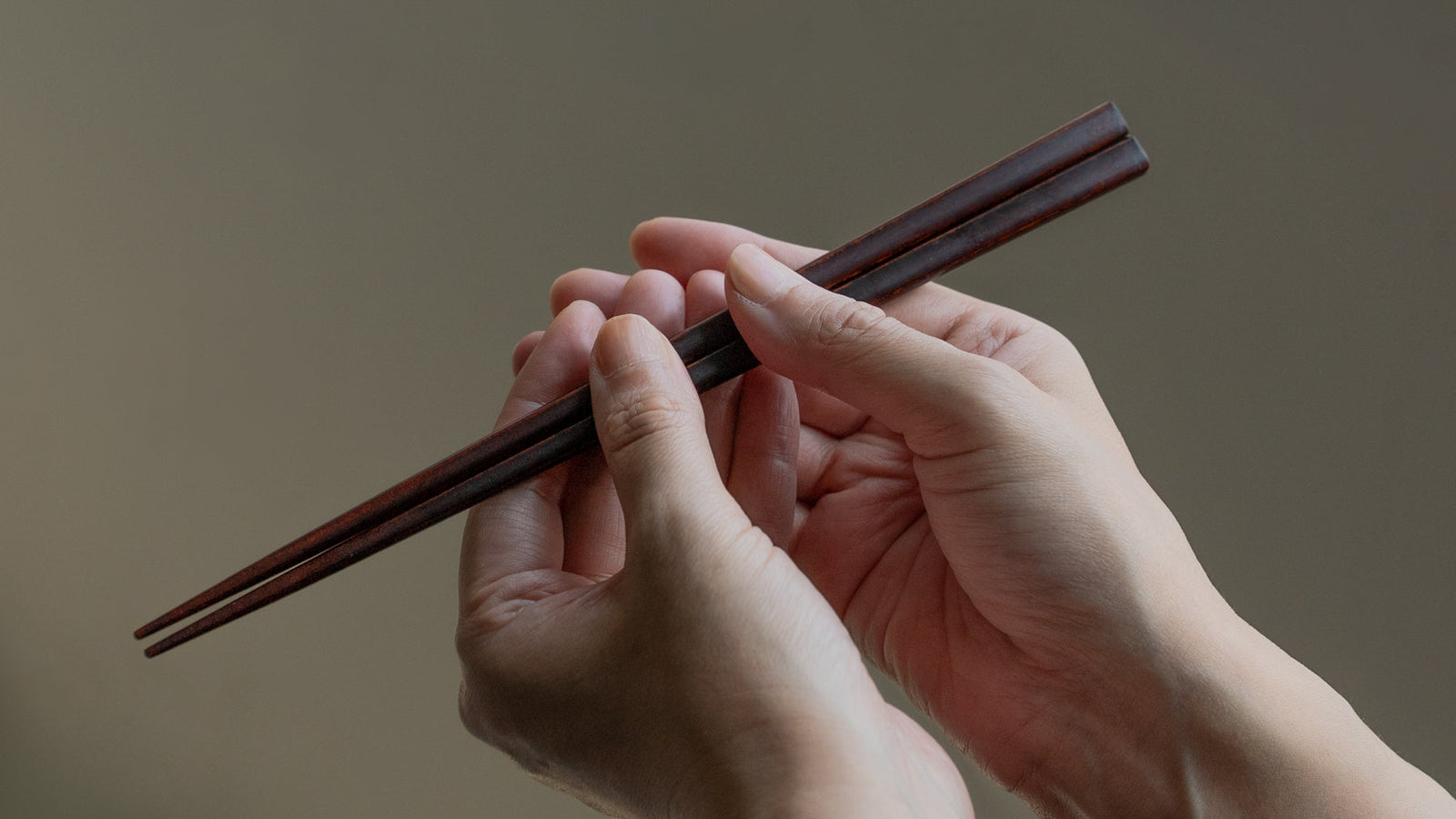
The luster of Japan’s highest-quality lacquer, the very same used for the restoration of historic buildings, brushed onto chopsticks one by one. Bamboo hand-cut by the artisan himself, then carefully sanded into shape. Chopsticks whittled by hand to achieve an ideal thinness.
From domestic lacquer tree groves and Kyoto bamboo forests to the workshops where expert craftspeople meticulously paint and polish, each pair of chopsticks goes through a journey of creation. Rooted in the specific land and craft where they were born, this is how something intangible—centuries of inherited tradition—is turned into something you can see, touch, and use.
These are the stories of chopsticks that embody the height of artisan technique.
Chopsticks That Bring out the Best in the Highest-Grade Lacquer in Japan
A grove of trees with bundles of diagonal stripes cut into them at regular intervals, each old scoremark black with dried sap. A craftsperson scrapes new lines across the bark, holding a bucket to catch the fresh, cream-colored liquid.

This is a scene from a typical lacquer forest, where trees are tapped for their natural sap—a sap that will soon be refined into urushi, or lacquer, a key material in a number of traditional crafts and architecture. Increasingly rare in Japan, domestically produced lacquer accounts for under 2 percent of the total market. An even smaller percentage—around 60–80 percent of domestic production, hovering around 1 percent of the Japanese market—represents the gold standard of Japanese urushi: Joboji lacquer.

Joboji lacquer is a trusted material used to restore Japan’s National Treasures, Important Cultural Properties, and UNESCO World Heritage Sites. Just one example is its use in the restoration of Toshogu Shrine in Nikko, the lavish, 400-year-old mausoleum and shrine complex dedicated to shogun Tokugawa Ieyasu. Surveys of the site found that a 20:80 mix of domestic and imported lacquer peeled significantly in just thirty years, yet 100 percent domestic lacquer was nearly undamaged after seventy-five years. This level of durability led those involved in restoration to consider the use of Joboji lacquer to be an indispensable part of the restoration work. It was used extensively in the repairs conducted from 2021 to 2026.

Yet it’s not only architecture where Joboji lacquer shines. These same qualities are also what draw chopstick makers to the material.
“Joboji lacquer is high quality even among other domestic lacquers,” says Ito Hiroshige of Ito Kanji Shoten, a lacquerware workshop in Nagano Prefecture with a hundred-year history. “Its hallmark is its uniquely soft and gentle feel. Even if you use the same methods to apply other lacquers, they’re just a little different.”

That velvety texture is the cornerstone of one of Ito Kanji Shoten’s special designs, the Kiwami Japanese Cherry Wood Chopsticks. An artisan applies Joboji lacquer evenly from end to tip. Rotating the chopstick while applying the lacquer helps achieve an even coat. Starting from a wipe-lacquer base followed by a polished undercoat, these chopsticks are then finished with at least four overcoats before they are complete.

“We take special care not to waste even a single drop of lacquer,” says Ito. “Lacquer tapping has recently begun in nearby Matsumoto City, but it’s extremely hard work. Lacquer is a precious resource.”

Following the final coat of lacquer is an unexpected finishing step: removing tiny fragments of dust from the surface using the chiseled tip of a quill feather. Against the smoothness of the Joboji lacquer, even small specks stand out.

Made with Japanese cherry wood, which is known for balancing flexibility with lightweight durability, these chopsticks truly bring out the best in domestic materials and domestic workmanship. And just like the fresh coats of Joboji lacquer adorning Toshogu’s shrines, this is a pair that is ready to last a lifetime.

A Single Craftsman’s Vision: From the Bamboo Forest to Your Hand
“We wanted to try doing everything ourselves,” says Nakata Yohei, a certified master of traditional craft in Kagawa lacquerware, and an artisan with the family-run lacquer workshop Nakata Shikki. This desire led him to go beyond his specialty in lacquer and take on the challenge of doing the woodworking himself. He even goes as far as harvesting his own bamboo.
Traditional Japanese crafts typically operate on a division of labor system in which specialists handle each step of the process. Lacquerware is no different. So why take this unusual step?
“With the aging of woodworkers, it has become harder to source materials. At first, we tried working with commercially available bamboo chopsticks, but they’re so brittle. They would break in an instant.”
Amidst these concerns, Nakata heard about the problem of abandoned bamboo forests in Kagawa Prefecture and thought, why not use this bamboo to create chopsticks himself?
Bamboo is cultivated in Japan for two main purposes: food in the form of takenoko (bamboo shoots) and woodworking materials. Yet one of bamboo’s greatest assets as a renewable resource—that it grows extremely quickly—can also be a drawback. If bamboo is left untended, it tends to take over landscapes. It encroaches on farmland; invades lumber forests, causing trees like cedar and cypress to die; and pushes into residential areas.

Although moso bamboo and other large varieties were long actively planted in many parts of Japan, a liberalization of imports in the 1970s led to a sharp drop in the price of domestic bamboo shoots, making their cultivation less economically viable. Add to that a lack of successors to elderly bamboo shoot farmers, widespread adoption of other building and woodworking materials, depopulation of rural and exurban areas, and, more recently, the aging of individuals who maintain bamboo forests, and you get Japan’s unique situation: an overabundance of a natural resource that has gone from useful to a nuisance.

Right as Nakata was experimenting with how to create the ideal pair of chopsticks, he met Tada Hirofumi. Director of the Sanuki Lacquer Craft Museum, Tada also happens to own a moso bamboo grove in Kagawa Prefecture—a grove that would become the answer to Nakata’s brittle chopsticks problem. Today, Tada, Nakata, and Nakata’s brother, Daisuke, harvest bamboo from Tada’s grove. After that, the Nakatas handle all aspects of drying and processing, followed by their more standard work of lacquering and finishing.


Thus, with materials secured, Nakata Yohei was able to turn his focus to designing the best pair of chopsticks he could. Working by feel and the naked eye, Nakata sands bamboo into the desired shape, making sensitive adjustments with his fingertips as he goes.

When it comes to the Nakata Yohei Hexagonal Bamboo Chopsticks, Nakata sands the six-sided facets all the way to the tips, rather than rounding them off. This increases the sense of delicacy and control when picking up food. He also makes the tips so thin they seem to vanish in the mouth.
“Sometimes I think I could make the tips of the chopsticks even thinner,” Nakata says. “But any thinner and they would actually become harder to eat with, so I restrain myself.”

The bamboo joints on the handle are not only comfortable to hold, but also remain as a symbol of the forest from which these chopsticks came. Handmade, sustainable, individual. These are the qualities that live within the heart of these chopsticks.

A Nature Born in Kyoto
Bamboo has been cultivated in Kyoto since the Heian period (794–1185 CE), and for good reason. It is the precise qualities of this local landscape that produce some of the finest bamboo in Japan.

The clay-rich soil causes bamboo to grow slowly, resulting in bamboo that is very hard while remaining very light. A wide temperature range and the freshness of the water produce bamboo that is both straight and supple. Bamboo grown and processed in Kyoto using traditional techniques belongs to an officially designated craft known as Kyomeichiku: literally “Kyoto’s famous bamboo.”
Kyomeichiku processing involves handwork at every stage, from the very moment of harvesting.
The beauty of bamboo hinges on its surface, says craftsperson Shimizu Katsu of Shimizu Meichiku, a leading Kyoto bamboo workshop that handles everything from forest management to harvesting and processing.

“People in lumber forestry have mechanized their work, but we can’t do that. If we damage the bamboo’s surface, we can’t use it,” Shimizu explains. That’s why he continues to cut bamboo using a handsaw and carries the stalks over to his kei truck by hand. “We lay a blanket between each layer of bamboo we place in the truck. We’re always mindful not to damage its skin.”
One of the defining features of Kyomeichiku is hinuki, the process of using heat to draw the bamboo’s natural oil to the surface, where it is wiped off with a cloth. Stalks are set over a burner that reaches up to 700°C (1,290°F). Though the craftspeople wear arm coverings, their hands are bare as they wipe the bamboo. With each wipe, a greater luster emerges.

While the bamboo is still hot, its curvature is straightened using leverage against a wooden brace. Then it is handed off to craftspeople who continue with the next stage: woodworking.
In the case of the Kyoto Bamboo series of chopsticks, this base material goes from Shimizu Meichiku to the workshop of Takanami Yoshi, a bamboo artisan with thirty years’ experience.

After splitting the bamboo into a rough chopstick shape, he leaves the pieces to fully dry for two summers. Though this stage takes time, completely removing the water prevents the bamboo from warping or being damaged by insects.

When it finally comes time to carve the chopsticks, Takanami whittles them into shape using planes and sharp work knives. “Doing it by hand allows me to make them thinner than I could with a machine, with an even final result.”


Surface patterns are another of the unique qualities of Kyomeichiku. Among them are shiratake (white), often seen in the inuyarai fencing that protects the base of Kyoto townhouses, and zumen (dappled), beloved in the tea ceremony for its wabi sabi feel. The careful hand-craftsmanship that starts the very moment bamboo is harvested is what allows the surfaces of these chopsticks to reveal their final beauty.
A pair of chopsticks that wouldn’t be possible without the land, heritage, and hands that surround it. It is this very essence of Kyoto artistry that rests between your fingers when you hold a pair of Kyoto Bamboo chopsticks.

There is a Japanese word that quietly runs through every story in this collection: kodawari. Commonly used, yet difficult to translate, if you were to simplify it into a single English phrase, it would become something like “a thing that one is particular about.” Yet kodawari is deeper than a simple preference. It is the end result of when a person adheres to their own standards down to the finest detail, and it implies a deep commitment to quality and aesthetic sensibility.
When you hear about a craftsperson filtering lacquer so as to waste not a single drop, waiting two years for bamboo to fully dry, or pursuing the best materials they can find, that is kodawari in action. It is not just hard work for hard work’s sake. It is all for that glorious end result: a pair of chopsticks that feels effortless to hold, that seems to disappear in the mouth. That holds centuries of craft tradition within a single object.
Stay close to the craft
Now and then, a quiet letter — new stories, seasonal notes, and the hands behind the work.
Tamura Seito: Calligraphy on Kutani Ware, Connecting Across Time
The fourth-generation practitioner of Kutani mohitsu saiji, Tamura Seito paints waka poems in micro…
The Art of Connection with Mizuhiki Artist Omoda Kyoko
Discover how mizuhiki artist Omoda Kyoko finds meaning, mindfulness, and connection in the craft…

Colorful Craft: Fujii Yuya's Journey of Chopstick Artistry
Meet the artist behind Matsukan's hand-painted chopsticks, sharing the incredible path he took to…
Leave a comment