

Kanbata Shinya: A World Shaped by Encounter
Step into Kanbata Shinya's world, where French cathedrals and Kutani tradition meet in fine ebicha linework.
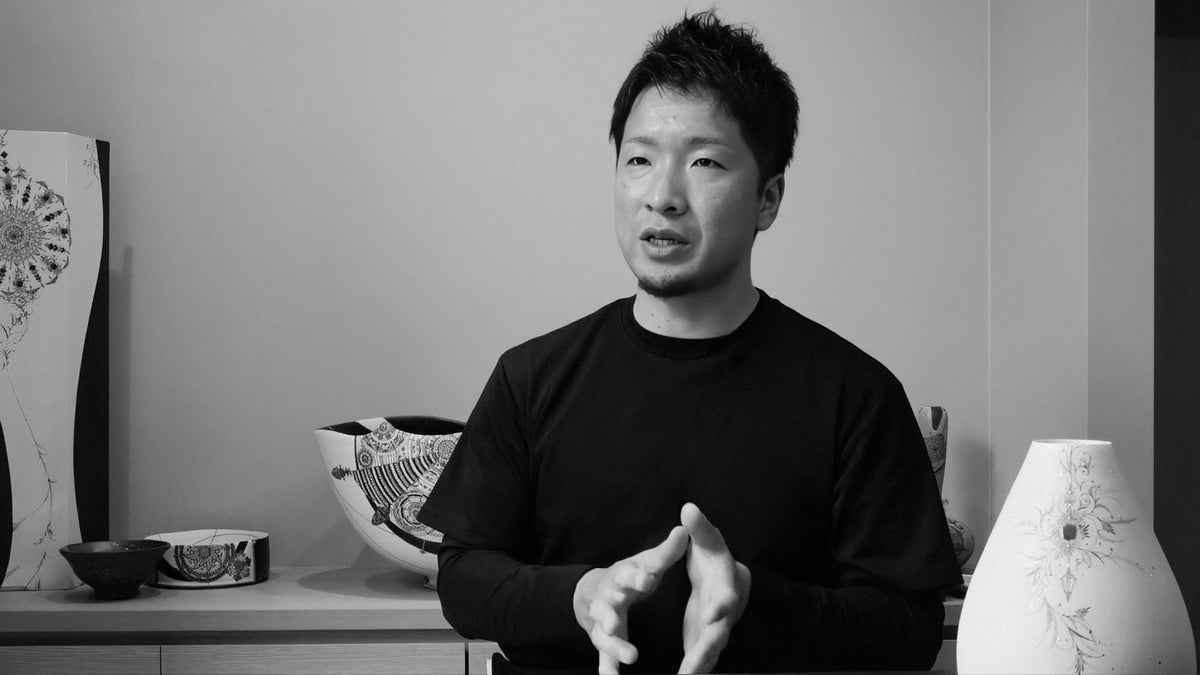
For Kutani ware artist Kanbata Shinya, a vessel begins long before the first brushstroke. From the clay and form to overglaze decoration and final gilding, every decision serves a single vision. Rather than decorating a finished vessel, he constructs an entire world.
That world has taken shape through meaningful encounters across Kanbata’s career: with the techniques and traditions of Kutani ware, with architecture and colors discovered in different places, and with people and ideas from other fields. Together, these encounters have shaped his artistry, guided by what moves him and grounded in a desire to create works that will be cherished.
With Someone in Mind
Kanbata’s path into ceramics began in the crafts program at a vocational high school. Already interested in drawing, he discovered a kind of satisfaction in clay: the ability to shape something with his own hands. Another early experience gave that interest a more personal dimension. A vessel he had made in class and given to a friend’s mother was warmly received. Years later, he discovered that she was still using it. This became a starting point for his desire to pursue making as a profession.
“To have the opportunity to see someone right in front of me take joy in something I’ve made—I feel very fortunate to be able to do this kind of work.”
Over time, this consideration for the person receiving his work developed into something broader. Kanbata began to think not only about the vessel itself, but about what its presence might bring to the time and space around it.

His visit to France helped give this idea clearer form. Seeing places such as Notre-Dame Cathedral and the abbey of Mont-Saint-Michel, he was drawn to their architecture, intricate details, and colors, but also to the feeling of entering the spaces themselves. Stepping inside churches and castles, he recalls, gave him a feeling of being in a sacred space, bringing with it a sudden sense of clarity and composure.

What stayed with him was this departure from ordinary experience. It gradually became connected to what he wanted his own work to offer.
“Instead of simply drawing patterns, I create with the idea of changing the space, or changing the atmosphere, so that the time spent with one of my vessels becomes something special.”
Building a World, Piece by Piece

At the center of Kanbata’s work is the technique he calls ebicha-saibyo, combining intricate linework with the muted reddish-brown color known as ebicha that has become a signature of his practice. Yet for Kanbata, neither the lines nor the color exist as decoration in isolation. They are elements within a larger world, conceived together with the vessel itself.
A story or concept comes first. Kanbata begins with an image of the finished whole and works backward. From that vision comes the shape, the choice of clay and glaze, and finally the motifs and their placement. Ideas may spend considerable time developing in notebooks and sketchbooks before he begins making; by the time he sits at the wheel, he already knows where the work is heading.
His own comparison is architectural:

“I work with the idea of building a structure, like a church or a palace. Even within a circular motif, I’m not just lining up patterns. In my mind, I’m arranging individual parts to create a single whole.”
One of those parts is the circle. Its origin can also be traced to the vast Rose Windows of Notre-Dame Cathedral. Kanbata remembers feeling almost drawn into them. The image has remained with him ever since, and continuing to draw circular forms serves, in part, as a reminder of an encounter that helped set his artistic direction in motion.

However, the circles in his work are not symbols with a fixed meaning. Within a composition, Kanbata thinks of them more as components. He varies their size and orientation and connects some with fine chains, creating movement across the surface. In his earlier works concerned with time and space, they could suggest gears or clock faces, with the chains tracing their movement.

Arabesques are approached in a similar way. Unlike the continuous patterns often seen across a vessel, Kanbata’s arabesques appear in one particular area, much like ornament assigned to a section of a building. Circle, chain, arabesque, glaze, and undecorated surface are brought together as individual parts of a larger construction.

The Ebicha-Saibyo Palace in the Haze Flower Vase shows how this way of working can also respond to what happens in the kiln. Its pale pink glaze was not an effect Kanbata originally set out to produce, but once it appeared, he found in it a tone he had been seeking. He left areas open so that the glaze itself could remain visible, balancing its softly varied surface against passages of fine painting and gold.

For Kanbata, a strong concept makes such adjustments possible. If an unexpected result in the glaze contributes something to the piece, he may depart from what he originally intended to paint. As long as the underlying story remains clear, a change in one element need not send the whole composition off course.
The final moment comes with gold. When the gilded areas first emerge from the kiln, their surfaces are dull and slightly rough. Only through polishing does the gold acquire its finished brilliance. For Kanbata, the change carries particular emotional weight.
“It (the piece) starts to come alive. It’s as though a switch has finally been turned on. Only when it begins to sparkle do I feel that, for me, it is finally complete.”

The polishing is also a stage that requires the greatest concentration, since too much pressure can remove the gold. Yet it is precisely at this final point that the work settles into place. As the surface begins to shine, Kanbata reaches the quiet assurance that what he envisioned has come together as it should.
Finding an Individual Expression in Kutani Ware

Kanbata’s present style emerged gradually, through a series of discoveries, not just from a single source.
One of the earliest came during his time at the Ishikawa Prefectural Kutani Ceramic Technical Training Institute. As part of his studies there, Kanbata encountered akae-saibyo in a class taught by Fukushima Buzan, one of the foremost practitioners of the technique. Although Kanbata had always enjoyed detailed work, learning the technique firsthand revealed just how demanding it was. The difficulty only deepened his fascination.
“It was incredibly difficult when I actually began learning it, but I also found it immensely enjoyable. From that point, my admiration for akae-saibyo became very strong.”
Unable to apprentice under Fukushima, Kanbata pursued saibyo independently. The lines he draws today are the result of years of practice rather than something he mastered from the outset.
The line, however, was only a part of the individual expression Kanbata was beginning to develop. Others emerged through color.

After traveling in France, Kanbata tried to capture the atmosphere that had stayed with him using the pigments available, but none quite conveyed what he remembered. Thinking of stone buildings, paved streets, and brickwork, he began mixing pigments until he arrived at the distinctive ebicha that would become central to his palette.
France was only one source. Kanbata has also been drawn to colors beyond the traditional five-color palette of Kutani ware, including turquoise, as well as patterns and visual elements encountered in other cultures. Yet he does not see these influences as a way of making his work appear Western, but as a way to express his internal vision.
“The buildings there were made of stone and brick, with stone-paved streets. I began mixing my own pigments to bring my colors closer to those tones, and that was how I arrived at ebicha. Even though I was working with the same materials, I found that I could create a world with a feeling of somewhere beyond Japan. That was the moment I began to feel that I might be able to create something of my own.”

A further shift came through the 2018 LEXUS NEW TAKUMI PROJECT, in which Kanbata participated as Ishikawa’s representative. Working with a mentor over the course of a year encouraged him to give greater weight to the concept or story behind each work, and to consider how it might resonate with the person encountering it. He began drawing inspiration not only from places he had seen, but also from literary worlds such as The Little Prince and Night on the Galactic Railroad.
The project also prompted him to look again at what had always surrounded him in Ishikawa. Meeting creators from other regions, and hearing them speak about their own local materials and traditions, made him newly conscious of the wealth of craft culture he had at home.

“Hearing all of these different stories, I found myself relating deeply to that attachment to one’s home region. It made me want to take another proper look at Kutani ware. I began incorporating the distinctive glassy enamels of Kutani that I hadn’t used very much before, thinking that perhaps my own work could become an opportunity for someone to discover Kutani ware.”
Even the name Kanbata gives his technique reflects this evolution. The Japanese term saibyo is conventionally written “細描.” While the second character means “drawing,” the first character, 細 (sai), means “fine” or “minute,” referring to the technique’s extraordinarily delicate linework.
Kanbata, however, chose another character with the same pronunciation: 彩 (sai), meaning “color.” The decision began partly out of respect for the tradition he had learned from Fukushima’s work.
“I had studied the technique, but I wasn’t his apprentice, and at the time I couldn’t draw with that degree of fineness. I felt it would be presumptuous to use 細, so I decided not to.”

Kanbata initially thought that he might eventually replace 彩 with 細 as his technique developed. Instead, the opposite happened. His commitment to color grew stronger, particularly after the LEXUS project. Ebicha, altered blues, and other pigments he adjusted to suit his palette became increasingly central to his work. A character initially chosen partly because of what he felt he could not yet claim came to describe more precisely the artistic language he had found for himself.
The lines themselves reveal another departure. Kanbata allows subtle changes within the same brushstroke to remain, valuing the movement of the brush and the vitality that comes from drawing by hand. No line can be reproduced in precisely the same way twice, and he carries that principle into the finished pieces, changing details even among related works so that each remains distinct.
Beyond Completion

Kanbata knows when a work feels complete to him. What happens after that, however, is something he leaves open.
The Ebicha-Saibyo Window of Colors makes the distinction particularly visible. The work draws on one of the formative sources of Kanbata’s artistic language: the stained-glass windows and sacred interiors that affected him in France.
Kanbata describes his work as taking on another dimension in someone else’s possession. It returns to the idea introduced earlier: a vessel may already be complete in the maker’s hands, yet another experience becomes possible once it enters someone else’s.

The Ebicha-Saibyo Window with Gold included in this collection reflects the sensibility Kanbata has cultivated through his study of traditional Japanese arts. Circles of different sizes and connecting chains move across a glaze whose own variations remain visible. Kanbata saw the combination as suggesting the passage of time over the course of a day.

Kanbata may give a work a title of his own, but he does not intend it to define how the work should be seen. He may begin with a particular image in mind, but cannot know what associations it might come to hold for someone else.
Colors that suggest a sunset or autumn foliage to one person might instead call to mind canola flowers or the first signs of plants beginning to emerge in spring.
The Ebicha-Saibyo Palace in the Haze Flower Vase leaves another kind of choice to the person living with it. Kanbata intentionally gave the front and back different compositions. The vase is already complete without flowers. Once arranged, however, either side may become the front depending on the setting.


There is a striking contrast between this openness and the precision of Kanbata’s process. Before a piece reaches this point, the concept, form, decoration, pigments, and final polishing have all been carefully considered. Though he knows the moment when the work feels finished in his own hands, what it can become remains open.
Where the Work Leads

About ten years after studying under Fukushima at the training institute, Kanbata happened to run into him at Haneda Airport. They had not been in contact, yet he greeted Kanbata by name, a recognition that meant a great deal to him.
Nearly another ten years passed before he invited Kanbata to take part in a group exhibition in Tokyo. Looking back on the journey from first learning from Fukushima to finally exhibiting alongside him, Kanbata became emotional. “It really took a long time,” he reflected. “Nearly twenty years.”
There is a particular consistency in his artistry. Kanbata takes seriously where a technique comes from without treating admiration as a reason to reproduce it unchanged. He studies what came before, works patiently through the process, and considers carefully how a technique can become part of his own artistic language.


That search is no longer confined to ceramics. Kanbata has collaborated with glass artists and with an origami artist working in handmade washi, and he is interested in accessories, jewelry, and even watch-dial design. These possibilities are not a wish to leave Kutani ware behind. They offer other places for the colors and motifs he has developed to travel.
Behind that expansion is a larger hope.
“I want my work to become a reason for someone to want to know about Kutani’s traditions, even old ko-Kutani. If that’s the purpose, I sometimes think it doesn’t necessarily have to be ceramics.”

The scale and complexity of Kanbata’s practice have changed considerably since the vessel he made for his friend’s mother in high school. Still, the impulse behind it remains recognizable: to look closely at what moves him, to treat its origins with care, and ultimately to make something that can find meaning in another person’s hands.
Stay close to the craft
Now and then, a quiet letter — new stories, seasonal notes, and the hands behind the work.
Tamura Seito: Calligraphy on Kutani Ware, Connecting Across Time
The fourth-generation practitioner of Kutani mohitsu saiji, Tamura Seito paints waka poems in micro…
How Chrysanthemums Bloom in Jonamagashi Sweets
Watch a fourth-generation Tokyo artisan shape autumn chrysanthemum wagashi petal by petal, with no…
The Art of Connection with Mizuhiki Artist Omoda Kyoko
Discover how mizuhiki artist Omoda Kyoko finds meaning, mindfulness, and connection in the craft…
Leave a comment